
Have you ever gazed at the night sky, wondering what secrets lie out there?
Redirecting a spacecraft to navigate the elusive ion tail of Comet 3I/ATLAS is like embarking on a cosmic adventure.
I must consider rapid shifts in temperature and the perils of high-velocity dust.
Effective communication is vital for relaying crucial data back home.
Every twist in trajectory is a dance with safety during close encounters.
Advanced instruments, like ion mass spectrometers, reveal the mysteries of this unique space environment.
Isn’t it thrilling to think about what we might discover?
Quick Takeaways
- NASA’s Europa Clipper and ESA’s Hera spacecraft are positioned to potentially cross the ion tail of interstellar comet 3I/ATLAS in late October and early November 2025.
- Hera will pass through the comet’s tail first but lacks instruments to directly study the ion tail’s properties.
- Europa Clipper has suitable instruments to sample the ion tail if solar wind conditions are favorable and mission priorities align.
- If neither spacecraft gathers data, ESA’s JUICE mission will observe the comet remotely in November for additional scientific insights.
Introduction to the Spacecraft Approaching the Comet’s Tail
Comets typically have two types of tails: a curved dust tail and a straighter ion (or plasma) tail that points directly away from the Sun. These ion tails can stretch for hundreds of millions of kilometers. The interstellar comet 3I/ATLAS, currently not fully studied, might have such an ion tail. Remarkably, two spacecraft—NASA’s Europa Clipper and ESA’s Hera—are poised to cross this comet’s ion tail soon, offering a rare chance to observe an interstellar object up close.
NASA’s Europa Clipper
Europa Clipper is a NASA mission traveling to Jupiter’s icy moon, Europa. Equipped with advanced scientific instruments, it is designed to analyze the moon’s environment and subsurface ocean. Importantly, its suite of in-situ instruments makes it capable of sampling and studying cometary plasma if conditions permit. The spacecraft is expected to encounter the ion tail between October 30 and November 6, during peak comet activity when 3I/ATLAS is closest to the Sun.
ESA’s Hera Mission
Hera is a European Space Agency spacecraft heading to the binary asteroid system Didymos and Dimorphos, known for the first planetary defense test by NASA’s DART mission. Hera will align with 3I/ATLAS’s ion tail earlier, from October 25 to November 1, coinciding with the comet’s peak activity. However, Hera lacks the instruments necessary to directly study the ion tail’s properties, limiting its ability to collect new data during this passage.
Opportunity and Challenges
The alignment presents a unique opportunity to study the ion tail of an interstellar comet, a rare event given 3I/ATLAS’s trajectory and distance from the Sun (about 203 million kilometers at closest approach). While Hera’s instruments won’t capture in-depth data, Europa Clipper potentially could—assuming favorable solar wind conditions and mission priorities.
NASA’s Jet Propulsion Laboratory, which manages Europa Clipper, has not yet confirmed whether the spacecraft will actively pursue this observation. This uncertainty is partly due to the current U.S. government shutdown and internal restructuring at JPL, which could affect mission operations.
Future Observations
If neither Europa Clipper nor Hera captures significant data from the comet’s ion tail, research efforts will continue. ESA’s JUICE mission plans to observe 3I/ATLAS from a distance on November 2 and November 25, contributing valuable scientific insights despite not crossing the tail.
Understanding the Unique Environment of Comet 3I/ATLAS Ion Tail
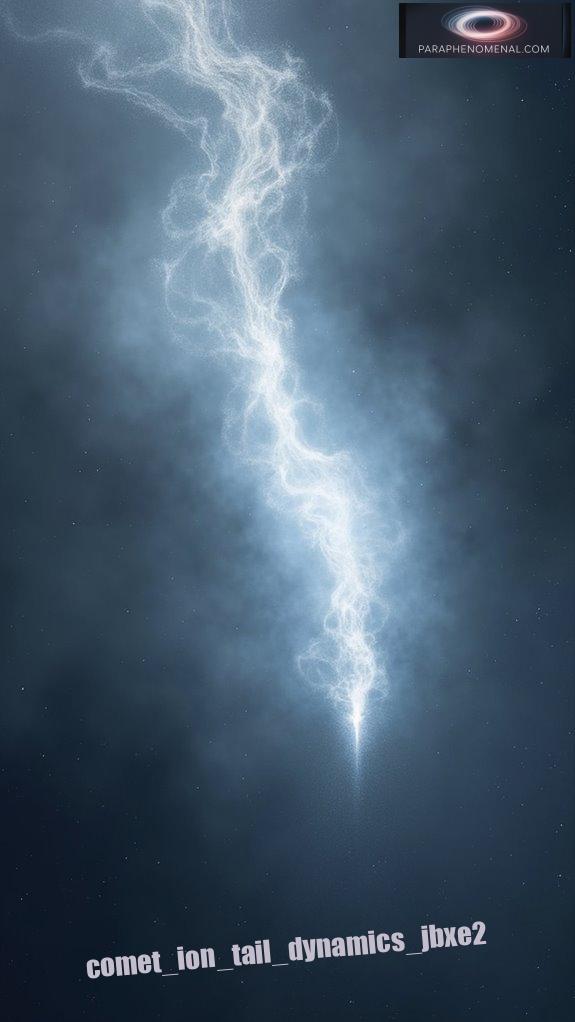
When you think about comets, you might picture a bright tail gleaming in the night sky, but the ion tail of Comet 3I/ATLAS is a complex environment shaped by various factors.
The ion tail’s composition primarily involves ionized gases released from the comet’s nucleus as it nears the Sun. As solar radiation heats the comet, ices sublime, forming a plasma that interacts with solar wind. This interstellar object, designated as Comet 3I/ATLAS, is particularly significant because it provides a unique opportunity to study materials from other planetary systems. NASA missions studying such interactions have revealed critical insights into plasma dynamics.
The ion tail of a comet forms from ionized gases as solar radiation heats its nucleus, creating a captivating plasma interaction.
These plasma interactions create a distinct environment, leading to rapid changes in the tail’s shape and density. The energetic particles move at impressive speeds, influenced by both the comet’s velocity and solar conditions.
Understanding these processes is essential for preparing spacecraft, connecting curiosity with our goal at ParaPhenomenal to explore the cosmos.
Essential Scientific Instrumentation for Ion Tail Analysis
Spacecraft designed for close encounters with Comet 3I/ATLAS need specialized scientific instruments to analyze the ion tail and gather meaningful data. Your mission will require precise instrumentation requirements that include a dust detector for evaluating particle composition and an ion mass spectrometer to measure ion species. To understand the dynamics of the tail, a plasma analyzer will provide essential data on density and temperature.
understanding water and gas loss rates will enhance our comprehension of the tail’s evolution over time. High-resolution imaging tools like telescopes and CCD cameras will capture the tail’s complex structures. Don’t forget spectrometers for thorough particle analysis, revealing the chemical makeup of gases present.
These instruments, along with data management systems, facilitate collaboration among scientists, ensuring that the discoveries we make serve the collective thirst for knowledge fostered by platforms like ParaPhenomenal. This mission will also allow for the study of the comet’s high-speed trajectory, which can provide insights into the effects of solar radiation on its ion tail.
Insights From Previous Missions and Design Analogies
Understanding the lessons from previous missions is essential for effectively designing spacecraft destined for Comet 3I/ATLAS. The knowledge gained from missions like Rosetta highlight how we can employ trajectory optimization to navigate high-speed environments.
Studying Comet 2I/Borisov showed that interstellar chemistry can differ markedly from solar system comets, guiding our material choices.
Moreover, the challenges of tracking fast-moving comets stress the need for robust communication systems and durable instruments.
Each earlier comet encounter teaches us about handling dust and gas interactions, ensuring that missions can withstand extreme conditions. Additionally, the experience gained from the ion tail of Comet 3I/ATLAS will be invaluable for future mission designs.
Drawing from these experiences, we can advance our understanding and avoid pitfalls, reflecting our values at ParaPhenomenal in seeking the freedom to explore the unknown.
FAQ
Why is it important that Europa Clipper and Hera might cross comet 3I/ATLAS’s ion tail?
Crossing the ion tail of an interstellar comet is a rare opportunity to directly sample and study material from outside our solar system. Europa Clipper’s instruments could analyze the plasma and particles in the tail, providing insights into the comet’s composition and interaction with solar wind. Hera’s alignment offers a chance for observation, even if it can’t analyze the tail in situ.
What obstacles might prevent these spacecraft from studying the comet’s ion tail?
Though the spacecraft are well positioned, Hera lacks the necessary instruments to study the tail directly, limiting its scientific return. Europa Clipper’s observation depends on favorable solar wind conditions and whether the mission team prioritizes this sudden opportunity. Additionally, operational disruptions like the current government shutdown and staffing changes at NASA’s JPL could delay or restrict mission activities.
When exactly will the spacecraft cross the comet’s ion tail?
Hera is expected to be in the right position to cross the ion tail from October 25 to November 1, coinciding with the comet’s peak activity near its closest approach to the Sun. Europa Clipper’s potential crossing window is slightly later, between October 30 and November 6, depending on solar wind conditions and mission scheduling.
Will these spacecraft be visible from Earth during the comet tail crossing?
Currently, comet 3I/ATLAS is not visible from Earth as it is positioned on the opposite side of the Sun. Therefore, direct observations from Earth are not possible during the spacecrafts’ crossing. However, ESA’s JUICE mission will observe the comet remotely in early and late November, contributing valuable data despite the visibility limitation.
How Will the Spacecraft’s Communication System Function During Ion Tail Crossing?
During ion tail crossing, the spacecraft’s communication system adapts to the ion tail effects.
It employs communication redundancy to guarantee data integrity despite potential interference from charged particles. The system uses specific frequencies to minimize disruptions, adjusts its data rate based on signal strength, and utilizes error correction algorithms.
What Is the Estimated Mission Duration for the Comet Encounter?
The estimated mission duration for the comet encounter is quite brief, typically lasting from hours to a few days during the close encounter phases.
How can such a short timeframe allow for significant scientific discovery?
The mission timeline focuses on rapid flybys, driven by the comet’s high speed and trajectory constraints.
While planning takes weeks or months before reaching the comet, the actual observation time within the ion tail remains incredibly limited and challenging.
References
- https://en.wikipedia.org/wiki/3I/ATLAS
- https://www.iflscience.com/anti-tail-and-odd-594-kilometer-feature-found-on-interstellar-object-3iatlas-by-keck-observatory-81188
- https://arxiv.org/abs/2510.13222
- https://www.space.com/astronomy/scientists-capture-interstellar-invader-comet-3i-atlas-growing-a-tail-this-image-is-both-a-scientific-milestone-and-a-source-of-wonder-photo-video
- https://science.nasa.gov/solar-system/comets/3i-atlas/
- https://www.sci.news/space/interstellar-comet-mission-14191.html
- https://www.swri.org/newsroom/press-releases/swri-proposed-mission-could-encounter-explore-future-interstellar-comet-3i-atlas-close
- https://www.jpl.nasa.gov/edu/resources/teachable-moment/the-science-behind-nasas-first-attempt-at-redirecting-an-asteroid/
- https://deepimpact.astro.umd.edu/educ/mod_ExploringComets/ExploringComets.pdf
- https://techport.nasa.gov/projects/105716
- https://www.spacedaily.com/reports/Spacecraft_study_shows_interstellar_comet_encounter_mission_within_reach_999.html
- https://www.iflscience.com/two-spacecraft-to-fly-through-comet-3iatlass-ion-tail-will-they-be-able-to-catch-something-81195
- https://science.nasa.gov/missions/hubble/as-nasa-missions-study-interstellar-comet-hubble-makes-size-estimate/
- https://news.northeastern.edu/2025/09/08/3i-atlas-comet-interstellar-traveler/
- https://www.youtube.com/watch?v=mwlTlw3rV5I
- https://ffesp.org/nasa-confirms-3i-atlas-mysterious-interstellar-visitor-enters-solar-system/
- https://www.stce.be/content/solar-orbiter-catches-second-comet-tail
- https://ras.ac.uk/news-and-press/research-highlights/tail-without-comet-dusty-remains-comet-atlas
- https://www.nasa.gov/solar-system/new-insights-on-comet-tails-are-blowing-in-the-solar-wind/
- https://astrobiology.com/2024/10/prospects-for-the-crossing-by-earth-of-comet-c-2023-a3-tsuchinshan-atlass-ion-tail.html
- https://svs.gsfc.nasa.gov/13661/
- https://www.planetary.org/articles/where-do-3i-atlas-and-other-interstellar-visitors-come-from
- https://www.seti.org/news/comet-3iatlas-a-visitor-from-beyond-the-solar-system/
- https://www.spectroscopyonline.com/view/interstellar-comet-3i-atlas-shows-its-spectral-secrets-through-palomar-and-apache-point-observations
- https://www.skyatnightmagazine.com/news/3i-atlas-not-aliens
- https://www.planetary.org/articles/what-is-comet-3i-atlas
- https://thedebrief.org/3i-atlas-update-what-new-data-reveals-about-the-most-puzzling-interstellar-object-ever-found/
- https://science.nasa.gov/asset/hubble/comet-3i-atlas/
- https://lweb.cfa.harvard.edu/~loeb/HCL25.pdf
- https://www.iflscience.com/seti-paper-responds-to-claims-interstellar-object-3iatlas-might-be-an-alien-spacecraft-81100