Tag: extraterrestrial technology

  • What Ground Marks Reveal About UFO Incidents?

    What Ground Marks Reveal About UFO Incidents?

    Have you ever stumbled upon unusual ground marks?

    I recently delved into UFO incident sites, and the signs reveal stunning anomalies.

    From heavy ground compression to scorching temperatures between 300-600°C, the evidence speaks volumes.

    Soil samples often show unexpected shifts, like spikes in phosphate and zinc.

    Even the flora nearby seems affected, showcasing peculiar growth patterns.

    What could explain all these changes and fuel our fascination with unidentified technologies?

    Join me as we uncover the mysteries behind these captivating traces of the unknown.

    My Unforgettable Encounter with UFO Ground Marks

    During a camping trip years ago, my friends and I discovered a strange clearing in the woods.

    The ground appeared scorched, and the surrounding vegetation had peculiar growth patterns.

    The vivid marks sparked my curiosity—were we witnessing the aftermath of a UFO landing?

    As we investigated, we stumbled upon unusual metallic fragments scattered around, adding to the intrigue.

    Reflecting on that unforgettable night, I often wonder about the hidden stories that lay beneath our feet.

    Are there other unexplained phenomena that could be linked to these encounters?

    In the end, I can’t help but think about how many secrets the earth holds.

    Quick Takeaways

    • Ground compression at UFO landing sites often exceeds 4-5 tons, indicating significant weight and potential advanced technology.
    • Soil analysis frequently reveals unusual chemical signatures, including trace elements like phosphate and zinc not typically found in similar areas.
    • Environmental changes near landing sites include altered plant growth patterns and reduced chlorophyll levels, implying potential impacts of unknown technologies.
    • Witness accounts generally align with observed ground marks, providing corroborative evidence that strengthens the credibility of UFO incidents.
    • Skepticism surrounding ground marks includes alternative explanations related to natural phenomena, vehicle movements, and inadequate documentation from investigations.

    The Trans-en-Provence Case: A Closer Look at Ground Compression and Heating
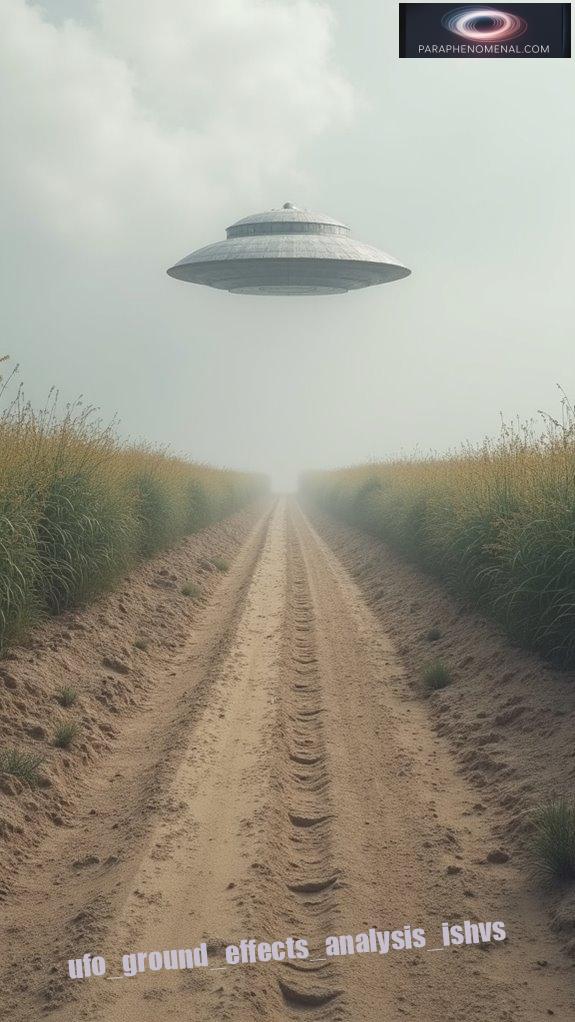
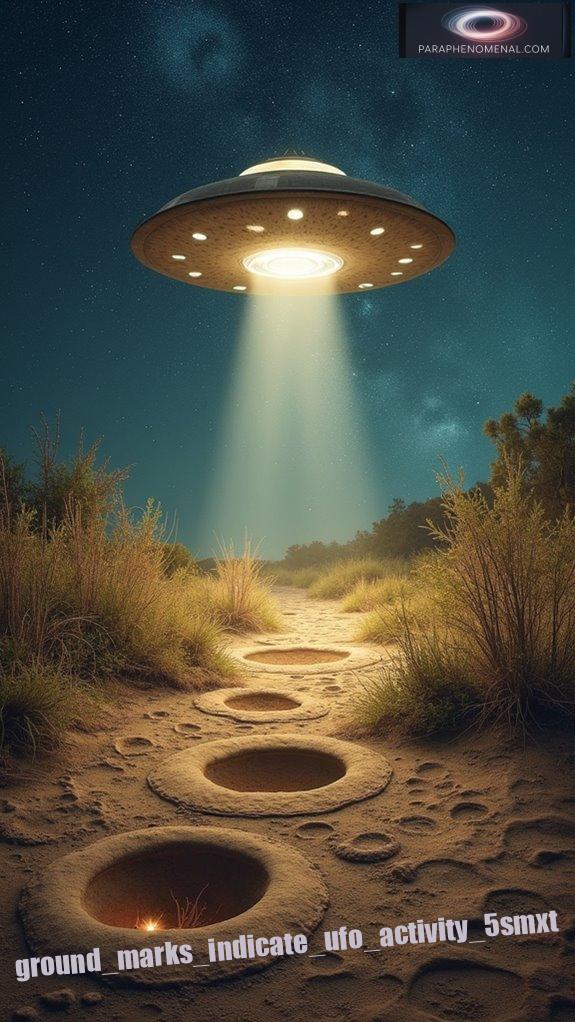
    ufo ground effects analysis

    What Ground Marks Reveal About UFO Incidents?

    The Trans-en-Provence Case: A Closer Look at Ground Compression and Heating

    When considering the peculiar phenomena associated with UFO sightings, the Trans-en-Provence Case stands out due to its scientifically documented ground compression and heating.

    In 1981, witnesses reported seeing a UFO, which later led to a detailed UFO physics analysis. The ground showed significant compression, estimated at 4-5 tons, and heating ranged between 300-600°C. These physical changes spurred interest in evidence analysis, revealing trace amounts of phosphate and zinc in the soil. Additionally, recent studies have highlighted how physical effects from close encounters can vary between incidents, revealing the complexity of these phenomena.

    Furthermore, alfalfa nearby exhibited reduced chlorophyll levels, suggesting unusual environmental effects. This case exemplifies how tangible evidence can spark intrigue and debate among those who seek freedom in their understanding of the unknown.

    That’s part of why ParaPhenomenal exists—to explore these compelling mysteries.

    Scientific Investigations: GEPAN’s Role in Analyzing Ground Marks

    GEPAN, the French space agency, plays a significant role in investigating UFO-related ground marks, building on findings like those from the Trans-en-Provence Case.

    Using GEPAN methodology, investigators apply scientific rigor to analyze physical trace evidence. They employ various investigative techniques, including soil sampling and environmental assessments, to determine if ground marks could indicate UFO activity.

    You might find it intriguing that GEPAN’s findings often spark debate among skeptics and enthusiasts alike, each presenting their own interpretations of the evidence. Recent studies have revealed that UFO landing burn marks often show unique chemical signatures that differentiate them from typical ground disturbances.

    Physical Effects: Changes in Plant Life and Soil Composition

    ufo environmental impact studies

    Investigators have found evidence suggesting that UFO incidents can lead to noticeable changes in plant life and soil composition surrounding landing sites.

    In many cases, researchers notice plant anomalies, like unusual growth patterns or discoloration, where UFOs allegedly landed. These findings raise questions about the potential impacts of unidentified technologies on the environment.

    Soil alterations, such as changes in mineral content or compaction, have also been observed, hinting at some form of unique energy exposure. Additionally, researchers have reported detecting radiation residue at these locations, which may further explain the environmental changes.

    Understanding these effects can provide critical revelations into the mysteries of UFO encounters. At ParaPhenomenal, we aim to illuminate these fascinating phenomena, merging scientific inquiry with the desire for freedom to explore the unknown.

    The complex relationship between UFO sightings and environmental changes continues to intrigue both believers and skeptics alike.

    Skeptical Perspectives: Questioning the Validity of Ground Mark Evidence

    Skepticism surrounding the validity of UFO-related ground marks is a significant area of discussion. Many people question whether these marks truly offer credible evidence of extraterrestrial visits.

    Skeptical analysis often points to alternative explanations, such as natural phenomena or human activity. For instance, circular impressions might just be caused by vehicles passing through, rather than UFO landings.

    Some critics argue that the science behind these marks isn’t robust enough and highlight gaps in documentation from investigations. While advocates present these clues as compelling pieces of the UFO puzzle, a more cautious approach urges you to contemplate all possibilities. Additionally, cases of electromagnetic interference related to aircraft often lead skeptics to attribute unusual ground marks to human activity affecting electronics.

    At ParaPhenomenal, we aim to provide a balanced view, encouraging open discussions about the unknown while challenging assumptions.

    Advocacy for Believers: Linking Eyewitness Accounts to Ground Marks

    eyewitness accounts and ground marks

    When examining the intriguing relationship between eyewitness accounts and ground marks, one can’t help but notice how these narratives often intertwine. You’ll see that eyewitness reliability can lend emotional impact to the perceived validity of these events. Advocates argue that when witnesses describe seeing strange crafts, and those descriptions align with the ground marks found, it offers compelling support for their claims. Additionally, humanoid traits observed in these incidents may also play a role in influencing witnesses’ perceptions and the ground effects reported.

    Eyewitness Account Ground Marks Found
    Descriptions of light, motion Circular impressions
    Witnesses feeling fear or awe Irregular soil patterns
    Claims of heat sources Altered plant life
    Conflicting testimonies Near-miss tire track signs

    Connecting these elements can strengthen believers’ claims. At ParaPhenomenal, we explore these connections to foster understanding.

    Exploring Other Notable Incidents: A Survey of Global UFO Ground Trace Cases

    Across the globe, numerous UFO ground trace cases have surfaced, each one adding to the enigma surrounding unidentified flying objects.

    Historical sightings, like the Trans-en-Provence incident in France, show remarkable physical evidence, including unusual ground compressions and altered soil properties.

    International reports detail similar occurrences, where the earth bears the marks of strange landings, influencing both believers and skeptics.

    Investigators often analyze these marks, searching for scientific explanations, yet many remain unresolved and mysterious, sustaining the curiosity of truth-seekers.

    ParaPhenomenal aims to shed light on such enthralling cases, encouraging a deeper discourse on these intriguing phenomena.

    While some marks might suggest natural events, the possibility of extraterrestrial encounters continues to ignite the quest for understanding.

    FAQ

    What Specific Methods Are Used to Analyze Soil in UFO Ground Mark Studies?

    Researchers use soil composition analysis to identify chemical changes and apply remote sensing techniques to visualize subsurface alterations. You’ll find these methods valuable for uncovering potential anomalies linked to UFO ground marks and enhancing your understanding.

    How Do Ground Marks Differ From Other Physical Evidence of UFO Sightings?

    Ground marks stand out with distinct visual characteristics, like specific shapes and patterns, while other physical evidence, such as eyewitness accounts or environmental changes, requires careful evidence comparison to establish connections to UFO sightings.

    Are There Documented Cases of Ground Marks Found in Urban Areas?

    Sure, you won’t find little green men hanging out in city parks. Urban sightings have spurred evidence collection yielding occasional ground marks, but skeptics argue they’re just a neighbor’s gardening mishap. Keep your eyes peeled!

    Have Ground Marks Ever Been Replicated Experimentally by Scientists?

    No experimental replications of ground marks have proven conclusive due to significant replication challenges. Scientific skepticism surrounds the ability to mimic unique features precisely, leaving many intrigued yet unconvinced about the authenticity of the original phenomena.

    What Role Do Weather Conditions Play in the Formation of Ground Marks?

    Weather can shape ground marks like an artist’s brush on canvas, with atmospheric factors influencing impressions. Rain, heat, and winds affect soil properties, making it essential to understand their impact when analyzing potential UFO evidence.

    References

  • Alien Probe Theory Behind 3I/ATLAS Comet Anomalies

    Alien Probe Theory Behind 3I/ATLAS Comet Anomalies

    The 3I/ATLAS comet has captivated my imagination since its discovery in July 2025.

    What if this wasn’t just a celestial wanderer, but an inquiry from beyond our world?

    With its bizarre outgassing and unexplained acceleration, it challenges our understanding of space phenomena.

    I feel the excitement of theorists as they speculate about potential extraterrestrial technology at play.

    Is it possible that this comet is an alien probe? The thought tantalizes from the edges of mainstream science as public intrigue grows, driven by vivid media narratives.

    After all, history is often a guide to unraveling mysteries like this one.

    A Close Encounter: My Fascinating UFO Experience

    A few years ago, I had a night that still gives me chills.

    While stargazing in a remote area, I spotted something flashing in the sky.

    It wasn’t a plane or a satellite, but a series of lights dancing in a peculiar formation.

    I wasn’t alone; friends witnessed the same spectacle.

    Talk of UFOs and extraterrestrial technology filled the air, much like the buzz around 3I/ATLAS today.

    Was it a drone, a military exercise, or something else entirely?

    Those questions linger as I reflect on those moments, connecting my experience to the ongoing discussions about unidentified aerial phenomena.

    Just like 3I/ATLAS, it’s our quest for answers that keeps the wonder alive!

    Quick Takeaways

    • The peculiar non-gravitational accelerations observed in 3I/ATLAS have sparked speculation about potential alien technology or probes influencing its trajectory.
    • Unlike ‘Oumuamua, 3I/ATLAS exhibits active outgassing, leading to theories about its composition and possible artificial structures.
    • Public fascination with 3I/ATLAS is amplified by social media and sensational media coverage, often depicting it as an extraterrestrial object.
    • Scientific consensus emphasizes data-driven analyses over speculative alien probe theories, urging critical thinking to separate fact from sensationalism.
    • Ongoing investigations focus on understanding 3I/ATLAS’s unique features rather than supporting theories of extraterrestrial origins or engineered anomalies.

    Overview of 3I/ATLAS Discovery

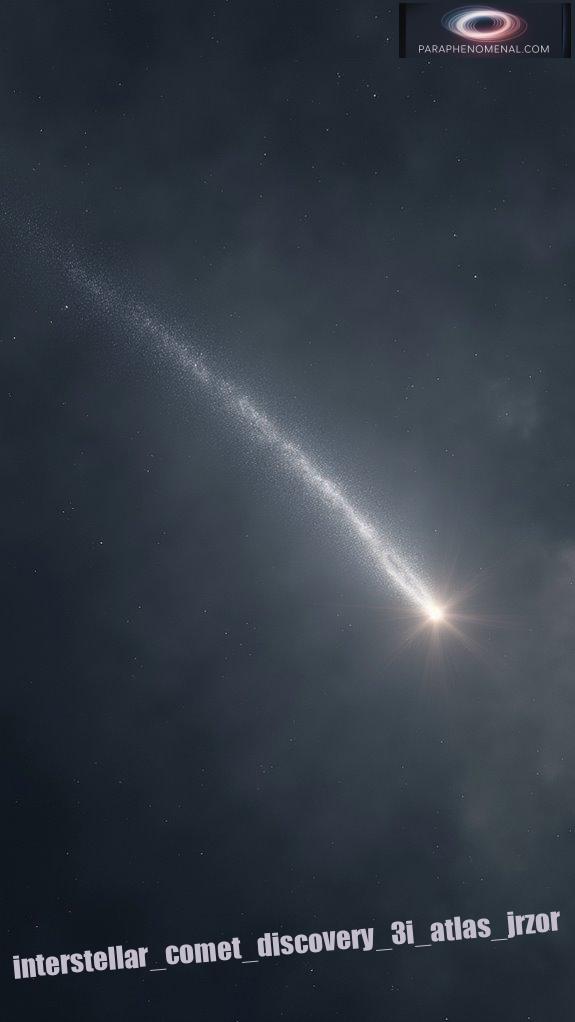
    interstellar comet discovery 3i atlas

    On July 1, 2025, a remarkable discovery unfolded in the domain of astronomy—a comet named 3I/ATLAS, confirmed to be originating from outside our Solar System.

    This exciting find was made by the NASA-funded ATLAS survey telescope at Río Hurtado, Chile. Initially designated as ‘A11pl3Z’, it quickly captured the attention of astronomers around the globe.

    Moving at an astonishing speed of 61 km/s relative to the Sun, 3I/ATLAS marks the third known interstellar object, following 1I/’Oumuamua. Follows a hyperbolic trajectory, which enhances its intrigue as the object moves too fast to be bound by the Sun’s gravity. Additionally, its high velocity signals that it is part of a diverse range of interstellar visitors, expanding our understanding of such celestial wanderers.

    The enchanting nature of its origins ignites curiosity, prompting questions about alien star systems. As enthusiasts, like those at ParaPhenomenal, explore its significance, the comet challenges our understanding and invites deeper exploration of the universe’s mysteries.

    Trajectory and Characteristics

    The discovery of comet 3I/ATLAS has brought an exciting opportunity to investigate its unique trajectory and characteristics.

    This comet follows an unbound, hyperbolic path, racing through space at an incredible speed of about 58 km/s (36 mi/s) relative to the Sun. With a high orbital eccentricity of 6.141, it stands out from previous interstellar visitors like 1I/ʻOumuamua. Additionally, its velocity of 130,000 miles (209,000 kilometers) per hour is the highest recorded for a solar system object. As it approaches perihelion, expected around October 29, 2025, its speed will increase even more. Mark your calendars, as it will closely approach Earth on December 19, 2025, at 1.80 AU.

    At ParaPhenomenal, we investigate such fascinating celestial events, exploring the scientific wonders behind them, satisfying our collective curiosity for the unknown.

    The Unusual Outgassing Phenomenon

    As comet 3I/ATLAS approaches the Sun, its unusual outgassing phenomena are raising eyebrows among scientists.

    Starting as early as May 2025, when it was over 6 AU away, this comet revealed unexpected activity.

    It’s releasing water “like a fire hose,” a phenomenon not seen before at this distance from the Sun, which has many questioning established assumptions about comets. Significant water loss occurs remarkably far from the sun, specifically 2.9 astronomical units away.

    The Sun’s heat plays a critical role, causing volatile ices to change into gas and dust.

    With its icy nucleus primarily made of carbon dioxide and water ice, it forms a coma that encircles it.

    Due to this significant outgassing, 3I/ATLAS could potentially trigger dramatic outbursts as it gets closer, making it a compelling subject for those exploring the unknown.

    Non-Gravitational Accelerations Explained

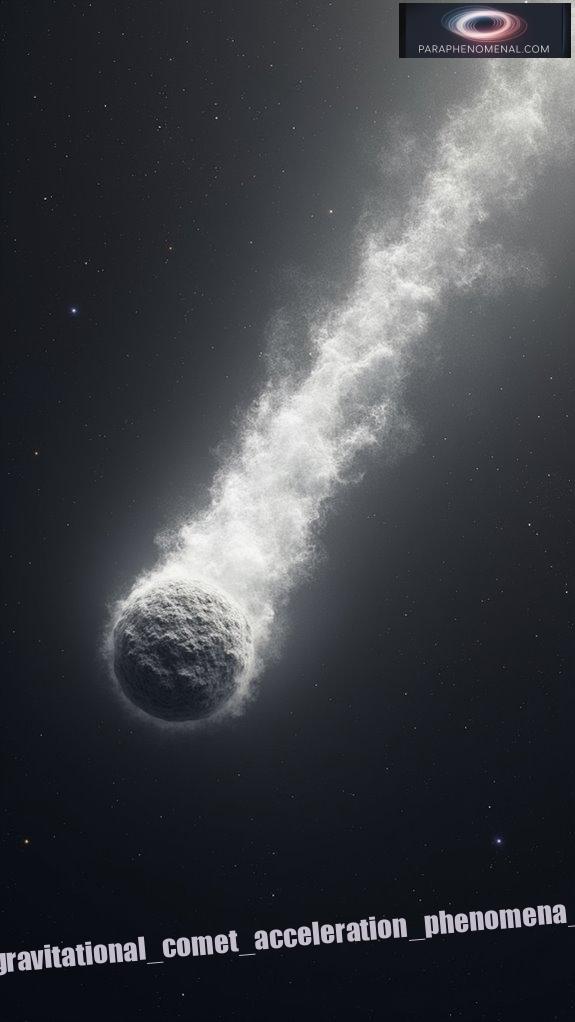
    non gravitational comet acceleration phenomena

    Understanding the dynamics of non-gravitational acceleration can provide key understandings into the behavior of comets like 3I/ATLAS, especially as mysterious phenomena arise during their journeys near the Sun.

    Non-gravitational acceleration refers to motion not explained by gravity; it’s often caused by volatile materials sublimating from a comet’s surface when they get close to the Sun. For 3I/ATLAS, researchers detected significant non-gravitational acceleration, suggesting forces at work beyond mere gravitational influence. Despite limited evidence of typical surface outgassing, these findings highlight the anomalies that challenge our understanding of comets. Additionally, the comet has a hyperbolic trajectory, indicating its origin outside the solar system, which adds to the complexities of its behavior as it approaches the Sun.

    As we explore the unknown, websites like ParaPhenomenal aim to unravel such mysteries, allowing us to freely question the origins of these cosmic wanderers.

    Anomalous Mass and Size

    Challenging our perceptions of cometary bodies, the mass and size of 3I/ATLAS raise numerous questions about its nature.

    Estimates for its nucleus range from 0.32 km to 5.6 km, with uncertainty surrounding direct measurements. The observed mass, exceeding 33 billion tons, suggests a density that contradicts what we typically expect for comets, indicating a potential structural difference. Recent studies have uncovered volatile ices and organic material in its composition, which adds another layer of complexity to our understanding of this mysterious object.

    While the nucleus appears small, the coma can stretch to vast distances, complicating assumptions about the object’s composition. This raised intrigue drives us at ParaPhenomenal to explore whether 3I/ATLAS might represent a new class of interstellar object.

    The unusual mass and size challenge existing cometary models, prompting questions about its origins and the possibility of alternative explanations beyond natural phenomena.

    Historical Context: Comparisons to ‘Oumuamua

    The unusual characteristics of 3I/ATLAS prompt comparisons to the earlier interstellar object ‘Oumuamua, which captured the public’s imagination and scientific interest alike. Both objects share an interstellar origin, yet they manifest distinct features that set them apart.

    Feature3I/ATLAS‘Oumuamua
    ClassificationCometAsteroid/Other
    Cometary ActivityYesNo
    SizeUp to 15 milesSmaller
    Orbital ApproachPerpendicularHead-on

    3I/ATLAS exhibits cometary activity, unlike ‘Oumuamua, and it’s essential to explore these differences for a thorough understanding. Recent observations have suggested interstellar origin for 3I/ATLAS, igniting further debate about its nature. At ParaPhenomenal, we seek to make sense of such enigmatic phenomena, encouraging curiosity about the cosmos.

    Alien Probe Theories and Speculations

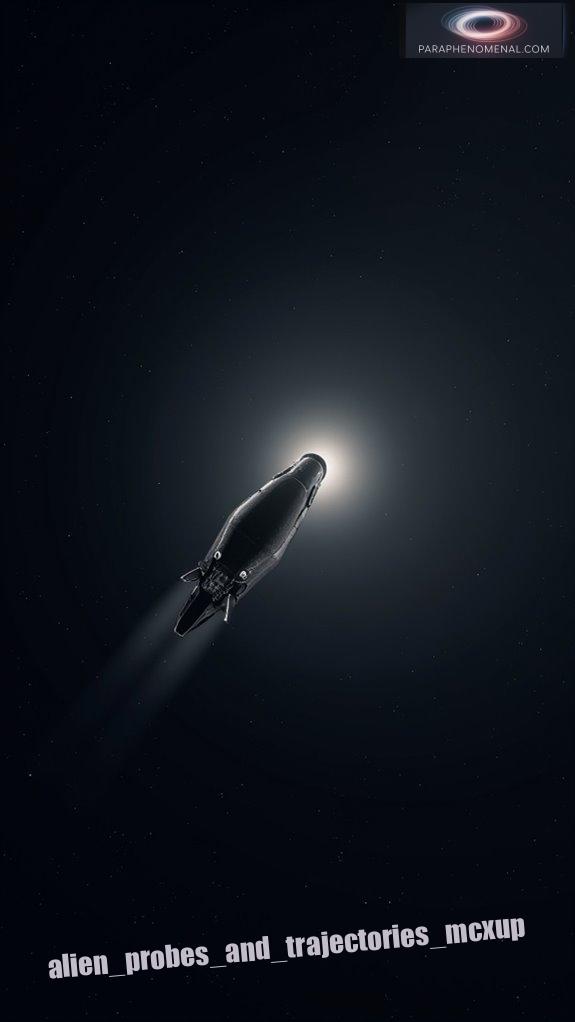
    alien probes and trajectories

    As you explore the concept of alien probes, it’s essential to contemplate the peculiar behaviors of interstellar objects like 3I/ATLAS.

    Some intriguing points arise:

    • It moves faster and approaches the solar system differently than other interstellar objects.
    • 3I/ATLAS’s trajectory allows for close encounters with planets, raising questions about possible technological capabilities.
    • Its unusual brightness and mass challenge existing models of natural origins, hinting at artificial construction.
    • The debate around its nature invites thoughts of a potential alien probe, sparking your curiosity and encouraging you to look deeper.

    While these speculations might seem outlandish, resources like ParaPhenomenal highlight the fascinating discussions that drive our understanding of the universe. Additionally, the peculiar trajectory of interstellar objects has been a crucial factor in analyzing the possibility of extraterrestrial technology.

    Keep questioning, seek the truth, and explore these extraordinary possibilities.

    Mainstream Scientific Perspectives

    Mainstream scientific viewpoints on 3I/ATLAS emphasize the importance of data-driven analysis in understanding interstellar objects. Scholars highlight its size, trajectory, and cometary features as key to classifying it within established cometary studies.

    CharacteristicObservationExplanation
    Size15 miles (24 km)Larger than previous interstellar visitors
    Anti-tailPresentCommon in comets; linked to dust dynamics
    Acceleration AnomaliesConsistent with outgassingNon-gravitational forces typical in comets

    Public Reaction and Media Discussion

    Public interest in 3I/ATLAS has surged dramatically, fueled by social media theories that often veer into sensationalism. People are captivated by the idea of an “alien probe,” sparking varied reactions and discussions online.

    • Widespread rumors label the comet as a potential doomsday object.
    • Catastrophic scenarios circulate without any scientific basis.
    • Viral posts compare it to an extraterrestrial mothership.
    • Misinformation about its size and trajectory breeds public anxiety.

    Mainstream media, seeking engagement, amplifies these sensational twists while experts attempt to clarify misunderstandings. Despite reassurance from NASA and ESA, the thrill of the unknown keeps you questioning, fueling fascination.

    Through this website, ParaPhenomenal aims to cut through speculation, encouraging critical thinking about what lies beyond our understanding.

    FAQ

    What Specific Volatile Ices Are Present in 3i/Atlas?

    3I/ATLAS contains notable volatile ices like water ice and carbon dioxide (CO₂).

    The CO₂ is present in high amounts, with a ratio of about 8:1 compared to water, which is unusually high for comets. Organic materials are also indicated, suggesting complex chemistry within the icy body.

    Understanding these ices helps you unveil secrets about its formation and the varying conditions across the galaxy.

    That’s part of why we created this site, ParaPhenomenal.

    How Are Interstellar Comets Like 3i/Atlas Detected?

    Interstellar comets like 3I/ATLAS are detected using wide-field survey telescopes that scan the sky repeatedly. They identify moving objects by stacking images to improve visibility.

    Follow-up observations involve large ground-based telescopes for detailed spectra, revealing the comet’s composition. Space-based observatories measure ultraviolet emissions, and radio telescopes listen for natural or artificial signals.

    This process helps you understand these mysterious visitors, making it essential to explore and discuss such intriguing phenomena on sites like ParaPhenomenal.

    What Technology Is Used for Tracking These Anomalies?

    To track anomalies like 3I/ATLAS, scientists rely on advanced technology. Ground-based telescopes like ATLAS and Pan-STARRS scan the skies nightly, detecting fast-moving objects.

    Space-based systems capture detailed images, minimizing atmospheric interference. Spectroscopic tools analyze comet compositions, while computational models predict orbits and behavior.

    This combination of ground and space technology, continually developing, helps us understand these unusual visitors.

    Discovering the unknown is one reason we created ParaPhenomenal, enhancing your exploration.

    How Does 3i/Atlas Compare to Other Comets?

    3I/ATLAS differs from typical comets in several ways.

    It originates from outside the solar system, moving at about 130,000 mph, which is incredibly fast compared to solar system comets.

    It shows unusual light emission far from the Sun, hinting at unique properties.

    Unlike regular comets, its dust and gas emissions behave dynamically similar, yet its trajectory highlights its interstellar roots, adding to the intrigue of celestial phenomena we explore here at ParaPhenomenal.

    What Implications Does 3i/Atlas Have for Future Space Exploration?

    3I/ATLAS has profound implications for future space exploration.

    Its unique interstellar origin informs spacecraft design, helping you prepare for high-speed encounters. The data gathered enhances models predicting how such objects behave, essential for safety during future missions.

    Understanding these hyper-fast visitors challenges current navigation methods, pushing technology boundaries.

    As you explore the cosmos, studying 3I/ATLAS can open doors to understanding alien materials and the universe’s mysteries, shaping humanity’s path in space.

    References