Have you ever wondered what secrets lie beneath UFO landing sites?
I’ve delved into soil evidence that reveals some astonishing anomalies.
In places like Trans-en-Provence, I found extreme temperature changes and chemical shifts in the earth.
Then there’s Valensole, where the ground hardened into something that looks like concrete.
In Saskatchewan, circular impressions hint at a hovering craft—so strange, yet so fascinating.
Each of these cases begs for scrutiny, pushing me to explore these bizarre phenomena even further.
Join me on this journey of uncovering the mysteries of these ultra-rare encounters.
A Personal Encounter with the Unknown
I still vividly remember my trip to a remote area rumored to be a UFO hotspot.
As twilight approached, I set up my equipment, fueled by curiosity and maybe a little fear.
Suddenly, I saw a glow in the sky—an orb dancing above the treetops.
It was unlike anything I had seen, and it ignited my passion for investigating UFO phenomena.
I explored other familiar facets like electromagnetic fields, strange sounds, and elusive witnesses.
Every tiny detail leaves me questioning the boundaries between our reality and the cosmos.
Quick Takeaways
- Soil anomalies at UFO landing sites often include unusual chemical compositions, such as elevated phosphate and calcium levels.
- Physical changes in the soil, like hardening and compression, can indicate intense pressure or heat exposure from a craft.
- Vegetation near landing sites frequently shows signs of distress, evidenced by reduced chlorophyll levels or decay.
- Investigations often face methodological flaws, including inconsistent sampling techniques and subjective interpretations of data.
- Standardized protocols are essential for future studies to ensure rigor and objectivity in analyzing soil evidence from UFO encounters.
Trans-en-Provence: Unexplained Anomalies in Soil

In 1981, the small town of Trans-en-Provence, France, became the center of a perplexing case involving unexplained anomalies in soil. Renato Nicolaï witnessed a metallic craft land in his garden, igniting curiosity and skepticism.
Subsequent soil analyses revealed significant changes in soil composition, including compression from a whopping 4–5 tons of pressure and temperatures soaring between 300–600°C.
Anomaly detection methods uncovered trace amounts of phosphate and zinc, sparking debates among scientists.
Interestingly, vegetation nearby showed 30–50% lower chlorophyll levels, hinting at stress.
Though some dismissed it as tire marks, the evidence remains controversial and unexplained. Additionally, investigations into physical ground indentations in other UFO landing sites have often yielded similar mysterious patterns, suggesting a larger phenomenon at play.
At ParaPhenomenal, we aim to explore such mysteries, urging further investigation into these extraordinary occurrences.
Valensole: The Concrete-Like Landing Evidence
Witnessing strange events can be both thrilling and unnerving, especially when they leave behind physical evidence. In the Valensole case, a UFO encounter resulted in striking soil anomalies.
- The landing site exhibited hardened soil, resembling concrete.
- Soil analysis revealed unusually high calcium levels.
- Nearby vegetation faced decay, indicating an environmental impact.
- The moist area hardened rapidly, intensifying the evidence.
These elements form a compelling narrative in UFOlogy. When experts analyze such soil conditions, they often look for explanations rooted in the natural world.
However, in Valensole, the evidence remains unexplained, adding layers to the mystery. The potential for environmental impacts of these phenomena emphasizes the need for systematic exploration and documentation of such cases. By documenting and studying these cases, we hope to foster understanding and encourage more rigorous scientific investigations into these unusual phenomena, hence ParaPhenomenal’s mission.
Saskatchewan: Circular Impressions Without Conventional Explanation
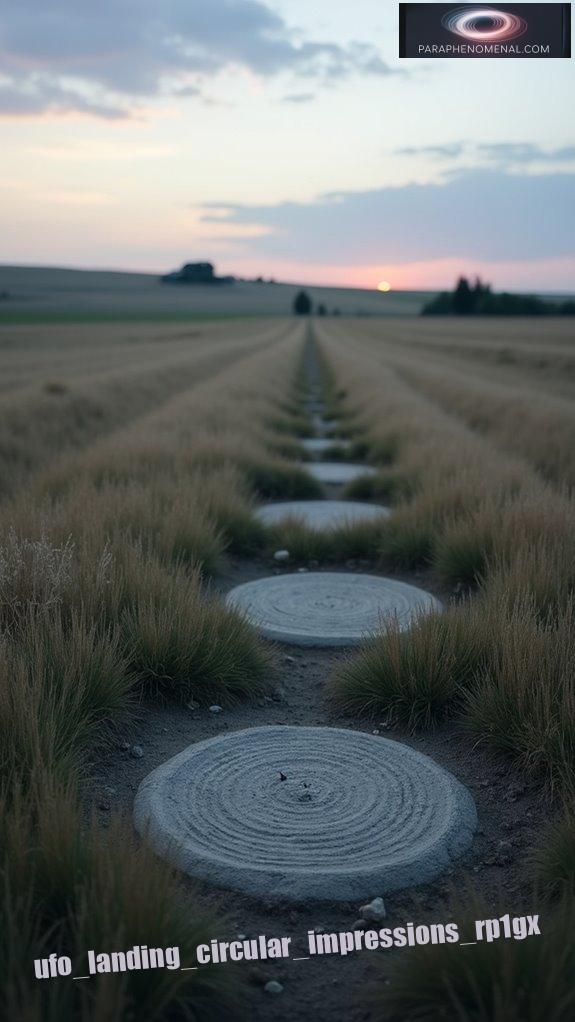
When five UFOs reportedly hovered over a Saskatchewan farm in the 1970s, they left behind intriguing circular impressions that continue to puzzle investigators.
These circular patterns measured 10.5 to 12 feet in diameter, featuring flattened centers about 18 inches wide. Farmer Edwin Fuhr discovered them, and no conventional explanation exists for these unexplained markings.
The Royal Canadian Mounted Police evaluated the evidence and found Fuhr’s testimony credible. They also confirmed there were no signs of terrestrial vehicles or machinery in the area. Additionally, these impressions have been categorized as UFO landing burn marks, showcasing the enigmatic possibilities surrounding such phenomena.
This case illustrates the mystery surrounding unidentified flying objects and their potential impact on the environment.
Exploring such cases fuels our curiosity and desire for freedom in questioning the unknown, which is why platforms like ParaPhenomenal exist.
Presque Isle: Claw-Like Impressions and Their Mystery
Amidst a terrain marked by mystery and intrigue, claw-like impressions were discovered near Presque Isle in the 1960s, raising questions that still puzzle investigators.
These notable features reveal unresolved evidence that fascinates everyone interested in the unknown.
- Impressions measured 18 inches wide and 6–8 inches deep.
- Descriptions highlight their distinct claw-like shape, hinting at otherworldly origins.
- No radiation was detected at the site, ruling out conventional explanations.
- Casts of the impressions were made for further analytical study.
This case remains a focal point for UFO enthusiasts and scientists alike, illustrating our quest for truth, which is why ParaPhenomenal seeks to share this fascinating evidence with the world. Recent research suggests that radiation residue at UFO landing sites could help further understand these phenomena.
Methodological Critiques in UFO Soil Evidence Studies

While many UFO soil evidence studies aim to uncover the truth behind unidentified phenomena, various methodological critiques arise that challenge their findings.
Many investigations suffer from methodological flaws, often leading to inconclusive results. For instance, sampling techniques can lack consistency, and the analysis mightn’t follow rigorous investigation standards. This inconsistency raises questions about the credibility of conclusions drawn from the evidence.
Sometimes, subjective interpretations overshadow objective data, leaving room for doubt.
It’s essential for future studies to adhere to more rigorous and standardized protocols to strengthen the validity of findings. Initiatives like ParaPhenomenal endeavor to analyze and present evidence meticulously, fostering a better understanding of these mysterious occurrences while encouraging a higher standard for investigation.
The Need for Rigorous Scientific Investigation in UFO Cases
As the world becomes more fascinated by UFOs and their mysteries, the demand for rigorous scientific investigation grows. Embracing scientific standards guarantees that anomalies surrounding potential UFO landing sites receive the attention they deserve.
Here are four critical steps in this pursuit:
- Standardized Methodology: Establish uniform protocols for soil sampling and analysis.
- Multi-Disciplinary Teams: Include geologists, biologists, and environmental scientists to offer diverse viewpoints.
- Comprehensive Environmental Analysis: Focus on physical and chemical changes in both soil and vegetation.
- Transparent Reporting: Make findings accessible to the public for scrutiny and discussion.
FAQ
Have Any UFO Soil Cases Been Proven to Be Hoaxes?
Isn’t it fascinating how UFO hoaxes sometimes involve soil manipulation? While some cases show signs of deceit, many remain unexplained. Each landing site offers unique mysteries, leaving us with more questions than answers.
What Are the Most Common Soil Sampling Techniques Used?
You’ll often find core sampling and surface analysis as popular soil sampling techniques. Core sampling extracts cylindrical sections, while surface analysis examines the top layer, giving perspectives into the soil’s composition and history.
Are Any Soil Anomalies Consistent Across Multiple UFO Cases?
Like silent whispers of the unknown, soil anomalies often show patterns across cases—high calcium levels and unusual compositional traits. You’ll find these anomaly patterns stir curiosity, pushing boundaries of what we think we understand.
How Do Scientific Protocols Differ Between UFO Investigations?
Scientific methodologies in UFO investigations often lack standardized investigation standards, leading to varying levels of rigor. You’ll see differences in sample collection, analysis techniques, and scientific team compositions, impacting the credibility of findings markedly.
What Future Research Is Planned for UFO Soil Evidence?
Like a spark igniting curiosity, future research on UFO soil evidence aims to refine methodologies and explore new funding opportunities. You’ll see standardized approaches emerge, empowering scientists to investigate the unknown with renewed vigor and passion.
References
- https://en.wikipedia.org/wiki/Trans-en-Provence_case
- https://blogs.agu.org/landslideblog/2018/03/05/landslide-weirdness-ufo/
- https://www.geoinstitute.org/news/geo-forums
- https://science.howstuffworks.com/space/aliens-ufos/valensole-ufo.htm
- https://leaderpost.com/news/saskatchewan/the-farmer-who-saw-and-the-mountie-who-believed
- https://www.cia.gov/readingroom/document/cia-rdp81r00560r000100010002-9
- https://apps.dtic.mil/sti/tr/pdf/AD0680975.pdf