
3I/ATLAS continues to baffle me with its intriguing water loss mysteries.
Did you know it loses water primarily due to carbon dioxide sublimation?
Unlike typical comets, this process kicks off even when it’s not close to the Sun.
Its surface—unique and highly rich in CO2—accelerates the sublimation, releasing water ice trapped beneath.
With a larger active area than your average comet, the rate of water loss is astonishing!
What cosmic secrets might we uncover from this behavior?
It’s all part of a much larger puzzle in our universe.
A Close Encounter with the Unexplained
During my years of UFO investigation, I’ve encountered phenomena that defy logic.
One memorable night, while observing the clear sky, I witnessed a strange object zigzagging faster than any aircraft.
Could it be related to the mysterious behavior of celestial bodies like 3I/ATLAS?
I immediately thought of the water loss linked to sublimation and the potential for life that could thrive in bizarre cosmic environments.
The more we explore, the more questions arise, don’t they?
What else is out there, waiting to be discovered?
Astrobiology, space exploration, and, of course, CO2 sublimation—these are just the tip of the iceberg in deciphering our universe’s riddles.
Quick Takeaways
- Water loss in 3I/ATLAS begins far from the Sun, driven by sublimation before typical heating occurs.
- The high abundance of carbon dioxide (CO2) accelerates sublimation, releasing trapped water ice.
- A significant active surface area of about 8% efficiently releases water vapor.
- Ice-coated dust grains enhance sublimation dynamics and contribute to the high water loss rate.
- Distinct composition and trajectory, including a unique nickel to iron ratio, influence the comet’s outgassing behavior.
Water Loss Rate in 3I/ATLAS
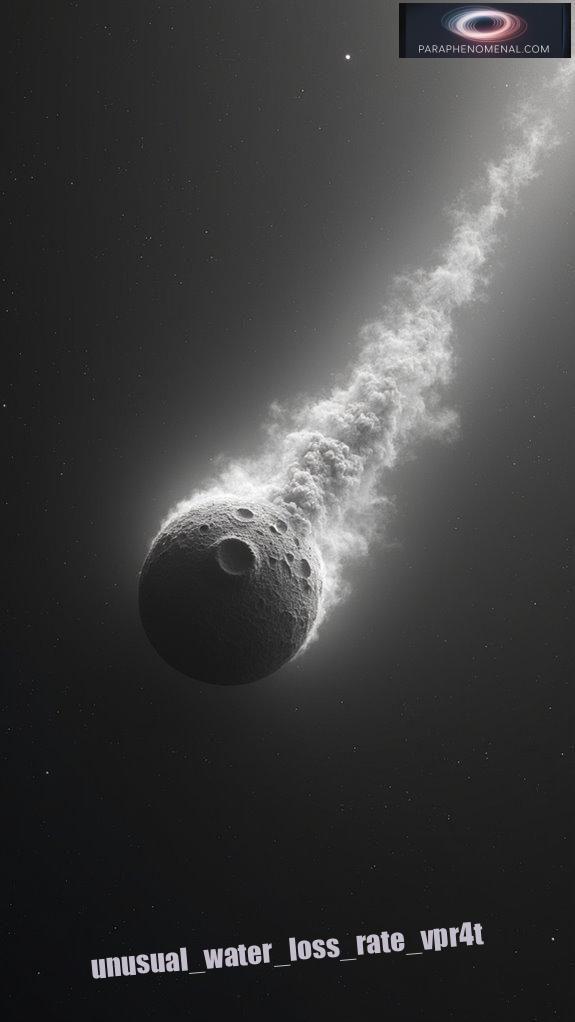
As you explore the unusual characteristics of comet 3I/ATLAS, you’ll find that its water loss rate is a significant point of interest. This comet sheds about 40 kilograms (88 pounds) of water every second, comparable to a firehose at full blast.
Over 18 hours, that rate equates to the volume of an Olympic-size swimming pool.
Notably, this water loss occurs when the comet is 2.9 to 3.3 AU from the Sun, a distance where most comets are inactive. The detected ultraviolet hydroxyl emissions hint at unique sublimation processes occurring, influenced by the comet’s distinct cometary composition. Such high activity indicates that 3I/ATLAS may differ fundamentally from other comets, confirming the diverse nature of celestial bodies we often capture on ParaPhenomenal. This level of water loss rate is particularly unusual for interstellar comets, setting 3I/ATLAS apart from its Solar System counterparts. Furthermore, the high ratio of carbon dioxide in the coma suggests that 3I/ATLAS could be undergoing different chemical processes, which might further explain its remarkable sublimation dynamics.
Causes of Water Loss
Understanding the causes of water loss in comet 3I/ATLAS provides understandings into its unique behavior in the cosmos.
Water loss starts far from the Sun, with sublimation processes kicking in even before typical heating occurs. The high abundance of carbon dioxide (CO2) plays an essential role, as CO2 sublimates more readily than water, releasing trapped water ice beneath the surface. Additionally, this comet exhibits a remarkable water loss rate of 88 pounds per second due to its unique composition and trajectory. Cometary gas sublimation processes significantly influence these dynamics, as the interplay between different volatiles affects the overall outgassing rate.
Icy debris in the coma also contributes to this outgassing, acting as mini-sources of water vapor. As these fragments warm under solar radiation, they generate water vapor without requiring high surface activity.
If you’re curious about cosmic phenomena, our website ParaPhenomenal can offer knowledge into these unique processes and the fascinating science behind them.
Active Surface Area and Its Role
The active surface area of comet 3I/ATLAS plays a crucial role in its water loss and unusual activity.
- About 8% of its surface releases water vapor.
- The high water loss rate of 40 kg/s illustrates considerable outgassing.
- This active surface outstrips that of typical comets, even far from the Sun.
- Ice-coated dust grains amplify sublimation dynamics, creating unexpected activity. Moreover, the comet’s unusual nickel to iron ratio contributes to its distinct characteristics, impacting its composition and behavior. Notably, fragmentation events can further influence water loss and activity levels.
These factors contribute to a unique scenario, where 3I/ATLAS defies conventional comet behavior.
Understanding how the active surface area interacts with sublimation dynamics provides understanding into its fascinating trajectory.
As we explore these cosmic wonders through ParaPhenomenal, we reveal the complex stories behind celestial phenomena, enhancing our appreciation for the freedom found in the vastness of space.
Detection Methods for Water Loss
Detecting water loss in comet 3I/ATLAS involves several advanced methods that facilitate the observation of its unique activity. These detection techniques include ultraviolet imaging and spectral analysis, employing space-based telescopes to overcome observational challenges caused by Earth’s atmosphere. Notably, NASA’s missions aim to understand NASA’s missions around comet 3I/ATLAS to provide deeper insights into its behavior.
| Detection Technique | Purpose | Key Instruments |
|---|---|---|
| Ultraviolet Imaging | Detects hydroxyl gas | Neil Gehrels Swift Observatory |
| Spectral Analysis | Analyzes composition | Gemini South Telescope |
| Multi-Mission Observations | Combines data from various sources | Hubble, James Webb, Swift |
Future Observations and Implications
How might future observations of comet 3I/ATLAS change our understanding of interstellar objects? As we explore deeper into its unique characteristics, the findings could reshape our perception of cosmic bodies and their histories:
- Discovering alien chemical signatures might reveal origins distinct from our Solar System.
- Uncovering icy debris helps us understand active sublimation outside typical ranges.
- Monitoring its water loss could indicate ancient cosmic collisions and transformations.
- Observing interactions within the coma sheds light on volatile distribution and mass loss.
Future observations may also provide insights into unusual comet trajectories, which could lead to a better understanding of how such objects navigate through space.
Future observations can bridge gaps in understanding the cosmic environment, illuminating both the past and future of interstellar objects.
This knowledge enriches our comprehension of the universe, allowing us to explore what lies beyond our home—a key aim of the ParaPhenomenal website.
FAQ
How Does Temperature Affect Water Loss From Comets Like 3i/Atlas?
Temperature greatly influences water loss from comets like 3I/ATLAS. As temperatures rise, sublimation increases, driven by the comet’s composition. This behavior resembles how wax melts when heated; smaller icy grains warm faster, releasing water vapor even in colder environments.
While you might think sunlight’s warmth is the only factor, the mix of gases, particularly carbon dioxide, can trigger activity at lower temperatures, impacting water loss rates and showing how complex these celestial bodies really are.
What Are the Implications of Water Loss for Future Research on Comets?
Water loss from comets like 3I/ATLAS has significant implications for future research on comet composition.
The unique ratios of water and carbon dioxide challenge our understanding of these bodies and their origins.
As scientists study these emissions, they can better evaluate the distribution of volatiles in the universe, which could inform models of organic molecule delivery and even the potential for life beyond Earth.
Your interest in these findings enriches our exploration of cosmic mysteries.
How Does 3i/Atlas Compare to Other Comets Regarding Water Loss?
3I/ATLAS loses water at a rate much higher than typical comets, with about 40 kilograms per second compared to the usual 3% to 5% surface activity.
Its unique water composition and enhanced cometary behavior, such as releasing water vapor from icy grains in the coma, set it apart.
Understanding this helps analyze how different origins and ages affect comets, which is part of why we created the ParaPhenomenal website to explore such phenomena.
What Is the Long-Term Fate of Comets Losing Water Rapidly?
Rapid water loss in comets like 3I/Atlas has important long-term implications for comet dynamics.
As they lose volatiles, their mass decreases, affecting their orbits and rotation. Eventually, these comets may become dormant or fragmented, resembling asteroids rather than lively, active bodies.
Without replenishment, they fade from visibility, leaving behind trails of debris.
Understanding this process allows us to appreciate the broader mechanics of celestial bodies, a focus we embrace at ParaPhenomenal.
Can the Water Loss Rate Change Over Time for 3i/Atlas?
Yes, the water loss rate for 3I/ATLAS can change over time.
It might fluctuate based on various water loss variables like the comet’s distance from the Sun and structural changes in its icy debris cloud.
Historical observations show that as the comet ages, its volatile reservoirs may diminish, leading to episodic bursts of activity.
This complex behavior reveals the comet’s unique characteristics, setting it apart from others in our Solar System.
References
- https://www.space.com/astronomy/comets/interstellar-comet-3i-atlas-is-leaking-water-like-a-fire-hose-running-at-full-blast-new-study-finds
- https://www.youtube.com/watch?v=PBNpv0QC4zg
- https://www.livescience.com/space/comets/comet-3i-atlas-is-losing-water-like-a-fire-hose-on-full-blast-rewriting-what-we-thought-we-knew-about-alien-star-systems
- https://www.iflscience.com/interstellar-comet-3iatlas-is-losing-buckets-of-water-every-second-and-its-got-cyanide-81130
- https://en.wikipedia.org/wiki/3I/ATLAS
- https://www.sci.news/astronomy/water-interstellar-object-3i-atlas-14270.html
- https://www.astronomy.com/science/comet-3i-atlas-shows-signs-of-water/
- https://phys.org/news/2025-10-physicists-ultraviolet-fingerprint-interstellar-comet.html
- https://www.spectroscopyonline.com/view/interstellar-comet-3i-atlas-shows-mysterious-spectroscopic-activity
- https://arxiv.org/html/2508.04675v1
- https://www.eurekalert.org/news-releases/1100952
- https://spaceexplored.com/2025/10/14/third-interstellar-object-offers-rare-glimpse-of-material-from-another-solar-system/
- https://astrobiology.com/2025/07/interstellar-comet-3i-atlas-discovery-and-physical-description.html
- https://www.esa.int/Science_Exploration/Space_Science/Comet_3I_ATLAS_frequently_asked_questions
- https://www.nasa.gov/solar-system/nasas-swift-mission-tallied-water-from-interstellar-comet-borisov/
- https://www.centauri-dreams.org/2019/05/28/a-comet-family-with-implications-for-earths-water/
- https://www.livescience.com/planet-earth/massive-comet-trail-may-have-transformed-earths-climate-more-than-12-000-years-ago-tiny-particles-suggest
- https://ui.adsabs.harvard.edu/abs/2021plde.confE.168M/abstract