Is 3I/ATLAS an alien spaceship?
I often find myself entranced by its mystique.
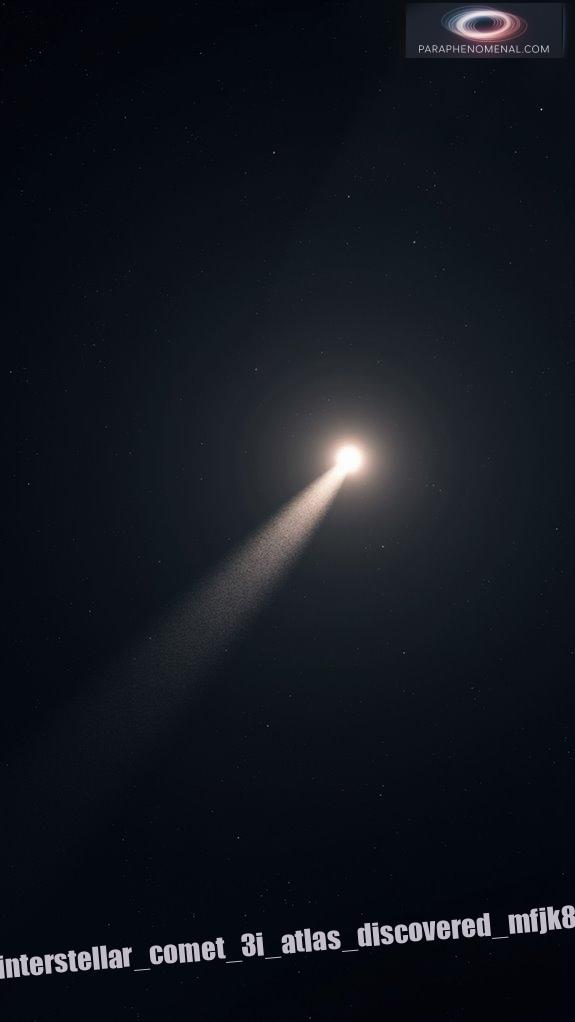
Discovered on July 1, 2025, this interstellar comet boasts an intriguing teardrop shape.
Its unusual chemical ratios and rapid speed certainly raise eyebrows. As I dig deeper, I notice its hyperbolic orbit—purely natural, it seems.
The outgassing activity? Evidence of a comet’s life, not alien technology.
Could we really be looking at something extraordinary? Or are we simply chasing shadows?
The more I explore, the more I ponder.
A Close Encounter with the Unknown: The Night I Spotted a UFO
I remember a night years ago when I spotted a strange light hovering in the sky. It flickered like a star but moved in ways that defied logic. My pulse raced as I grabbed my binoculars, desperately searching for answers.
Could it have been related to 3I/ATLAS?
The excitement of that night ignited my passion for investigating UFO phenomena. I learned about atmospheric conditions, light reflections, and unconventional crafts—yet I still wondered.
Was I just witness to an unidentified flying object, or was it something extraterrestrial?
Encounters like mine spark curiosity, as we delve into the wider world of UFO research, hoping one day to find the truth behind these celestial mysteries.
Quick Takeaways
- The composition of 3I/ATLAS includes nickel and cyanide, which suggests a natural origin rather than artificial technology.
- Spectral data indicates potential nickel-carbonyl formation, an unusual but natural chemical reaction for comets.
- Its hyperbolic trajectory and high speed are consistent with known physical laws governing celestial bodies, not engineered motion.
- Fragmentation events and dust ejection are typical cometary behaviors, not indicative of extraterrestrial constructs.
- Current scientific evidence strongly supports a natural origin rather than an alien spacecraft, despite ongoing investigation.
Overview of 3I/ATLAS

Is 3I/ATLAS an Alien Spaceship?
Overview of 3I/ATLAS
When you first hear about 3I/ATLAS, you might think it’s just another comet, but there’s much more to it than meets the eye. This interstellar visitor showcases unique cometary behavior, with unusual chemical ratios, including nickel and cyanide. Spectral data indicates it might undergo nickel-carbonyl formation, an intriguing process not typically observed in comets. Its teardrop shape and dust plume reveal ongoing activity, pointing to its extraordinary nature. Additionally, its eccentricity of 6.1 to 6.2 highlights the remarkable trajectory that sets it apart from conventional comets. Furthermore, the unusual characteristics and interstellar origin of 3I/ATLAS challenge our understanding of how these celestial bodies can traverse vast distances between star systems.
Chemical analysis suggests its composition reflects ancient origins from another star system, about 10 billion years old. Understanding these features offers perspectives into the processes of star system formation, revealing what makes 3I/ATLAS distinct. Our exploration, found at ParaPhenomenal, dives deeper into cosmic mysteries like this one.
Discovery and Tracking
3I/ATLAS stands out not just for its unique composition but also for its remarkable journey through space, beginning with its discovery on July 1, 2025.
Discovered using the NASA-funded ATLAS survey telescope in Río Hurtado, Chile, this comet initially appeared faint, with an apparent magnitude of 18.
Its discovery timeline kicked off with pre-discovery images from June 14, 2025, followed by collaborations among global observatories like the Zwicky Transient Facility.
Observational techniques confirmed its hyperbolic trajectory, establishing it as an interstellar object.
You’ll find that 3I/ATLAS’s speed of 61 km/s makes it one of the fastest observed comets, enchanting both scientists and enthusiasts alike—further solidifying ParaPhenomenal’s mission to uncover the mysteries of the universe.
Physical Characteristics of 3I/ATLAS
As researchers explore the physical characteristics of this intriguing comet, you’ll discover that 3I/ATLAS has a diameter estimated between 320 meters and 5.6 kilometers. The nucleus, while solid and icy, isn’t visible even through Hubble observations; scientists derive size estimations from indirect measurements.
3I/ATLAS, an enigmatic comet, has a diameter between 320 meters and 5.6 kilometers, with its icy nucleus elusive to observation.
Notably, the comet features a teardrop-shaped dust cocoon, forming a coma from materials ejected from its icy surface. The surface composition suggests active outgassing, typical of such comets. Additionally, the comet’s dust mass-loss rate is calculated at approximately ∼0.11-1.0 kg/s, indicating significant activity and material release. The potential for fragmentation events is a factor that could further enhance our understanding of its behavior.
Dust particles that range from micrometer to millimeter sizes contribute to its brightness and unique tail, characterized by a bizarre “anti-solar tail.”
Observations like these pique curiosity, prompting us at ParaPhenomenal to probe deeper into the mysteries of celestial bodies like 3I/ATLAS.
The Alien Spaceship Hypothesis

Could 3I/ATLAS be more than just a comet drifting through our solar system? A July 2025 paper proposed that it might be a form of extraterrestrial technology, based on its unusual trajectory and size. This led to speculation about cosmic probes sent by intelligent civilizations, possibly even hostile ones. Additionally, the comet anomalies observed in its trajectory have fueled theories regarding potential alien activity.
| Hypothesis | Argument |
|---|---|
| Extraterrestrial technology | Unusual size and trajectory raise questions. |
| Cosmic probes | Could be a preemptive measure against other civilizations. |
| Anomalous features | Ignites curiosity despite scientific skepticism. |
| Dark Forest Hypothesis | Suggests survival drives civilizations to act first. |
| Controversial stance | Lacks support among astronomers. |
The debate continues as more observations are made. The possibility of 3I/ATLAS being anything beyond a comet stirs both fear and intrigue, which is why we created this website, ParaPhenomenal, to explore such extraordinary ideas.
Scientific Evidence Supporting a Natural Origin
Many scientists believe there’s compelling evidence that supports a natural origin for 3I/ATLAS. This interstellar comet likely results from natural phenomena, showcasing a unique cometary composition that sets it apart from our Solar System’s objects.
Its high vertical velocity indicates a tilted orbit, suggesting it hails from an older stellar population. The composition hints at materials from a disrupted exoplanetary body, drawing intrigue as researchers study its distinctive chemical makeup.
The tilted orbit and unique composition of 3I/ATLAS suggest intriguing origins from an ancient stellar population.
Studies using advanced tools like the Hubble Space Telescope reveal unexpected thermal emissions and spectral patterns, further supporting the hypothesis of a natural origin. Additionally, its trajectory has sparked discussions around unexplained phenomena, as some observers speculate about potential UFO sightings linked to its passage.
By expanding our knowledge of interstellar objects, we embrace our curiosity, aiding our understanding here at ParaPhenomenal.
As research continues, more surprises may lie ahead.
Observational Efforts by NASA and ESA
Following the evidence supporting a natural origin for 3I/ATLAS, both NASA and ESA have stepped up their observational efforts to gather more data on this intriguing interstellar comet.
Ground and space telescopes, including Hubble and James Webb, quickly monitored the comet’s trajectory and brightness, sharing data to maximize scientific output.
In the coming years, Mars orbiters and the Juice spacecraft will provide detailed observations, further enhancing our understanding of 3I/ATLAS’s physical properties. Additionally, these missions will explore trajectory options that could reveal more about the comet’s origins and behavior.
Their collaborative efforts guarantee no duplication of work and promote transparency through shared multimedia resources and scientific updates.
The Role of Trajectory and Orbit in Understanding 3I/ATLAS

The trajectory and orbit of 3I/ATLAS are essential for understanding its interstellar nature and the reasons behind its unique characteristics. Its hyperbolic trajectory, along with its high velocity of about 58 to 61 km/s, reveals much about its origin and path.
Here are three key points regarding its trajectory dynamics and orbital mechanics:
- Hyperbolic trajectory: It indicates that 3I/ATLAS isn’t bound to the Sun and will leave the Solar System.
- Orbital plane orientation: The slight tilt of about 5° and the retrograde motion complicate any potential interception efforts.
- High eccentricity: With an eccentricity of around 6, it showcases extreme conditions typical of interstellar travel, highlighting its unusual journey from beyond our Solar System.
Understanding these factors can keep your curiosity alive as you explore the cosmos with us at ParaPhenomenal.
Implications for Future Interstellar Research
As scientists continue to analyze 3I/ATLAS and its mysterious properties, the discoveries made could reshape our understanding of interstellar research.
The comet’s unique chemical signatures indicate significant interstellar compositions that diverge from what we typically see in our Solar System. This tells us there’s a world of chemical diversity to explore, suggesting that materials in earlier star systems vary widely.
Monitoring 3I/ATLAS during its perihelion in late 2025 is essential; coordinated efforts from missions like ESA’s Juice and NASA’s Europa Clipper could reveal understanding into comet dynamics and ejection processes.
FAQ
What Is the Significance of 3i/Atlas’s High-Speed Trajectory?
3I/ATLAS’s high-speed trajectory is significant for studying interstellar objects. Its incredible speeds, joined with gravity assists from other stars, indicate it’s unbound to the solar system.
By applying trajectory analysis, scientists gain understanding into its interstellar origins and the dynamics of comet movement.
This data helps refine techniques for future object detection, which ParaPhenomenal aims to highlight, enhancing our comprehension of the cosmos and our place within it.
Are There Any Plans for a Spacecraft Mission to 3i/Atlas?
Yes, there are plans for a spacecraft mission to 3I/ATLAS.
With advancements in spacecraft technology, scientists consider mission feasibility to explore its unique characteristics. The Southwest Research Institute has proposed a close encounter, aiming to uncover knowledge into its composition and origins.
Future missions, like ESA’s Comet Interceptor, might target comets, potentially including 3I/ATLAS if timing aligns.
Exploring such celestial visitors expands our understanding of the universe, connecting human curiosity with the unknown.
How Does 3i/Atlas Compare to Other Interstellar Objects?
3I/ATLAS stands out among interstellar objects due to its unusual shape and cosmic origin.
It boasts a hyperbolic orbit, moving at an astonishing speed of 58 km/s, making it the fastest known.
Unlike others, it’s much older, estimated at 7.5 billion years, showcasing material from a time before the Solar System formed.
Understanding 3I/ATLAS helps uncover the mysteries of our universe, which is why we created ParaPhenomenal—to share these cosmic wonders with you.
What Predictions Are There for 3i/Atlas’s Future Behavior?
Predictions for 3I/ATLAS’s future behavior suggest a gradual dimming as it moves away from the Sun.
After perihelion, you’ll notice a decline in brightness and activity due to reduced solar heating. Its outbound path follows celestial mechanics that will soon take it beyond the Solar System, with observations detailing its journey.
As you explore, keep in mind, we created ParaPhenomenal to share such enthralling cosmic stories amidst the mysteries of the universe.
Can 3i/Atlas Provide Clues About Other Star Systems?
Yes, 3I/ATLAS can provide valuable clues about other star systems.
Its unique stellar composition offers perspectives into the chemical diversity found in extraterrestrial environments. Observations of its behavior can reveal potential extraterrestrial signals related to how comets form across different star systems.
References
- https://lweb.cfa.harvard.edu/~loeb/HCL25.pdf
- https://www.esa.int/Science_Exploration/Space_Science/Comet_3I_ATLAS_frequently_asked_questions
- https://en.wikipedia.org/wiki/3I/ATLAS
- https://www.planetary.org/articles/what-is-comet-3i-atlas
- https://www.iflscience.com/prof-brian-cox-explains-what-he-finds-remarkable-about-interstellar-object-3iatlas-story-81168
- https://science.nasa.gov/solar-system/comets/3i-atlas/
- https://www.esa.int/Science_Exploration/Space_Science/ESA_s_ExoMars_and_Mars_Express_observe_comet_3I_ATLAS
- https://news.northeastern.edu/2025/09/08/3i-atlas-comet-interstellar-traveler/
- https://www.iflscience.com/anti-tail-and-odd-594-kilometer-feature-found-on-interstellar-object-3iatlas-by-keck-observatory-81188
- https://thedebrief.org/3i-atlas-update-what-new-data-reveals-about-the-most-puzzling-interstellar-object-ever-found/
- https://www.skyatnightmagazine.com/news/3i-atlas-not-aliens
- https://www.seti.org/news/comet-3iatlas-a-visitor-from-beyond-the-solar-system/
- https://www.spectroscopyonline.com/view/interstellar-comet-3i-atlas-shows-its-spectral-secrets-through-palomar-and-apache-point-observations
- https://ffesp.org/nasa-confirms-3i-atlas-mysterious-interstellar-visitor-enters-solar-system/
- https://science.nasa.gov/blogs/planetary-defense/2025/07/02/nasa-discovers-interstellar-comet-moving-through-solar-system/
- https://astrobiology.com/2025/07/interstellar-comet-3i-atlas-discovery-and-physical-description.html
- https://ui.adsabs.harvard.edu/abs/2025MNRAS.542L.139B/abstract
- https://arxiv.org/abs/2507.05252
- https://science.nasa.gov/missions/hubble/as-nasa-missions-study-interstellar-comet-hubble-makes-size-estimate/
- https://www.iflscience.com/seti-paper-responds-to-claims-interstellar-object-3iatlas-might-be-an-alien-spacecraft-81100
- https://www.youtube.com/watch?v=mwlTlw3rV5I
- https://www.livescience.com/space/extraterrestrial-life/here-we-go-again-controversial-paper-questions-whether-interstellar-visitor-3i-atlas-is-possibly-hostile-alien-tech-in-disguise
- https://www.spectroscopyonline.com/view/3i-atlas-an-interstellar-enigma-natural-comet-or-engineered-probe-
- https://www.sciencedaily.com/releases/2025/10/251009033128.htm
- https://www.esa.int/Science_Exploration/Space_Science/ESA_observations_of_interstellar_comet_3I_ATLAS
- https://science.nasa.gov/solar-system/comets/3i-atlas/comet-3i-atlas-multimedia/
- https://esahubble.org/news/heic2509/
- https://timesofindia.indiatimes.com/science/interstellar-object-3i/atlas-is-remarkable-prof-brian-cox-explains-its-origins-and-7-5-billion-year-journey/articleshow/124607576.cms
- https://www.youtube.com/watch?v=XEggZo3SXNM
- https://www.planetary.org/articles/studying-a-distant-visitor-what-we-know-about-interstellar-object-3i-atlas