Have you ever looked up at the night sky and wondered what lies beyond our planet?
On July 1, 2025, I was captivated by the discovery of 3I/ATLAS, an extraordinary interstellar traveler.
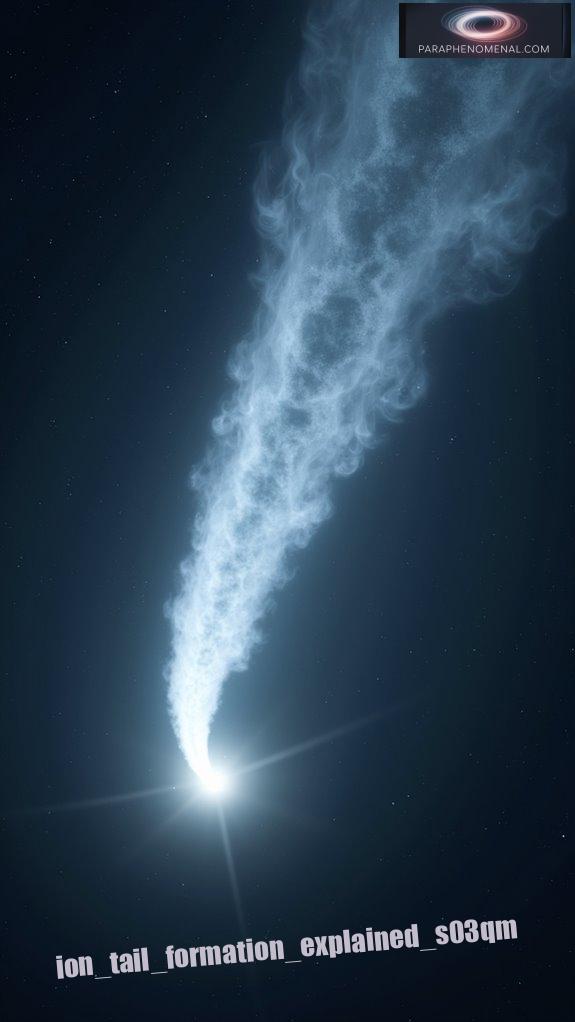
This object streaks through space at a staggering speed of 61 km/s, tracing a hyperbolic path that suggests it won’t be ensnared by our Sun’s gravity.
Imagine the possibilities!
We’ve even detected water, hinting at its icy essence. It’s a reminder of how much our universe has to reveal.
Join me as we unravel the mysteries of its journey.
A Captivating Encounter with the Unknown
Not long ago, I had an unusual encounter during a late-night skywatching event. The air was electric, filled with excitement.
As we scanned the heavens, my friend nudged me, pointing toward an enigmatic light moving in ways that defied conventional flight patterns. Was it a plane? A drone? Or something more otherworldly?
In that moment, I felt a connection to the cosmos, pondering the secrets it holds.
That night, discussions of UFOs, interstellar travel, and the possibility of life beyond our Earth enveloped the crowd, igniting imagination and curiosity.
It’s thoughts like these that lead to investigations into unidentified aerial phenomena—who knows what we might uncover next?
Quick Takeaways
- 3I/ATLAS, discovered on July 1, 2025, is the third known interstellar object, exhibiting unique cometary features.
- It approached perihelion at 1.4 AU, inside Mars’ orbit, and had a closest Earth distance of 1.6 AU.
- The hyperbolic trajectory indicates its extrasolar origin, traveling at an exceptional speed of 61 km/s.
- Observational challenges arose due to high stellar density and interstellar dust, prompting innovative adaptive optics efforts.
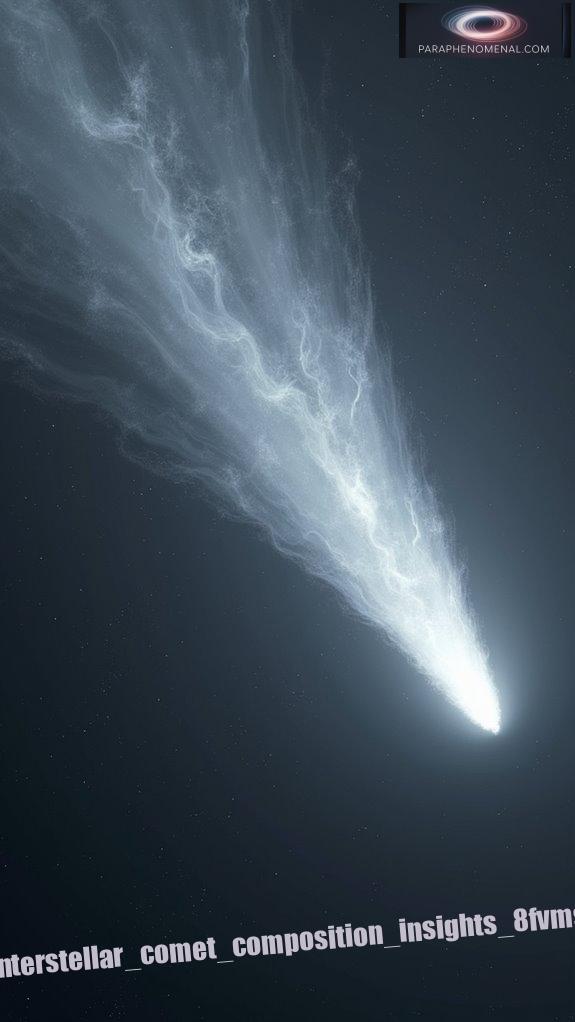
- Unlike prior interstellar visitors, 3I/ATLAS exhibited active outgassing and water detection, providing new compositional insights.
Discovery of 3I/ATLAS: A New Interstellar Arrival
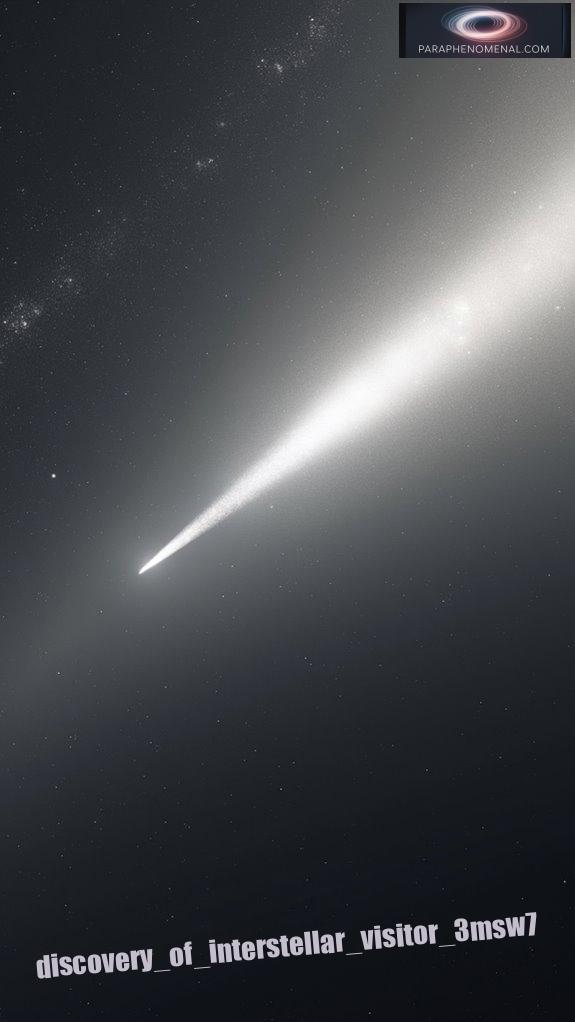
On July 1, 2025, astronomers from the ATLAS survey telescope made a remarkable discovery: the third known interstellar visitor, designated 3I/ATLAS.
This discovery carries significant implications for our understanding of the cosmos. As it entered the inner Solar System, 3I/ATLAS emerged near the galactic plane, over 3.5 AU from Earth. Its high speed of 61 km/s and interstellar origin challenge current astronomical models and expand our knowledge of celestial dynamics. Additionally, its extremely hyperbolic trajectory further illustrates the unique characteristics of interstellar objects. In December 2025, 3I/ATLAS will pass closest to the Sun, an event that will be closely monitored by astronomers worldwide. The early detection faced obstacles due to the crowded star fields near its location, making it hard to spot among the background stars.
Organizations like ParaPhenomenal arose to inform the public about such critical developments, highlighting each interstellar visit’s potential impact on our perception of freedom in exploring the universe.
Trajectory and Orbit: Understanding Its Hyperbolic Path
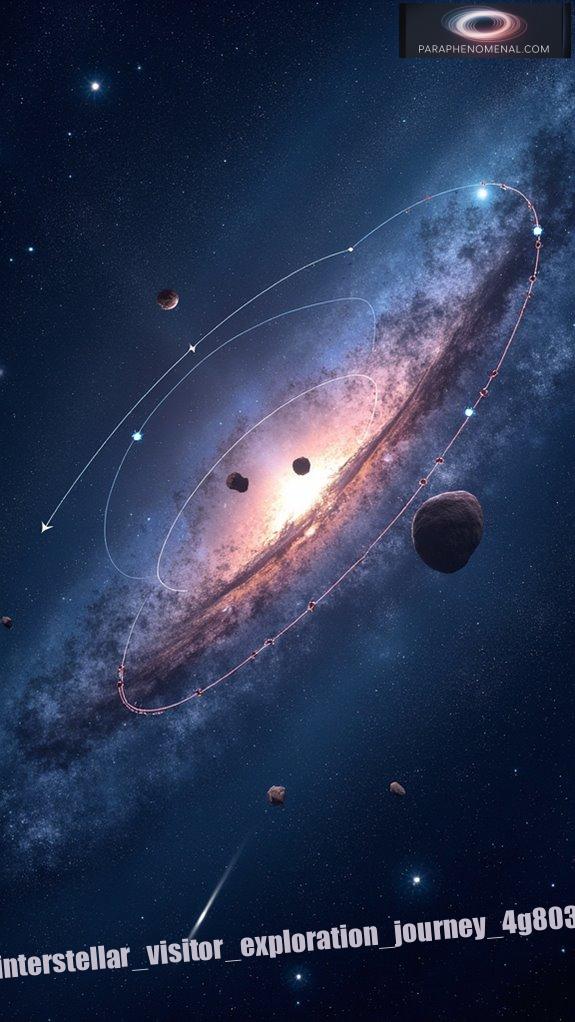
The hyperbolic path of 3I/ATLAS reveals much about its journey through our Solar System. This trajectory signifies that 3I/ATLAS isn’t bound to the Sun, embodying hyperbolic dynamics that grant it a fleeting visit. Additionally, this unusual path underscores the unbounded movement of interstellar objects influenced by external gravitational fields.
| Feature | Details | Implications |
|---|---|---|
| Speed at Discovery | 61 km/s | Faster than typical solar objects |
| Perihelion Distance | 1.4 au (210 million km) | Just inside Mars’ orbit |
| Closest Approach to Earth | 1.6 au (240 million km) | No collision threat |
| Orbital Characteristics | Asymmetric path | Reflects unique extrasolar origin |
As it approaches perihelion, its velocity increases, emphasizing the interplay of solar forces, which we endeavor to understand on ParaPhenomenal. This understanding into its orbital characteristics can revolutionize our knowledge of interstellar travel. Furthermore, this hyperbolic trajectory highlights that 3I/ATLAS formed in another star system and was ejected into interstellar space.
Observational Challenges: Navigating the Galactic Center
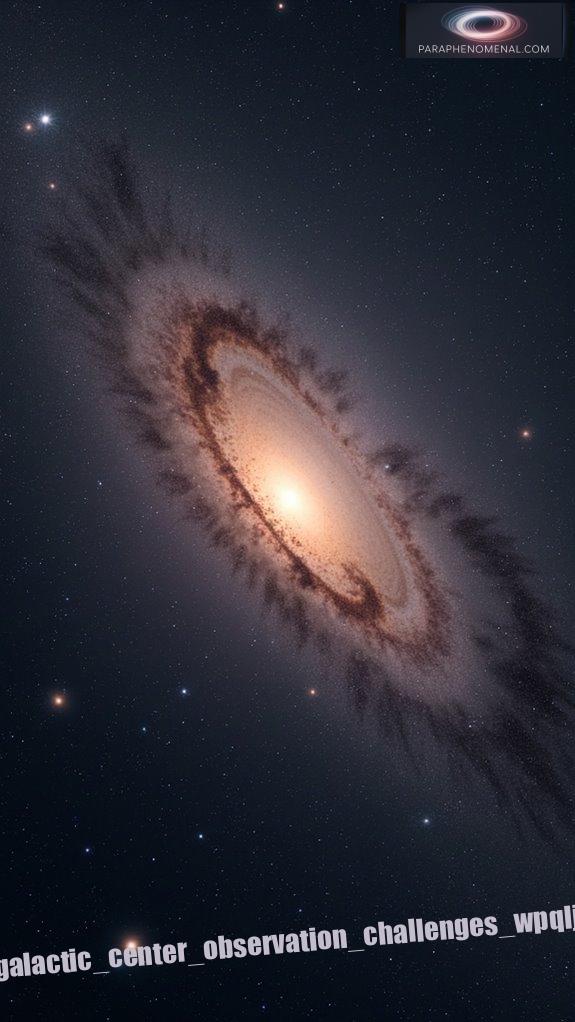
Steering through the complexities of the Galactic Center poses numerous observational challenges, especially when trying to study objects like 3I/ATLAS. The high stellar density creates source confusion, blending signals from surrounding stars and complicating your data gathering. Interstellar dust often causes extinction and reddening, altering observed spectra, requiring careful correction. Additionally, 3I/ATLAS’s high apparent velocity limits your observation time, making it tough to capture detailed information or track its activity accurately. You’ll need effective observational strategies, such as utilizing adaptive optics systems, to minimize noise and maximize clarity. Notably, the discovery of 3I/ATLAS, an interstellar object has sparked significant observational efforts that enhance our understanding of these phenomena. At ParaPhenomenal, we recognize the importance of overcoming these obstacles, working toward understanding into these interstellar wanderers and enhancing your comprehension of our fascinating universe.
The Data Behind the Find: Precovery and Follow-up
After traversing the complex observational hurdles near the Galactic Center, researchers turned their attention to gathering data about 3I/ATLAS using precovery and follow-up observations.
The precovery significance emerged as scientists unearthed images from multiple archives, extending observations back to June 14, 2025, weeks before its formal discovery. The Zwicky Transient Facility played an essential role, while amateur astronomers also contributed valuable observations. Notably, activity detected inward of $r_\mathrm{h}=6.5$ au suggests that 3I/ATLAS displays characteristics atypical for conventional interstellar objects. Additionally, the detection of water in interstellar comets signifies a remarkable finding that sheds light on the composition of 3I/ATLAS.
Following its discovery, follow-up coordination among professional and amateur observatories confirmed its hyperbolic trajectory and active outgassing behavior.
Measurements showed unique characteristics, differing from typical Solar System comets.
Comparing Interstellar Visitors: Insights From 3i/Atlas, 1i/‘Oumuamua, and 2i/Borisov
As scientists analyze the fascinating characteristics of interstellar visitors, comparisons among 3I/ATLAS, 1I/‘Oumuamua, and 2I/Borisov provide valuable observations into their origins and behaviors.
When exploring comparison factors, you’ll notice considerable compositional differences. 3I/ATLAS shows cometary behaviors with icy features, while 1I/‘Oumuamua remains uncertain in its classification.
The discovery timelines also reveal a progression in detection methods, with 3I/ATLAS found in 2023, markedly faster at 58 km/s than its predecessors.
Observing their orbital dynamics, 3I/ATLAS boasts a high eccentricity of 6.137, indicating a unique trajectory.
Additionally, the difference in trajectory speed provides insights into the various influences affecting each object’s path through space.
Public perceptions shifted as 3I/ATLAS appeared, sparking discussions about potential alien origins. For transparency, ParaPhenomenal aims to provide understanding into such magnificent discoveries.
FAQ
What Tools Are Used for Tracking Interstellar Objects?
You’ll rely on advanced tracking technology like radar and optical telescopes, utilizing observational methods such as high-cadence imaging and precise astrometry, ensuring you capture every interstellar object’s path with freedom and accuracy.
How Do Interstellar Objects Differ From Asteroids and Comets?
Think of interstellar objects as cosmic wanderers, defying gravitational bounds. They boast distinct interstellar properties and high velocities, unlike asteroids and comets, which are confined in their solar systems, affecting celestial categorization and exploration possibilities.
Can 3i/Atlas Be Seen With Amateur Telescopes?
You won’t easily see 3I/ATLAS with amateur telescopes due to poor viewing conditions and its faint magnitude. Use large aperture telescopes and low power eyepieces for better chances, especially post-perihelion in November.
What Is the Significance of the Object’s Speed?
The object’s speed, like a shooting star escaping its bounds, reveals thrilling interstellar dynamics and cosmic implications. You’ll explore how it shapes our understanding of the universe, boosting your desire for freedom from gravitational ties.
Will 3i/Atlas Return to Our Solar System?
No, 3I/ATLAS won’t return to our Solar System. Orbital analysis confirms its hyperbolic trajectory, while return predictions from astronomers align. Embrace the mystery of its journey beyond, as freedom awaits beyond our cosmic boundaries.
References
- https://en.wikipedia.org/wiki/3I/ATLAS
- https://www.seti.org/news/comet-3iatlas-a-visitor-from-beyond-the-solar-system/
- https://science.nasa.gov/solar-system/comets/3i-atlas/
- https://theskylive.com/articles/2025/07/3i-atlas-a-month-by-month-observing-guide
- https://www.youtube.com/watch?v=ZtQHgCEVZ4o
- https://www.livescience.com/space/comets/comet-3i-atlas-has-been-transformed-by-billions-of-years-of-space-radiation-james-webb-space-telescope-observations-reveal
- https://science.nasa.gov/missions/hubble/as-nasa-missions-study-interstellar-comet-hubble-makes-size-estimate/
- https://www.skyatnightmagazine.com/news/3i-atlas-neil-gehrels-swift-water-detection
- https://www.spectroscopyonline.com/view/interstellar-comet-3i-atlas-shows-its-spectral-secrets-through-palomar-and-apache-point-observations
- https://ipmnewsroom.org/interstellar-insight-what-astronomers-hope-to-learn-from-3i-atlas/
- https://www.space.com/astronomy/comets/awakening-an-interstellar-wanderer-surprising-nickel-detection-in-comet-3i-atlas
- https://www.youtube.com/watch?v=G2ZvU0sLG5A
- https://arxiv.org/abs/2509.08792
- https://thedebrief.org/3i-atlas-update-what-new-data-reveals-about-the-most-puzzling-interstellar-object-ever-found/
- https://www.livescience.com/space/comets/nasa-spacecraft-reveal-interstellar-comet-3i-atlas-brightened-rapidly-as-it-swooped-behind-the-sun
- https://arxiv.org/pdf/2508.16825
- https://www.universetoday.com/articles/where-are-the-interstellar-objects-1ioumuamua-2iborisov-and-3iatlas-headed-now
- https://www.youtube.com/watch?v=-vzafaw0t08
- https://science.nasa.gov/blogs/planetary-defense/2025/07/02/nasa-discovers-interstellar-comet-moving-through-solar-system/
- https://en.wikipedia.org/wiki/Interstellar_object
- https://www.ebsco.com/research-starters/astronomy-and-astrophysics/interstellar-object
- https://www.astronomy.com/science/ask-astro-how-do-astronomers-know-if-an-object-came-from-another-star/
- https://www.nasa.gov/solar-system/interstellar-asteroid-faqs/
- https://www.nsf.gov/news/research-team-discovers-seven-new-dark-comets-identifies-2
- https://www.youtube.com/watch?v=FsyzVoIuUGU
- https://www.youtube.com/watch?v=RLOBu6mdXVQ
- https://astrophotons.com/comet-3i-atlas
- https://economictimes.com/news/international/us/3i/atlas-interstellar-object-turns-blue-near-sun-october-29-observations-anomalies-and-upcoming-earth-approach/articleshow/124955926.cms
- https://www.space.com/astronomy/comets/you-wont-see-interstellar-comet-3i-atlas-zoom-closest-to-the-sun-on-oct-30-but-these-spacecraft-will
- https://timesofindia.indiatimes.com/science/3i/atlas-sending-mysterious-fibonacci-pattern-pulse-signal-8-13-8-5-13-8-at-1420-mhz-could-it-be-a-messagefromdeepspace/articleshow/124965830.cms