Tag: comet

  • Why Is 3i/Atlas Emitting Light?

    Why Is 3i/Atlas Emitting Light?

    Have you ever gazed up at the night sky and pondered what truly makes some celestial bodies shine?

    It’s fascinating!

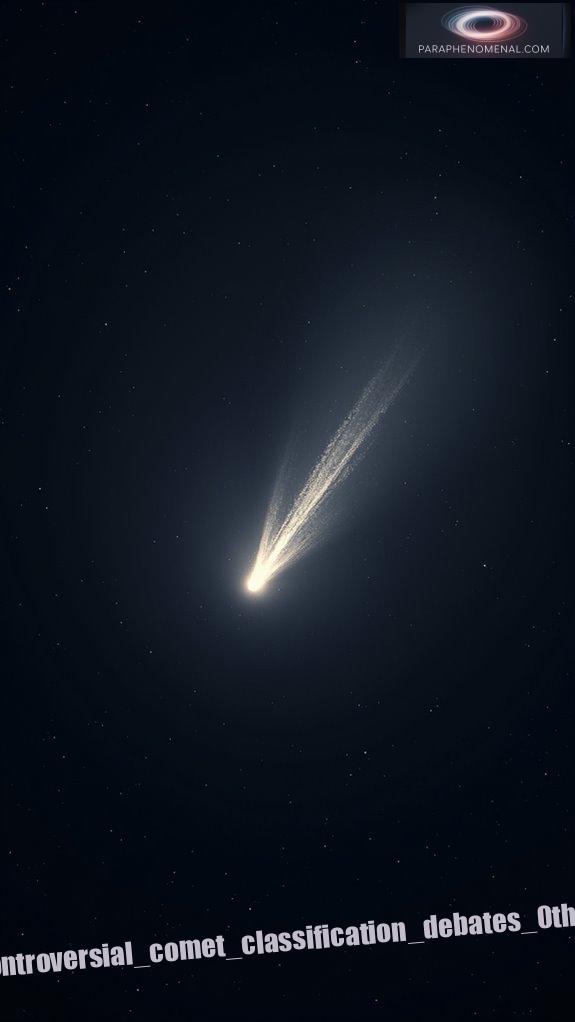
    Comet 3I/ATLAS catches my attention because it emits light as it approaches the Sun. The icy materials within it sublimate, releasing gases and dust.

    This astonishing process creates a glowing coma and a mesmerizing tail.

    To top it off, unique chemicals like cyanide are unveiled, intensifying its brightness.

    Isn’t it extraordinary how solar radiation fuels these reactions and enhances luminosity?

    There’s so much more to discover about this cosmic marvel!

    A Close Encounter: UFO and Celestial Wonders

    I remember stargazing one evening, fascinated by a sudden bright object streaking across the sky. As it dispelled into a beautiful tail of light, I initially thought it was a UFO.

    Curiosity drove me to investigate, leading me down a rabbit hole of astronomy, UFO sightings, and meteoric phenomena. I later learned it was likely a bright meteor, but the experience ignited my passion for exploring the universe’s mysteries.

    Engaging with fellow enthusiasts about meteors, comets, and potential extraterrestrial encounters has since enriched my understanding. What have you seen in the skies that left you in awe?

    Quick Takeaways

    • Comet 3I/ATLAS emits light primarily due to the sublimation of icy volatiles as it approaches the Sun, creating gas and dust emissions.
    • Solar radiation heats the comet, initiating photochemical reactions that break down molecular ices, resulting in additional light emissions.
    • The intense light is influenced by the accelerated sublimation process, leading to a bright coma formed from escaping gases and dust.
    • Unique chemical signatures, including cyanide and complex organic materials, contribute to the comet’s distinct spectral emissions observed in its light.
    • Continuous outgassing, primarily of water vapor and carbon dioxide, results in increased brightness and unique light emission properties of 3I/ATLAS.

    Observational Evidence of Light Emission

    comet 3i atlas light emissions

    Observational evidence reveals intriguing details about the light emission from comet 3I/ATLAS, showcasing features typically associated with these celestial wanderers.

    The comet displays a distinct coma and tail formed through sublimation of icy volatiles, like water and carbon dioxide, which release vapor and dust, creating a luminous display. Observations reveal a clear coma and tail for 3I/ATLAS, emphasizing its classification as a comet rather than an asteroid. This process is influenced by the water and gas loss rates, determining the intensity of the emissions.

    Spectroscopic data confirms substantial gaseous emissions, particularly cyanide, contributing to the overall light output. These findings illustrate how cometary dynamics affect emission mechanisms, giving us valuable observations into 3I/ATLAS’s behavior.

    Direct imaging reveals a bright dust tail, exemplifying ongoing ejection of material.

    With each observation, we deepen our understanding, inspiring a sense of connection to the universe and exemplifying why we created this website, ParaPhenomenal.

    The Role of Solar Radiation

    As 3I/ATLAS travels through space, its light emission reflects the dynamic interplay between solar radiation and cometary materials.

    The journey of 3I/ATLAS illuminates the captivating interaction between solar energy and cometary substances in the cosmos.

    Solar heating plays a vital role here, igniting a process known as sublimation. This causes ices on 3I/ATLAS to transform directly into gas, releasing dust and gas and creating its distinctive coma and tail. The discovery of 3I/ATLAS has allowed scientists to observe this process in real-time, enhancing our understanding of how interstellar objects behave in our Solar System. The rates of sublimation are influenced by the gas sublimation rates of the comet’s ices, determining how much material is released into the coma.

    The sunlight’s intensity also drives photochemical reactions, breaking down molecular ices and producing fluorescing fragments.

    Some of these gases, like hydroxyl radicals, contribute to the light you see, distinct from just reflected sunlight.

    As you explore phenomena like 3I/ATLAS, keep in mind that these cosmic dances reveal the power of solar radiation, illustrating how they can shape the universe, a central theme of our ParaPhenomenal journey.

    Characteristics of 3I/ATLAS’s Spectrum

    The range of 3I/ATLAS reveals a fascinating portrait of its chemical composition and interactions with the surrounding solar environment. This unique spectrum showcases significant spectral features, hinting at intriguing organic compounds.

    Here are three key characteristics of 3I/ATLAS’s spectrum:

    1. Presence of Nickel: The detection of atomic nickel (Ni I) marks a distinct chemical signature. Additionally, the high carbon dioxide ratio in its coma indicates active outgassing processes.
    2. Cyanogen Detection: Cyanogen (CN) indicates ongoing chemical reactions with solar radiation.
    3. Reddish Dust and Organics: The spectrum is dominated by reddish dust, suggesting complex organic materials not typically found in local comets. The discovery of water vapor in its spectrum further underscores the comet’s unique chemical makeup.

    Understanding these spectral features of 3I/ATLAS not only broadens our knowledge of interstellar objects but also inspires curiosity about potential life beyond Earth, reminding us why we created this website, ParaPhenomenal.

    The Influence of Sublimation on Emission

    sublimation enhances cometary emissions

    Sublimation dynamics play an essential role in this comet’s volatile behavior. When solid ices directly transform into gas, they release various gases and dust, creating a visible coma.

    This process occurs even at great distances from the Sun, indicating the presence of highly volatile components that emit light at specific wavelengths. As the comet approaches during its closest approach to the Sun, the heat accelerates sublimation, increasing the intensity of light emitted.

    As gases escape, they carry unique chemical signatures that provide perspectives into the object’s composition and origin—possibly from outside our Solar System.

    This early activity hints at how sublimation impacts light emission, underscoring the necessity of studying interstellar objects.

    Websites like ParaPhenomenal aim to explore such cosmic phenomena, fostering a deeper understanding of the universe.

    Gaseous Contributions to Light Emission

    Gases play an essential role in the emission of light from celestial objects, especially in the framework of comets like 3I/ATLAS.

    Understanding how gas excitation works helps reveal the underlying emission mechanisms at play.

    1. Atomic and Molecular Shifts: Light is emitted when gas atoms or molecules drop from higher to lower energy states.
    2. Energy Sources: Ultraviolet radiation from nearby stars can excite these gases, initiating the emission of light.
    3. Emission Lines: Each element produces unique emission lines, enabling astronomers to identify chemical compositions in gases, vital for our knowledge of cosmic phenomena.

    Furthermore, the comet’s unusual interstellar velocity can also influence the characteristics of the emitted light due to changes in gas interactions.

    Unique Composition and Its Effects

    Unique elements in the composition of comet 3I/ATLAS set it apart from other comets. It exhibits strong nickel emissions, a feature rare in these celestial wanderers. Unlike others, 3I/ATLAS lacks detectable iron, hinting at a unique elemental balance that captivates scientists.

    Additionally, cyanide uniqueness adds another layer of intrigue to its chemical makeup. These nickel-carbonyl formation processes resemble those found in industrial activities on Earth, suggesting that the comet’s interactions might echo familiar scenarios yet to be fully understood in the cosmos.

    As we explore these exceptional characteristics, we enhance our understanding of interstellar materials and the advanced dynamics of celestial visitors like 3I/ATLAS, crafting a deeper appreciation for the universe around us.

    Comparisons With Other Solar System Comets

    unique characteristics of 3i atlas

    As scientists study the peculiar characteristics of comet 3I/ATLAS, comparisons to other solar system comets reveal intriguing differences in trajectory and composition.

    1. Origin: 3I/ATLAS comes from outside the solar system, marked by its hyperbolic orbit, unlike typical solar comets with elliptical paths.
    2. Dust Activity: While 3I/ATLAS shows active dust and gas emissions, its activity mirrors that of long-period solar system comets, despite occurring at greater distances.
    3. Volatile Release: Its release of water vapor and hydroxyl gas at unprecedented distances challenges our understanding of interstellar comparisons with known solar system comets.

    These striking features of 3I/ATLAS highlight its uniqueness, prompting us at ParaPhenomenal to explore the cosmic behaviors that continue to captivate both scientists and enthusiasts alike.

    FAQ

    How Far Can 3i/Atlas Travel Before Becoming Inactive?

    3I/ATLAS can travel around 5 to 10 AU from the Sun before becoming inactive.

    As it distances itself, light emission starts to fade due to distance decay; solar heating ceases, halting any activity.

    This fascinating interstellar wanderer, once brimming with energy from the Sun, will soon sail through the quiet void of space.

    Our website, ParaPhenomenal, explores these cosmic voyages, shedding light on their mysteries before they vanish into the darkness.

    What Instruments Are Used to Observe 3i/Atlas in Detail?

    To observe 3I/ATLAS in detail, astronomers use various instruments.

    Spectroscopic analysis from telescopes like Hubble and JWST measures atomic emissions and volatile compositions.

    Imaging techniques from observatories, such as the VLT and Keck, capture coma growth and tail behavior, revealing dust properties.

    These tools help you uncover the comet’s unique characteristics, supporting the scientific journey celebrated by ParaPhenomenal, as you explore the mysteries of the universe’s wonders together.

    Is 3i/Atlas Visible to the Naked Eye?

    3i/Atlas isn’t visible to the naked eye, no matter how clear the atmospheric conditions.

    Even at its peak brightness, it’s far too faint, remaining a mysterious object for telescopes alone.

    Envision trying to spot a firefly on a moonless night—that’s how elusive it is!

    Your only chance to witness this celestial wanderer relies on powerful telescopes, as it dances silently behind the Sun and away from our view, reminding us of the universe’s vast secrets.

    How Often Are Observations of 3i/Atlas Conducted?

    Observations of 3I/ATLAS occur frequently, particularly during its vital periods close to the Sun.

    From May to October 2025, various facilities conducted extensive data collection, such as imaging and spectroscopy. The Vera C. Rubin Observatory, for instance, provided continuous monitoring, aiding in capturing significant changes over time.

    This coordinated approach allows scientists to track comet activity effectively, revealing fascinating understandings. Understanding these dynamics is a key part of our mission at ParaPhenomenal.

    What Other Comets Are Similar to 3i/Atlas?

    Other comets similar to 3I/ATLAS include 2I/Borisov, which also exhibits clear comet characteristics like comas and dust tails.

    Both comets show signs of volatile ices sublimating as they approach the Sun, generating gas and dust in their wake.

    Astronomical observations of these interstellar bodies reveal their hyperbolic trajectories and unusual speeds.

    Through our site, ParaPhenomenal, we aim to share fascinating discoveries about these objects and their impact on our understanding of the universe.

    References

  • 3I/ATLAS Rapidly Brightens and Gets Blue

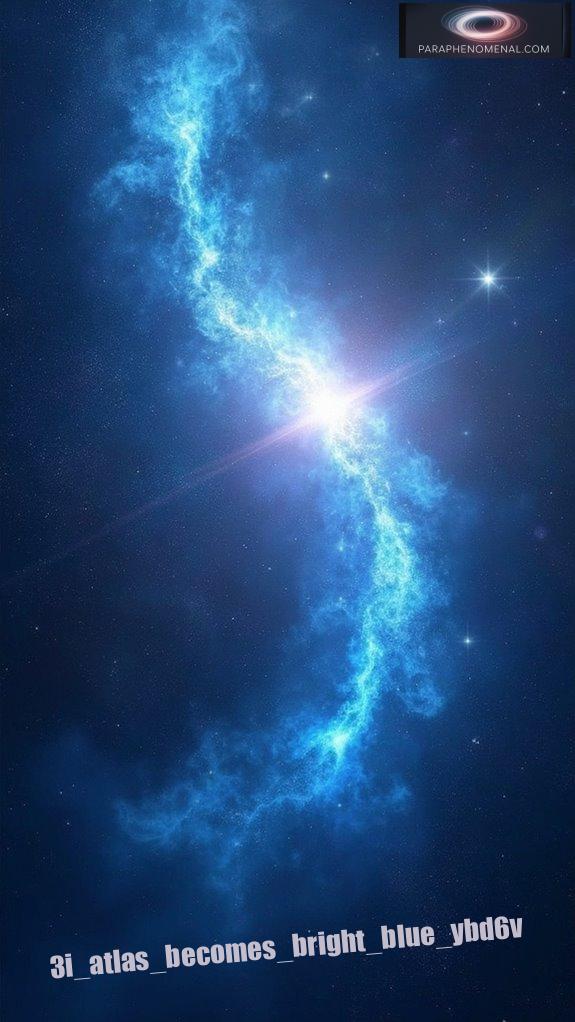
    3I/ATLAS Rapidly Brightens and Gets Blue

    Have you ever witnessed a cosmic spectacle that just leaves you in awe?

    As I follow 3I/ATLAS, its brilliant glow captivates me.

    Approaching perihelion, its V magnitude nearly hits 9.

    I can’t help but marvel at the transformation — its coma shifting from reddish to deep blue.

    This fascinating color change, fueled by the rapid sublimation of gas, especially water ice, reveals how solar radiation shapes its emissions.

    Isn’t it incredible to think about such celestial phenomena and their behaviors?

    There’s so much more to uncover about its unique journey!

    Quick Takeaways

    • 3I/ATLAS exhibited rapid brightening as it approached perihelion, with geocentric V magnitude nearing 9 due to intense solar radiation.
    • The comet’s coma color changed from reddish to blue hues, indicating an increase in gas emissions related to its proximity to the Sun.
    • Brightness enhancement exceeded that of typical Oort cloud comets, attributed to the fast sublimation of water ice driven by solar heating.
    • Observations from the Hubble Telescope and other advanced instruments highlighted the dynamic evolution of the comet’s coma composition.
    • The increased emissions also featured ionized molecules, showcasing complex interactions between solar radiation and the comet’s volatile components.

    Brightening Behavior Ahead of Perihelion

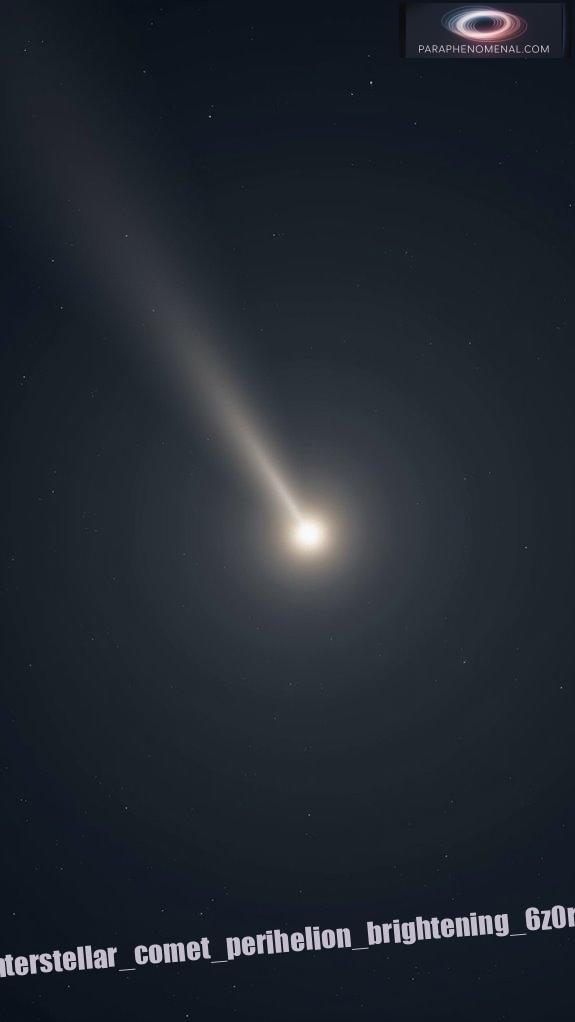
    interstellar comet perihelion brightening

    3I/ATLAS, an interstellar comet, recently exhibited remarkable brightening behavior as it approached perihelion, reaching an estimated geocentric V magnitude near 9.

    This striking brightening likely stems from specific brightening mechanisms linked to perihelion dynamics. As the comet neared the Sun, heat from solar radiation triggered the fast sublimation of gases, particularly water ice, which enhanced its brightness.

    Importantly, this rate of brightening surpassed that of typical Oort cloud comets at similar distances. The unique interplay of sunlight and the comet’s composition plays an essential role, allowing you to witness these changes as they unfold. Furthermore, the sublimation rates of gases in comets can vary significantly based on their distance from the Sun and the composition of their ices.

    Understanding these dynamics and mechanisms helps deepen appreciation for our universe, a core desire that drives the creation of platforms like ParaPhenomenal.

    Color Changes and Coma Evolution

    As the comet approached perihelion, noticeable changes in its coma color became evident, reflecting the complex interactions between sunlight and the comet’s materials.

    You’d observed the coma shifting from reddish hues of early observations to a distinctly bluer shade near perihelion. This transformation hints at developing coma composition, driven by increased gas emissions.

    The gas emissions, influenced by solar radiation, led to variations in the color spectrum, revealing an interconnected relationship between brightness and color changes. Recent observations with the Hubble Telescope have provided invaluable insights into these phenomena.

    Through our ongoing interest, we created this platform, ParaPhenomenal, to share perspectives about such phenomena.

    Understanding these changes in 3I/ATLAS not only captivates but reveals the dynamic lifecycle of a traveling interstellar visitor.

    Keep watching; the journey of this comet unfolds remarkable discoveries.

    Orbital and Physical Characteristics

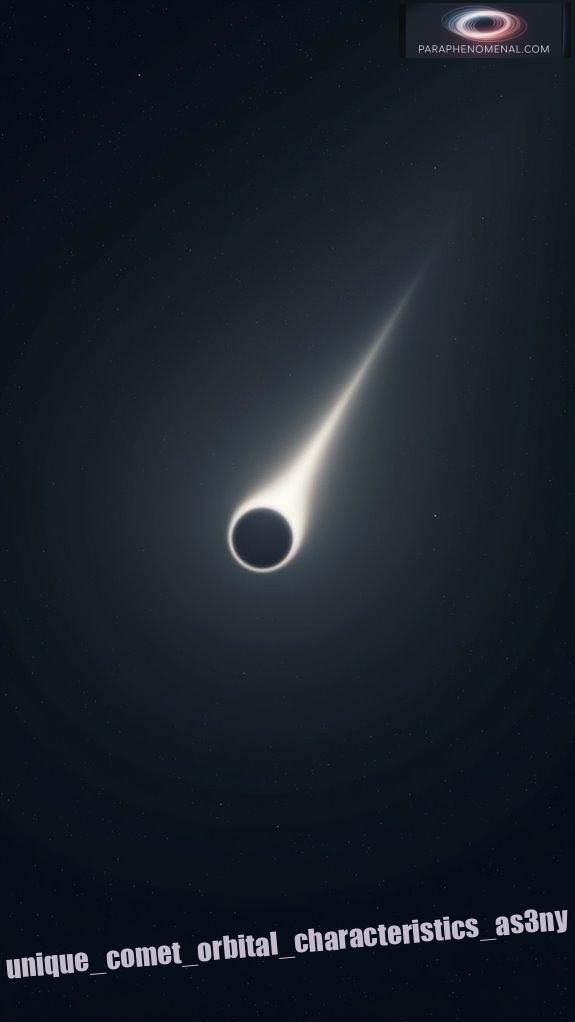
    unique comet orbital characteristics

    While tracking the comet’s journey, you can observe its unique orbital and physical characteristics that set it apart from typical solar system comets.

    1. Perihelion: This event occurred on October 29, 2025, at 1.36 AU from the Sun, a space between Earth’s and Mars’s orbits.
    2. Velocity: The comet moves at a staggering speed of over 130,000 mph (210,000 km/h), reflecting its interstellar origin.
    3. Trajectory Analysis: Its trajectory is remarkably straight and flat, differing from the more curved paths of typical solar system comets.
    4. Nucleus Composition: The specifics of its nucleus, including shape and material, remain uncertain due to limited observations. Recent studies suggest that its trajectory may have been influenced by gravitational interactions with Mars and Jupiter, leading to its unusual path.

    Understanding these characteristics deepens our knowledge of cometary science, which is why ParaPhenomenal was created—to explore the wonders of our universe.

    Observation Techniques and Instruments

    The observation of 3I/ATLAS relied on advanced techniques and instruments that provided critical understandings into its behavior as it approached the Sun.

    Multiple platforms collaborated to guarantee data accuracy, utilizing space-based solar observatories like GOES-19 and SOHO, alongside ground-based telescopes such as the Nordic Optical and Teide twin telescopes.

    These imaging techniques offered crucial perspectives into brightness metrics and color changes.

    Observers faced detection challenges during solar conjunction, but consistent collaboration filled data gaps.

    Spectral analysis revealed gas emissions, contributing to our understanding of the comet’s activity. Notably, these discoveries are part of NASA’s ongoing mission to study comets and their properties, which helps enhance our knowledge of celestial bodies and their effects on the solar system.

    Such tools are indispensable for studying unique objects like 3I/ATLAS, highlighting why platforms like ParaPhenomenal exist—to advance knowledge on fascinating astronomical events that capture our imagination.

    Cometary Activity and Sublimation Processes

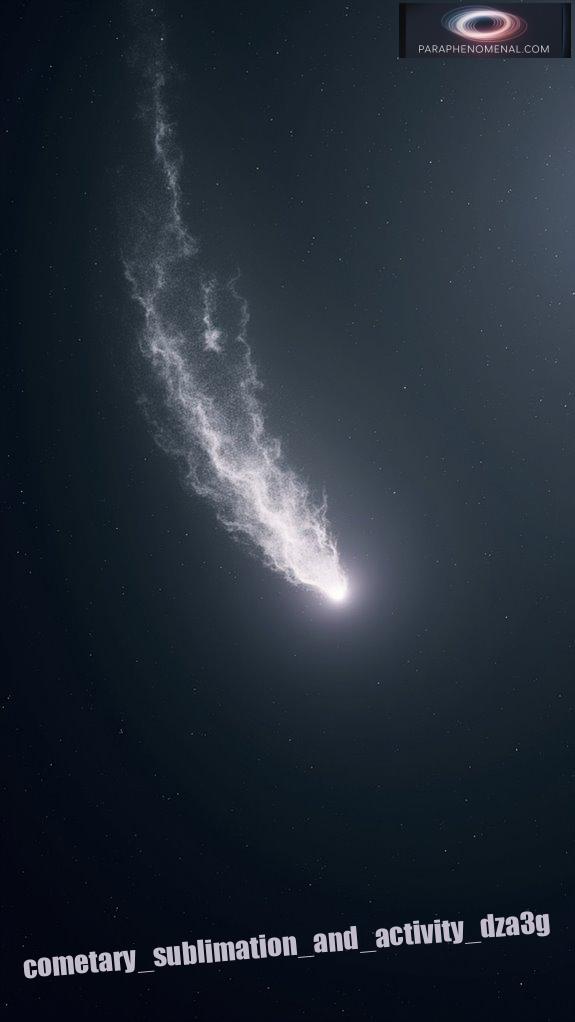
    cometary sublimation and activity

    Understanding cometary activity and sublimation processes reveals how these celestial bodies transform as they journey through the solar system.

    1. Early sublimation occurs mainly through CO₂, cooling the surface and delaying water ice sublimation.
    2. Near perihelion, solar heating triggers rapid sublimation of H₂O, resulting in increased gas emissions.
    3. Gas emissions often include ionized molecules influenced by solar radiation, enhancing brightness and leading to a blue color shift.
    4. Changes in coma composition show the dynamic interaction of volatiles, driving variations in activity patterns.

    Additionally, the unusual interstellar velocity of 3I/ATLAS plays a crucial role in its sublimation dynamics, affecting its brightness and evolution.

    FAQ

    What Does the “I” in 3i/Atlas Stand For?

    The “i” in 3I/ATLAS stands for “interstellar,” highlighting its interstellar implications. This comet showcases fascinating cometary composition, giving you a unique opportunity to explore materials and dynamics from beyond our solar system. Isn’t that thrilling?

    How Does 3i/Atlas Compare to Previous Interstellar Comets?

    3I/ATLAS stands out among interstellar comets due to its unique trajectory, composition, and rapid brightening behavior. You’ll find its characteristics differ considerably, offering new perspectives compared to previous interstellar visitors like 2I/Borisov and ʻOumuamua.

    Are There Any Potential Hazards From 3i/Atlas Passing by Earth?

    “Better safe than sorry.” While 3I/ATLAS poses minimal risks during its pass, remaining vigilant is smart. Potential impacts mostly concern celestial threats, but current trajectories suggest Earth will experience no significant hazards from this comet.

    What Is the Significance of Its High Velocity?

    The significance of its high velocity lies in unique velocity measurements, highlighting its interstellar origin. This provides cosmic implications, showcasing processes from beyond our solar system, and offering perspectives into the universe’s vast and dynamic nature.

    How Was 3i/Atlas Initially Discovered?

    You’d find that 3I/ATLAS was discovered using advanced observation techniques, including the Zwicky Transient Facility. These discovery methods allowed astronomers to detect its unusual trajectory, marking it as a unique interstellar visitor, sparking curiosity and excitement.

    References

  • Is 3I/ATLAS a Comet?

    Is 3I/ATLAS a Comet?

    Is 3I/ATLAS the next big scoop in our search for UFOs?

    I’m captivated by the idea that this celestial body, discovered in 2025, could be from another star system.

    With its hyperbolic trajectory and nucleus brimming with volatile ices, it certainly exhibits classic cometary traits.

    Who’s to say it doesn’t have more secrets hiding within its coma?

    Imagine the possibilities if this object held clues to alien life or advanced technology.

    Could 3I/ATLAS redefine our understanding of cosmic visitors?

    Let’s explore it together!

    A Close Encounter with the Unknown

    I once spent a night stargazing in a remote area, seeking clarity about unexplained phenomena. Suddenly, I saw a bright object streaking across the sky.

    It resembled a comet, but as it glowed, it changed directions mid-flight. Could it have been 3I/ATLAS?

    With thoughts racing, I wondered how many of these objects could be more than just space debris. As I delved deeper into UFO studies, I pondered the connection between comets, asteroids, and extraterrestrial technology.

    This experience ignited my passion for uncovering cosmic mysteries, urging me to share findings that may bridge the gap between our understanding of the universe and the allure of the unknown.

    Quick Takeaways

    • 3I/ATLAS features gas emissions and a dust coma, suggesting typical cometary activity indicative of a comet classification.
    • Its nucleus composition includes volatile ices, aligning with characteristics commonly found in comets.
    • The object has an orbital eccentricity of approximately 6.08 to 6.14, confirming its hyperbolic trajectory associated with interstellar comets.
    • Ongoing spectroscopic analyses and imaging from observatories support its classification as a comet, providing data on its behavior and morphology.
    • The complex taxonomy and lack of universal classification criteria by the IAU contribute to ongoing debates about categorizing 3I/ATLAS as a comet.

    Discovery and Initial Classification

    3i atlas discovery and classification

    When 3I/ATLAS was discovered on July 1, 2025, it stirred curiosity among astronomers and the public alike. Found at the ATLAS survey telescope in Chile, the discovery significance quickly became clear. With an apparent magnitude of 18, it beckoned people to explore the great mysteries of the universe.

    However, classification challenges emerged. Initially, 3I/ATLAS’s nature was uncertain—was it a Near-Earth Object or interstellar? As follow-up observations from various telescopes confirmed its hyperbolic trajectory, excitement built.

    Classification challenges arose initially for 3I/ATLAS, leaving its true nature—near-Earth or interstellar—shrouded in mystery.

    This comet’s classification brought attention to its extraordinary origins and potential revelations into the cosmos. Our website, ParaPhenomenal, exists to share these wonders, helping you grasp the complexity of celestial exploration.

    Ultimately, 3I/ATLAS invites you to pursue freedom in understanding the universe’s secrets.

    Orbital Characteristics and Interstellar Origin

    As the excitement surrounding 3I/ATLAS continues to grow, its orbital characteristics reveal much about its interstellar origin. The comet defies expectations with an orbital eccentricity of approximately 6.08 to 6.14, indicating a hyperbolic trajectory that suggests it’s not bound to the Solar System. Its perihelion distance, around 1.36 AU, places it just inside Mars’ orbit, while its interstellar velocity reaches 57-60 km/s, showing it was likely ejected from another star. Notably, the current distance from Earth is 367,639,427 km, highlighting its position in relation to our planet. Given its distinct trajectory, 3I/ATLAS can be categorized as a hyperbolic trajectory, similar to other interstellar visitors.

    Understanding its path helps us grasp its place among other interstellar visitors:

    Aspect 3I/ATLAS 1I/‘Oumuamua 2I/Borisov
    Object Type Comet Asteroid-like Comet

    Physical Attributes and Confirmed Features

    Understanding the physical attributes and confirmed features of 3I/ATLAS reveals why scientists classify it as a comet.

    The estimated nucleus size ranges between 1,000 feet and 3.5 miles, comprised of volatile ices typical of comets. This solid icy nucleus hasn’t been directly imaged, but its presence is indicated through observed gas emissions and cometary activity, including a coma—an essential cometary trait. The unique composition of the nucleus aligns with the volatile ices that are characteristic of other known comets.

    Photometric data supports its classification, showing color indices consistent with comet surfaces, while active dust ejection further confirms its nature. Recent observations from the Hubble Space Telescope have provided a clearer picture of this activity, enhancing our understanding of its characteristics.

    Dust particles varying in size and velocities between 0.01 and 1 m/s reflect typical comet behavior. These attributes highlight the significance of analyzing such celestial bodies, fascinating enthusiasts who explore these wonders through ParaPhenomenal’s perspectives.

    Controversial Perspectives on Comet Classification

    controversial comet classification debates

    The classification of comets like 3I/ATLAS sparks a range of opinions and debates among scientists.

    Comet taxonomy isn’t straightforward, largely due to varying orbital classification methods. Traditionally, short-period comets orbit the sun in less than 200 years, while long-period comets take longer. However, some researchers argue this approach oversimplifies things.

    The classification of comets is complex, with short and long periods sparking ongoing debate among researchers.

    The Tisserand parameter helps distinguish between comet-like and asteroid-like objects, yet even this creates disagreements.

    Furthermore, objects that lack observable activity—like dormant comets or asteroid-like bodies in cometary orbits—further complicate classification. With no universal criteria from the IAU, researchers find themselves often at odds.

    As we explore these controversies through ParaPhenomenal, understanding comet classification grows even more intriguing.

    Ongoing Research and Observational Campaigns

    While many astronomers enthusiastically pursue the study of comets like 3I/ATLAS, ongoing research and observational campaigns provide essential observations into its characteristics and behavior.

    You can expect perspectives from these key areas:

    • Spectroscopic analysis from multiple observatories to track gas emissions and volatile chemistry.
    • Imaging techniques utilized to observe dust coma and changes in morphology over time.
    • Coordinated monitoring by global telescopes covering visibility periods around perihelion.
    • Early observations from the Very Large Telescope and Hubble revealing its structure.
    • Archival data enabling thorough studies across various wavelengths.

    These efforts not only enhance our understanding of 3I/ATLAS but also contribute to the broader knowledge of interstellar comets, a focus of our ParaPhenomenal initiative. Additionally, the research showcases the importance of space telescopes which are crucial for detailed observations of such distant objects in our solar system.

    Implications of 3I/ATLAS’s Composition

    3I/ATLAS’s composition raises intriguing questions about the nature and formation of interstellar bodies. Its unusual chemical anomalies set it apart from typical solar system comets, hinting at differing evolutionary paths.

    You’ll notice 3I/ATLAS’s low-velocity dust ejection and the absence of expected emission lines at a considerable distance from the Sun, which challenge conventional models of comet behavior. These characteristics may indicate a unique gas and dust release mechanism never seen before. Additionally, its extraordinary interstellar speed suggests that 3I/ATLAS may not be subject to the same gravitational influences that affect comets within our solar system.

    The implications for interstellar chemistry are profound. Studying its preserved volatiles could reshape our understanding of planetary formation beyond our Solar System.

    This journey into 3I/ATLAS’s composition allows us at ParaPhenomenal to connect interstellar exploration with the core elements that shaped our universe, inspiring curiosity about what’s out there.

    Public and Scientific Discourse on 3I/ATLAS

    curiosity meets scientific skepticism

    Public curiosity fuels interest in 3I/ATLAS, while scientific skepticism provides a necessary balance, ensuring that claims about its nature are rigorously examined. This tension between lay fascination and expert analysis drives the conversation about the comet.

    • Media coverage highlights its interstellar status, sparking debate.
    • Observations from multiple global observatories enhance understanding.
    • Public access to sky charts encourages amateur astronomers to engage actively.
    • Avi Loeb’s comments stir speculation, reinforcing the need for critical thinking.
    • Ongoing studies continue to unravel the mystery of its composition.
    • The public perception of celestial phenomena, such as UFO sightings, can significantly impact interest and research funding in cases like 3I/ATLAS.

    FAQ

    How Can I Observe 3i/Atlas Myself?

    To observe 3I/ATLAS, start by checking the constellation Virgo, where it’s currently located.

    You may see it with the naked eye if it brightens enough near its perihelion date on October 29, 2025.

    Use basic observation techniques like star maps or astronomy apps to pinpoint its position.

    Binoculars or a small telescope can enhance your view.

    Engaging with astronomy clubs and resources from websites can deepen your experience.

    What Tools Are Needed for Amateur Observations?

    To observe 3I/ATLAS, you’ll need specific tools. Why not use a telescope that suits your needs?

    Larger amateur telescopes can enhance visibility, while astronomical software helps you track its movement. CCD cameras are excellent for detailed images, and star charts guide your search.

    Don’t underestimate the value of dark skies and joining local astronomical clubs for resources. They make your observation experience more accessible and enjoyable, which is why we created this website, ParaPhenomenal.

    Will 3i/Atlas Pose Any Danger to Earth?

    No, 3I/ATLAS won’t pose any danger to Earth.

    Its trajectory analysis shows it’s on a hyperbolic path, meaning it will leave the Solar System without making contact.

    Astronomical organizations are actively monitoring it for any changes in its trajectory, ensuring that 3I/ATLAS impact risk remains minimal.

    Exploring such interstellar objects reminds us of our vast universe, which is part of why we created ParaPhenomenal—to share intriguing discoveries.

    What Do Scientists Hope to Learn From 3i/Atlas?

    Scientists hope to learn about 3I/ATLAS’s comet composition and its orbital trajectory.

    By analyzing its icy nucleus, gas, and dust, they can uncover materials from interstellar space and understand differences compared to Solar System comets.

    Observing the comet’s unique features and trajectory helps refine theories about planet formation.

    This knowledge can prepare you for future interstellar objects and enhance your understanding of our universe.

    Are There Any Planned Missions to Study 3i/Atlas?

    Right now, there aren’t any planned missions to study 3I/ATLAS.

    Scientists remain interested in its unique characteristics, which could reveal much about interstellar origins.

    Without mission objectives or dedicated scientific instruments targeted at it, researchers rely heavily on ongoing observations to gather data.

    This lack of exploration isn’t from a lack of curiosity; it’s to emphasize the need for additional understanding before any future missions can be determined.

    References