Have you ever gazed up at the night sky and pondered what truly makes some celestial bodies shine?
It’s fascinating!
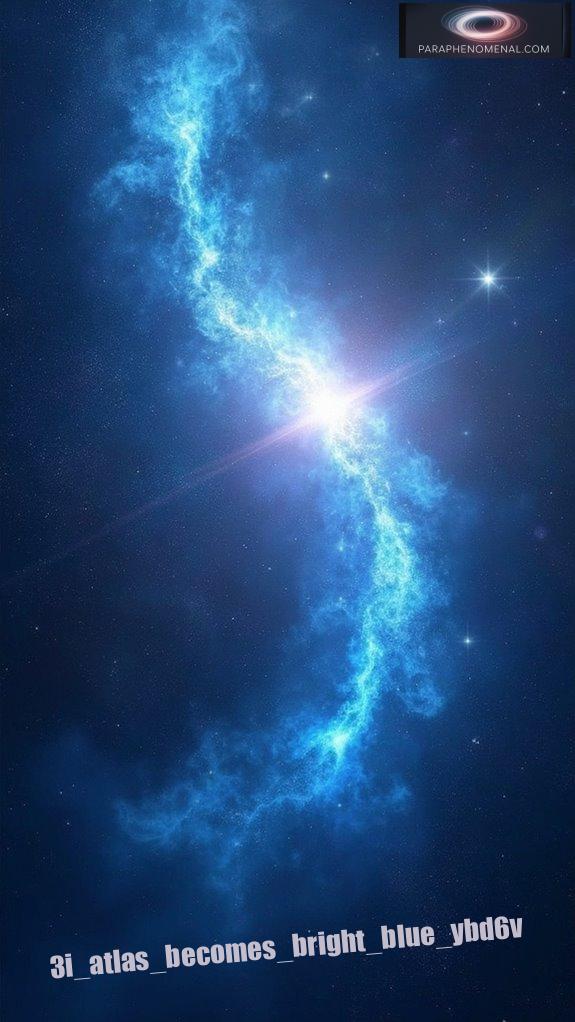
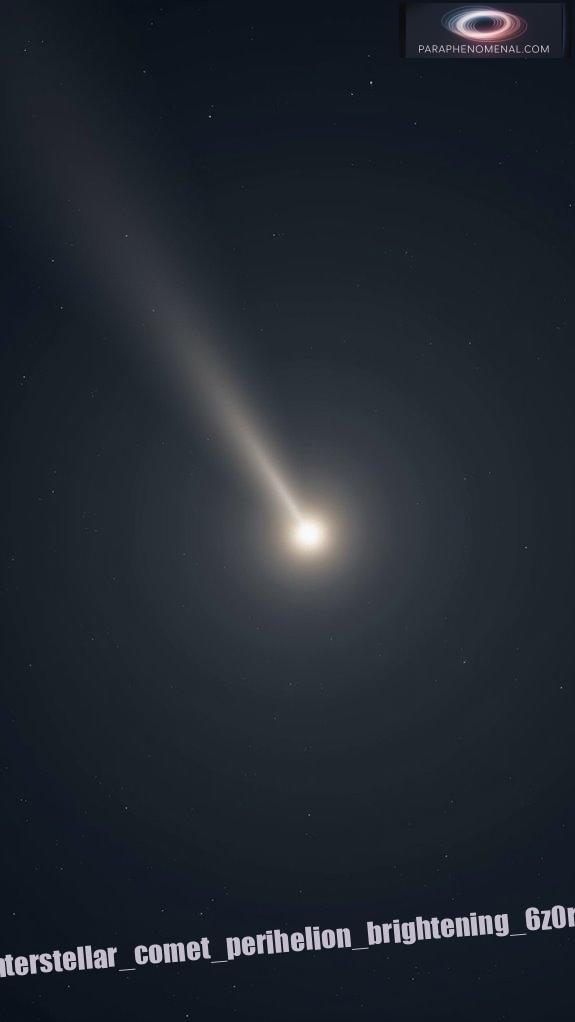
Comet 3I/ATLAS catches my attention because it emits light as it approaches the Sun. The icy materials within it sublimate, releasing gases and dust.
This astonishing process creates a glowing coma and a mesmerizing tail.
To top it off, unique chemicals like cyanide are unveiled, intensifying its brightness.
Isn’t it extraordinary how solar radiation fuels these reactions and enhances luminosity?
There’s so much more to discover about this cosmic marvel!
A Close Encounter: UFO and Celestial Wonders
I remember stargazing one evening, fascinated by a sudden bright object streaking across the sky. As it dispelled into a beautiful tail of light, I initially thought it was a UFO.
Curiosity drove me to investigate, leading me down a rabbit hole of astronomy, UFO sightings, and meteoric phenomena. I later learned it was likely a bright meteor, but the experience ignited my passion for exploring the universe’s mysteries.
Engaging with fellow enthusiasts about meteors, comets, and potential extraterrestrial encounters has since enriched my understanding. What have you seen in the skies that left you in awe?
Quick Takeaways
- Comet 3I/ATLAS emits light primarily due to the sublimation of icy volatiles as it approaches the Sun, creating gas and dust emissions.
- Solar radiation heats the comet, initiating photochemical reactions that break down molecular ices, resulting in additional light emissions.
- The intense light is influenced by the accelerated sublimation process, leading to a bright coma formed from escaping gases and dust.
- Unique chemical signatures, including cyanide and complex organic materials, contribute to the comet’s distinct spectral emissions observed in its light.
- Continuous outgassing, primarily of water vapor and carbon dioxide, results in increased brightness and unique light emission properties of 3I/ATLAS.
Observational Evidence of Light Emission

Observational evidence reveals intriguing details about the light emission from comet 3I/ATLAS, showcasing features typically associated with these celestial wanderers.
The comet displays a distinct coma and tail formed through sublimation of icy volatiles, like water and carbon dioxide, which release vapor and dust, creating a luminous display. Observations reveal a clear coma and tail for 3I/ATLAS, emphasizing its classification as a comet rather than an asteroid. This process is influenced by the water and gas loss rates, determining the intensity of the emissions.
Spectroscopic data confirms substantial gaseous emissions, particularly cyanide, contributing to the overall light output. These findings illustrate how cometary dynamics affect emission mechanisms, giving us valuable observations into 3I/ATLAS’s behavior.
Direct imaging reveals a bright dust tail, exemplifying ongoing ejection of material.
With each observation, we deepen our understanding, inspiring a sense of connection to the universe and exemplifying why we created this website, ParaPhenomenal.
The Role of Solar Radiation
As 3I/ATLAS travels through space, its light emission reflects the dynamic interplay between solar radiation and cometary materials.
The journey of 3I/ATLAS illuminates the captivating interaction between solar energy and cometary substances in the cosmos.
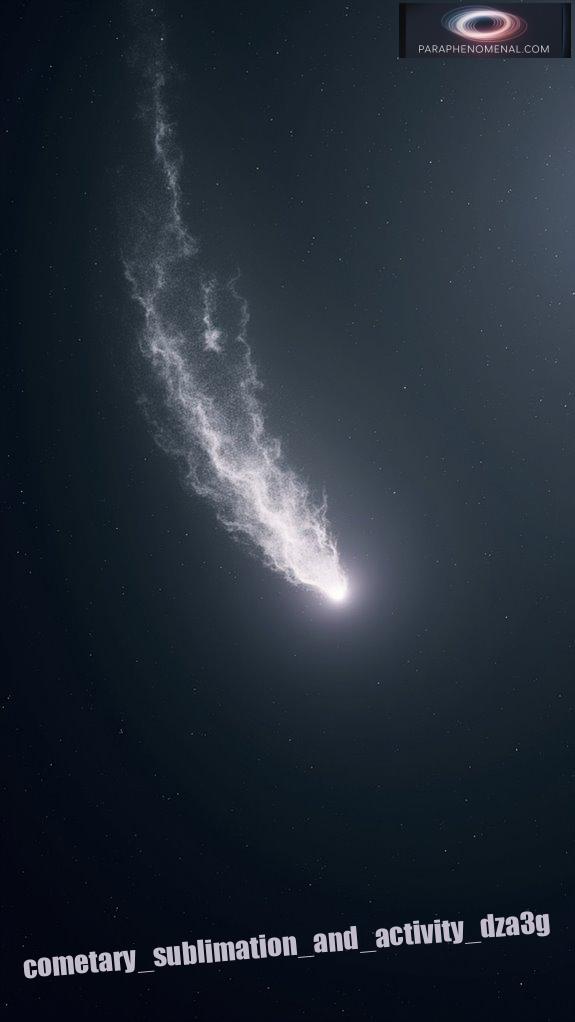
Solar heating plays a vital role here, igniting a process known as sublimation. This causes ices on 3I/ATLAS to transform directly into gas, releasing dust and gas and creating its distinctive coma and tail. The discovery of 3I/ATLAS has allowed scientists to observe this process in real-time, enhancing our understanding of how interstellar objects behave in our Solar System. The rates of sublimation are influenced by the gas sublimation rates of the comet’s ices, determining how much material is released into the coma.
The sunlight’s intensity also drives photochemical reactions, breaking down molecular ices and producing fluorescing fragments.
Some of these gases, like hydroxyl radicals, contribute to the light you see, distinct from just reflected sunlight.
As you explore phenomena like 3I/ATLAS, keep in mind that these cosmic dances reveal the power of solar radiation, illustrating how they can shape the universe, a central theme of our ParaPhenomenal journey.
Characteristics of 3I/ATLAS’s Spectrum
The range of 3I/ATLAS reveals a fascinating portrait of its chemical composition and interactions with the surrounding solar environment. This unique spectrum showcases significant spectral features, hinting at intriguing organic compounds.
Here are three key characteristics of 3I/ATLAS’s spectrum:
- Presence of Nickel: The detection of atomic nickel (Ni I) marks a distinct chemical signature. Additionally, the high carbon dioxide ratio in its coma indicates active outgassing processes.
- Cyanogen Detection: Cyanogen (CN) indicates ongoing chemical reactions with solar radiation.
- Reddish Dust and Organics: The spectrum is dominated by reddish dust, suggesting complex organic materials not typically found in local comets. The discovery of water vapor in its spectrum further underscores the comet’s unique chemical makeup.
Understanding these spectral features of 3I/ATLAS not only broadens our knowledge of interstellar objects but also inspires curiosity about potential life beyond Earth, reminding us why we created this website, ParaPhenomenal.
The Influence of Sublimation on Emission

Sublimation dynamics play an essential role in this comet’s volatile behavior. When solid ices directly transform into gas, they release various gases and dust, creating a visible coma.
This process occurs even at great distances from the Sun, indicating the presence of highly volatile components that emit light at specific wavelengths. As the comet approaches during its closest approach to the Sun, the heat accelerates sublimation, increasing the intensity of light emitted.
As gases escape, they carry unique chemical signatures that provide perspectives into the object’s composition and origin—possibly from outside our Solar System.
This early activity hints at how sublimation impacts light emission, underscoring the necessity of studying interstellar objects.
Websites like ParaPhenomenal aim to explore such cosmic phenomena, fostering a deeper understanding of the universe.
Gaseous Contributions to Light Emission
Gases play an essential role in the emission of light from celestial objects, especially in the framework of comets like 3I/ATLAS.
Understanding how gas excitation works helps reveal the underlying emission mechanisms at play.
- Atomic and Molecular Shifts: Light is emitted when gas atoms or molecules drop from higher to lower energy states.
- Energy Sources: Ultraviolet radiation from nearby stars can excite these gases, initiating the emission of light.
- Emission Lines: Each element produces unique emission lines, enabling astronomers to identify chemical compositions in gases, vital for our knowledge of cosmic phenomena.
Furthermore, the comet’s unusual interstellar velocity can also influence the characteristics of the emitted light due to changes in gas interactions.
Unique Composition and Its Effects
Unique elements in the composition of comet 3I/ATLAS set it apart from other comets. It exhibits strong nickel emissions, a feature rare in these celestial wanderers. Unlike others, 3I/ATLAS lacks detectable iron, hinting at a unique elemental balance that captivates scientists.
Additionally, cyanide uniqueness adds another layer of intrigue to its chemical makeup. These nickel-carbonyl formation processes resemble those found in industrial activities on Earth, suggesting that the comet’s interactions might echo familiar scenarios yet to be fully understood in the cosmos.
As we explore these exceptional characteristics, we enhance our understanding of interstellar materials and the advanced dynamics of celestial visitors like 3I/ATLAS, crafting a deeper appreciation for the universe around us.
Comparisons With Other Solar System Comets

As scientists study the peculiar characteristics of comet 3I/ATLAS, comparisons to other solar system comets reveal intriguing differences in trajectory and composition.
- Origin: 3I/ATLAS comes from outside the solar system, marked by its hyperbolic orbit, unlike typical solar comets with elliptical paths.
- Dust Activity: While 3I/ATLAS shows active dust and gas emissions, its activity mirrors that of long-period solar system comets, despite occurring at greater distances.
- Volatile Release: Its release of water vapor and hydroxyl gas at unprecedented distances challenges our understanding of interstellar comparisons with known solar system comets.
These striking features of 3I/ATLAS highlight its uniqueness, prompting us at ParaPhenomenal to explore the cosmic behaviors that continue to captivate both scientists and enthusiasts alike.
FAQ
How Far Can 3i/Atlas Travel Before Becoming Inactive?
3I/ATLAS can travel around 5 to 10 AU from the Sun before becoming inactive.
As it distances itself, light emission starts to fade due to distance decay; solar heating ceases, halting any activity.
This fascinating interstellar wanderer, once brimming with energy from the Sun, will soon sail through the quiet void of space.
Our website, ParaPhenomenal, explores these cosmic voyages, shedding light on their mysteries before they vanish into the darkness.
What Instruments Are Used to Observe 3i/Atlas in Detail?
To observe 3I/ATLAS in detail, astronomers use various instruments.
Spectroscopic analysis from telescopes like Hubble and JWST measures atomic emissions and volatile compositions.
Imaging techniques from observatories, such as the VLT and Keck, capture coma growth and tail behavior, revealing dust properties.
These tools help you uncover the comet’s unique characteristics, supporting the scientific journey celebrated by ParaPhenomenal, as you explore the mysteries of the universe’s wonders together.
Is 3i/Atlas Visible to the Naked Eye?
3i/Atlas isn’t visible to the naked eye, no matter how clear the atmospheric conditions.
Even at its peak brightness, it’s far too faint, remaining a mysterious object for telescopes alone.
Envision trying to spot a firefly on a moonless night—that’s how elusive it is!
Your only chance to witness this celestial wanderer relies on powerful telescopes, as it dances silently behind the Sun and away from our view, reminding us of the universe’s vast secrets.
How Often Are Observations of 3i/Atlas Conducted?
Observations of 3I/ATLAS occur frequently, particularly during its vital periods close to the Sun.
From May to October 2025, various facilities conducted extensive data collection, such as imaging and spectroscopy. The Vera C. Rubin Observatory, for instance, provided continuous monitoring, aiding in capturing significant changes over time.
This coordinated approach allows scientists to track comet activity effectively, revealing fascinating understandings. Understanding these dynamics is a key part of our mission at ParaPhenomenal.
What Other Comets Are Similar to 3i/Atlas?
Other comets similar to 3I/ATLAS include 2I/Borisov, which also exhibits clear comet characteristics like comas and dust tails.
Both comets show signs of volatile ices sublimating as they approach the Sun, generating gas and dust in their wake.
Astronomical observations of these interstellar bodies reveal their hyperbolic trajectories and unusual speeds.
Through our site, ParaPhenomenal, we aim to share fascinating discoveries about these objects and their impact on our understanding of the universe.
References
- https://www.spectroscopyonline.com/view/interstellar-comet-3i-atlas-shows-its-spectral-secrets-through-palomar-and-apache-point-observations
- https://en.wikipedia.org/wiki/3I/ATLAS
- https://arxiv.org/html/2507.02757v1
- https://www.youtube.com/watch?v=TPLwBU9G_Xw
- https://news.northeastern.edu/2025/09/08/3i-atlas-comet-interstellar-traveler/
- https://science.nasa.gov/solar-system/comets/3i-atlas/
- https://www.skyatnightmagazine.com/news/3i-atlas-not-aliens
- https://science.nasa.gov/missions/hubble/as-nasa-missions-study-interstellar-comet-hubble-makes-size-estimate/
- https://arxiv.org/html/2509.01647v2
- https://www.youtube.com/watch?v=GQ-FktCDFuY
- https://www.seti.org/news/comet-3iatlas-a-visitor-from-beyond-the-solar-system/
- https://www.spectroscopyonline.com/view/interstellar-comet-3i-atlas-shows-mysterious-spectroscopic-activity
- https://www.britannica.com/topic/Comet-3I-ATLAS
- https://www.astronomy.com/science/comet-3i-atlas-shows-signs-of-water/
- https://futurism.com/space/interstellar-object-sun-coronal-mass-ejection
- https://www.iflscience.com/anti-tail-and-odd-594-kilometer-feature-found-on-interstellar-object-3iatlas-by-keck-observatory-81188
- https://arxiv.org/abs/2508.02777
- https://ffesp.org/nasa-confirms-3i-atlas-mysterious-interstellar-visitor-enters-solar-system/
- https://cata.cl/en/cata-astronomers-reveal-surprising-data-on-interstellar-object-3i-atlas/
- https://www.spectroscopyonline.com/view/3i-atlas-an-interstellar-enigma-natural-comet-or-engineered-probe-
- https://www.space.com/astronomy/scientists-capture-interstellar-invader-comet-3i-atlas-growing-a-tail-this-image-is-both-a-scientific-milestone-and-a-source-of-wonder-photo-video
- https://www.planetary.org/articles/studying-a-distant-visitor-what-we-know-about-interstellar-object-3i-atlas
- https://www.youtube.com/watch?v=-J6i061NlOc
- https://pages.astronomy.ua.edu/keel/galaxies/gas.html
- https://web.williams.edu/Astronomy/research/PN/nebulae/exercise3.php
- https://imagine.gsfc.nasa.gov/science/toolbox/spectra1.html
- https://en.wikipedia.org/wiki/Emission_spectrum
- https://www.cfa.harvard.edu/research/topic/spectroscopy
- https://arxiv.org/html/2409.04138v1
- https://darksky.org/news/light-is-energy-estimating-the-impact-of-light-pollution-on-climate-change/