
Have you ever wondered about the thrilling cosmic events that unfold in our universe?
Let’s talk about 3I/ATLAS.
I was fascinated to learn that during its closest approach on December 19, 2025, it’ll be a whopping 1.8 astronomical units away—around 270 million kilometers! That’s far beyond typical near-Earth objects.
Currently, the impact risk of this comet is considered zero, which is a relief. It follows a hyperbolic path, meaning it won’t be swinging back around to visit us again.
Understanding 3I/ATLAS feels crucial for our exploration of interstellar objects. Just imagine the stories it could tell if it could!
My Encounter with the Unexplained: Chasing UFOs
In my younger years, I was captivated by the idea of UFOs. One starry night, out camping with friends, I spotted a peculiar light darting across the sky. It was unlike anything I’d seen!
Could it have been a secret military craft or something from another world? We pulled out our phones to capture the moment, but it vanished in an instant.
This experience sparked my curiosity for interstellar research and UFO activity. My deep dive into the exploration of celestial objects—like 3I/ATLAS—has unveiled wonders, and I suspect we’re just scratching the surface of what’s out there. Could we be on the brink of encountering something extraordinary?
Quick Takeaways
- 3I/ATLAS follows a hyperbolic trajectory, indicating it will not return to the solar system after its current pass.
- The closest approach to Earth will be on December 19, 2025, at a distance of approximately 1.8 AU.
- This distance of 1.8 AU translates to about 270 million kilometers, ensuring no collision threat.
- Current assessments confirm the impact probability of 3I/ATLAS is effectively zero.
- Comprehensive tracking and monitoring show no future collision possibilities with Earth.
Nature of 3I/ATLAS
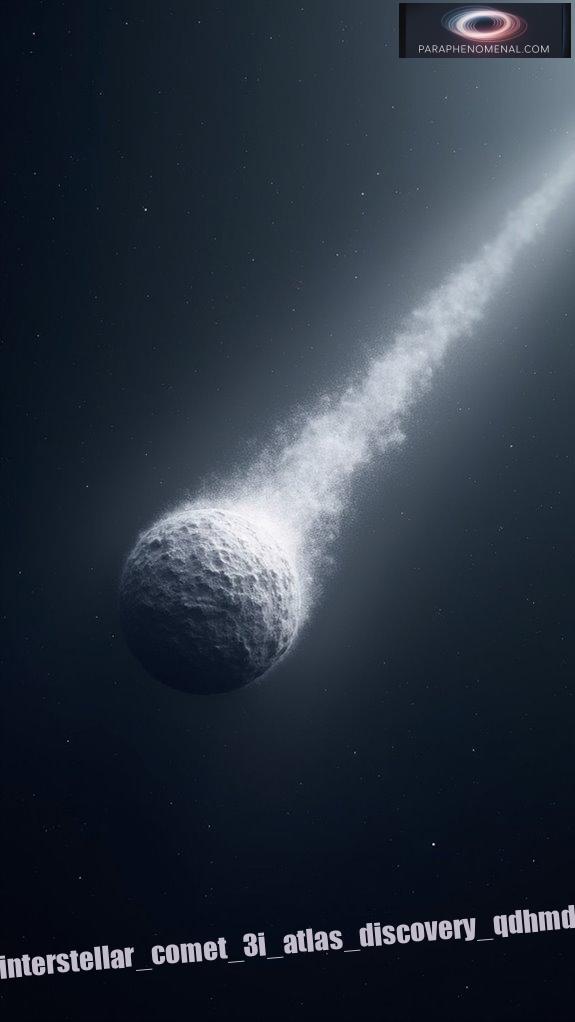
The interstellar comet 3I/ATLAS is a fascinating object that offers understanding into our universe. This comet, with its interstellar origin, moves at incredible speeds and carries a unique icy nucleus, distinguishing it from asteroids. Its nucleus can reach up to 3.5 miles in diameter. As it approaches the Sun, you’ll see it accelerate further. 3I/ATLAS isn’t just a random celestial body; it holds clues about the materials floating between stars. Notably, its expected closest point to the Sun is projected to occur around October 30, 2025, providing a prime opportunity for observation and study. Furthermore, its hyperbolic trajectory suggests that it has come from beyond our solar system, making it an extraordinary opportunity to study interstellar comets in greater detail.
Scientists, including those at ParaPhenomenal, aim to uncover its secrets to shed light on our cosmos. By studying this comet, you can grasp the magnificence of interstellar objects and their role in the grand tapestry of space.
Orbital Path of 3I/ATLAS
Orbiting through the solar system, 3I/ATLAS follows a unique hyperbolic path that sets it apart from other celestial bodies. This comet originates from beyond our solar system, and its orbital characteristics indicate it won’t return after this visit.
Traveling at an astonishing 130,000 miles per hour, it approaches Mars in early October 2025, passing 17 million miles away. Its closest encounter with the Sun occurs around October 30, 2025, when it reaches 1.4 astronomical units. Additionally, it will reach a maximum altitude of 28.7 degrees in the sky as observed from Earth on October 10, 2025. Observers will notice how interstellar objects can display trajectories that defy our expectations during this rare event.
Approaching Mars in October 2025, 3I/ATLAS travels at 130,000 miles per hour, nearing the Sun shortly after.
As 3I/ATLAS speeds past Jupiter in March 2026, its hyperbolic trajectory highlights the dynamics of interstellar objects interacting with our solar system.
For enthusiasts, such as those at ParaPhenomenal, observing this comet reveals the wonders of the cosmos.
Distance From Earth at Closest Approach
At closest approach on December 19, 2025, you’ll find that 3I/ATLAS will be approximately 1.8 astronomical units (AU) from Earth, which translates to about 270 million kilometers or 170 million miles.
This distance comparison highlights that 3I/ATLAS is well beyond the typical range of near-Earth objects. In fact, it’s about 1.5 times farther than the distance from Earth to the Sun, ensuring no threat of collision. Additionally, the comet’s hyperbolic trajectory ensures that it moves too fast to be bound by the Sun’s gravity, further indicating the absence of any impact risk. As it travels through space, the comet will continue on a future trajectory that carries it out of our solar system.
While some other planets experience closer encounters, like Mars at approximately 28 million kilometers, Earth enjoys a substantial separation from this comet.
With 3I/ATLAS’s swift transit through the inner Solar System, it ultimately reaffirms our mission at ParaPhenomenal to keep you informed about cosmic events like this.
Impact Risk Assessment
As scientists analyze the trajectory of 3I/ATLAS, they can confidently conclude that the comet poses no risk of impacting Earth.
With its closest approach more than 1.8 AU away, the impact probability is effectively zero.
The comet’s retrograde and inclined orbit keeps it safely distant from Earth, ensuring a clear path.
Risk evaluation shows current data confirms no future collision possibility, further validating our comprehension.
While potential impact effects are significant for similar-sized bodies, 3I/ATLAS isn’t a threat.
In fact, the unusual scientific implications of its hyperbolic interstellar trajectory highlight the fascinating dynamics of comets in our solar system.
Here at ParaPhenomenal, we aim to provide clear perspectives into celestial events, emphasizing the importance of understanding and monitoring such phenomena.
Tracking and Monitoring by Space Agencies
Tracking and monitoring by global space agencies is essential for understanding the behavior of comets like 3I/ATLAS. These agencies utilize advanced tracking systems and various observation techniques to keep an eye on the comet.
The ATLAS network, with telescopes in Hawaii, Chile, and South Africa, first detected 3I/ATLAS, and NASA’s Swift telescope further monitored its unusual activity in ultraviolet light. Ground-based optical telescopes and space-based platforms work together to refine trajectory predictions.
Spectroscopic techniques reveal unique gas emissions, while machine learning systems enable real-time tracking of any unexpected changes. By integrating data from multiple sources, we enhance our understanding of 3I/ATLAS and reduce potential risks, which is why we at ParaPhenomenal emphasize the importance of staying informed about these events. NASA is currently evaluating multiple trajectory options for comet missions to optimize observations and ensure safety.
Scientific Significance of 3I/ATLAS
The scientific significance of 3I/ATLAS extends beyond its status as an interstellar object; it serves as a window into the composition and dynamics of celestial bodies from other star systems.
The interstellar 3I/ATLAS offers insights into the materials and dynamics of celestial bodies from distant star systems.
By examining this comet, you’ll gain understandings into materials from distant environments, enhancing our understanding of astrophysical processes. It presents a unique opportunity for scientific collaboration among researchers globally, merging astronomical studies with public interest.
As the third known interstellar visitor, 3I/ATLAS allows you to compare its features with Solar System comets, potentially revealing organic compounds that could enlighten theories on prebiotic chemistry.
With its high velocity and distinct trajectory, this object offers a rare chance to advance knowledge in interstellar research, making it a topic that engages both scientists and enthusiasts alike.
FAQ
How Was 3i/Atlas Discovered?
3I/ATLAS was discovered on July 1, 2025, by the ATLAS survey telescope in Chile.
Using advanced discovery methods, it monitored the night sky, identifying objects at risk. Initially faint with a magnitude around 18, its observations suggested a hyperbolic trajectory, hinting at its interstellar origin.
This discovery holds astronomical significance, making 3I/ATLAS the third interstellar object found, sparking immense scientific interest in its unique features and behavior.
What Tools Were Used to Track 3i/Atlas?
To track 3I/ATLAS, astronomers utilized various tracking methods and observation techniques. Ground-based optical telescopes like ATLAS and SALT monitored its brightness and composition, while space telescopes, including the Hubble, provided detailed dust plume observations.
The JPL Horizons system helped predict its orbital path, aiding accurate trajectory calculations. These combined efforts guarantee a thorough understanding of the comet’s behavior, ultimately fostering our curiosity and interest in celestial phenomena at ParaPhenomenal.
What Is the Age of 3i/Atlas?
The age of 3I/ATLAS is estimated to be between 3 and 11 billion years, with some studies suggesting around 7.5 billion years.
This age offers intriguing perspectives into its orbital history and compositional analysis. If it originated during the galaxy’s formation, it could reveal key details about early chemical and physical conditions in the Milky Way.
Exploring this ancient traveler fuels our desire for knowledge, a core reason behind creating ParaPhenomenal.
Does 3i/Atlas Have Any Moons?
No, 3I/ATLAS doesn’t have any moons. High-resolution observations show no signs of moon formation or secondary objects affecting its trajectory.
The absence of detected moons simplifies celestial dynamics, focusing attention on its nucleus and dust production instead. Previous interstellar objects also lacked moons, suggesting that ejected comets typically lose close companions.
Our curiosity drives us to explore these cosmic anomalies, and we aim to share these discoveries on ParaPhenomenal.
Can We See 3i/Atlas From Earth?
Yes, you can see 3I/ATLAS from Earth under the right visibility conditions.
With its predicted brightness during closest approach, you might catch a glimpse without special equipment. However, using advanced observation techniques like telescopes will enhance your viewing experience.
The comet’s unique speed and composition make it a fascinating subject for study.
We created this website, ParaPhenomenal, to share such intriguing cosmic events with you, enriching your understanding of the universe.
References
- https://atlas.fallingstar.com
- https://www.seti.org/news/comet-3iatlas-a-visitor-from-beyond-the-solar-system/
- https://www.skyatnightmagazine.com/news/will-3-i-atlas-hit-earth-or-mars
- https://www.esa.int/Science_Exploration/Space_Science/Comet_3I_ATLAS_frequently_asked_questions
- https://science.nasa.gov/missions/hubble/as-nasa-missions-study-interstellar-comet-hubble-makes-size-estimate/
- https://science.nasa.gov/solar-system/comets/3i-atlas/
- https://arxiv.org/abs/2507.05252
- https://astrobiology.com/2025/07/interstellar-comet-3i-atlas-discovery-and-physical-description.html
- https://news.northeastern.edu/2025/09/08/3i-atlas-comet-interstellar-traveler/
- https://ui.adsabs.harvard.edu/abs/2025MNRAS.542L.139B/abstract
- https://www.youtube.com/watch?v=ZtQHgCEVZ4o
- https://theskylive.com/c2025n1-info
- https://ffesp.org/nasa-confirms-3i-atlas-mysterious-interstellar-visitor-enters-solar-system/
- https://en.wikipedia.org/wiki/3I/ATLAS
- https://science.nasa.gov/blogs/planetary-defense/2025/07/02/nasa-discovers-interstellar-comet-moving-through-solar-system/
- https://www.youtube.com/watch?v=yoMVYeX0zFI
- https://arxiv.org/html/2508.18382v1
- https://thedebrief.org/3i-atlas-is-displaying-surprising-new-activity-that-scientists-liken-to-a-note-from-another-planetary-system/
- https://www.spectroscopyonline.com/view/3i-atlas-an-interstellar-enigma-natural-comet-or-engineered-probe-
- https://watchers.news/2025/10/16/unusual-nickel-and-cyanide-emissions-detected-around-interstellar-object-3i-atlas/
- https://www.youtube.com/watch?v=1VSqkWv3PJ0
- https://www.iflscience.com/anti-tail-and-odd-594-kilometer-feature-found-on-interstellar-object-3iatlas-by-keck-observatory-81188
- https://www.planetary.org/articles/what-is-comet-3i-atlas
- https://www.caltech.edu/about/news/zwicky-transient-facility-nabs-an-interstellar-visitor
- https://www.skyatnightmagazine.com/news/3i-atlas-not-aliens
- https://arxiv.org/html/2508.00808v1
- https://science.nasa.gov/asset/hubble/comet-3i-atlas/
- https://thedebrief.org/3i-atlas-update-what-new-data-reveals-about-the-most-puzzling-interstellar-object-ever-found/
- https://www.livescience.com/space/comets/interstellar-comet-3i-atlas-may-come-from-the-mysterious-frontier-of-the-early-milky-way-new-study-hints
- https://www.youtube.com/watch?v=XEggZo3SXNM