Are we alone in the universe?
As I dive into the world of UFO investigations, I can’t help but feel a thrill.
Analyzing UFO activity opens doors to fascinating discoveries.
Through cutting-edge tools and technology, like satellite imaging, we can track and study unexplained phenomena. How do these objects defy our understanding of physics?
With each sighting, questions arise. Are they advanced technology or something beyond our comprehension?
Every investigation expands our knowledge. It’s a maze of wonder and curiosity that fuels my passion.
So, are you ready to join me on this quest?
The Night That Changed Everything: A Personal Encounter with UFOs
Years ago, I experienced something I can never forget.
On a clear summer night, my friends and I were stargazing when a bright, iridescent light zipped across the sky.
We watched in amazement as it darted and maneuvered with impossible speed.
It was a classic case of a UFO sighting. Our hearts raced, and we immediately began discussing the possibilities.
Was it a military craft, a natural phenomenon, or… something extraterrestrial?
That night ignited my passion for investigating otherworldly experiences and seeking answers.
Now, I explore everything from unusual lights to mysterious crop circles, fully immersed in the enigma of the unknown.
Quick Takeaways
- Utilize high-resolution imaging from telescopes like Hubble to estimate comet nucleus size and observe coma activity effectively.
- Employ near-infrared spectroscopy with the James Webb Space Telescope to analyze the chemical composition of the comet’s coma and nucleus.
- Detect water vapor and hydroxyl signatures through ultraviolet imaging with the Neil Gehrels Swift Observatory to assess the comet’s water content.
- Combine data from multiple telescopes to enhance understanding of the comet’s characteristics and activity, addressing observational challenges.
- Prepare for future missions, such as ESA’s Comet Interceptor, to study pristine interstellar comets under optimal observational conditions.
Multi-Spacecraft Observations of 3I/ATLAS
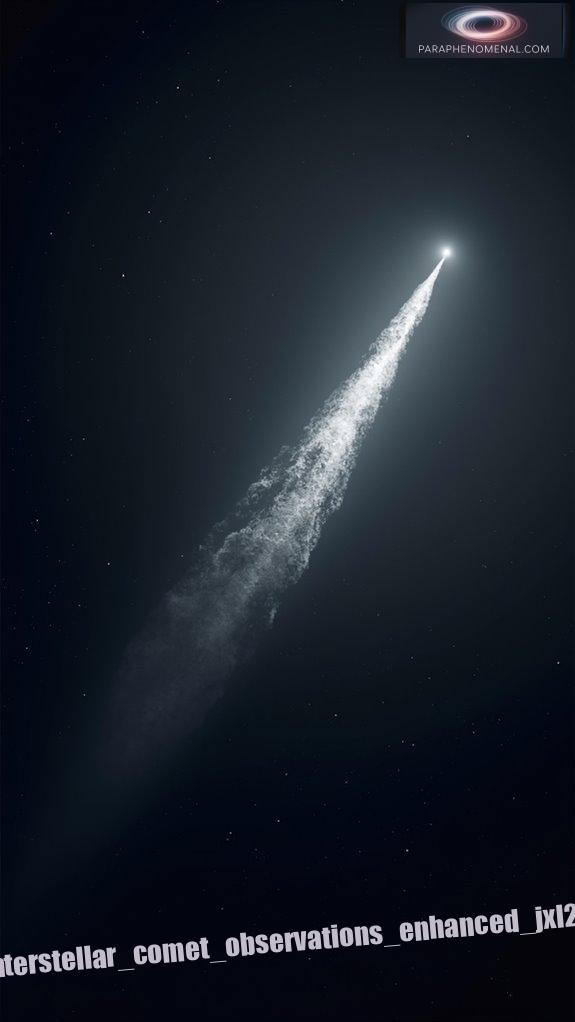
As you explore the fascinating observations of comet 3I/ATLAS, you’ll see that multi-spacecraft efforts have greatly enhanced our understanding of its properties. This comet follows a hyperbolic trajectory, originating from outside our Solar System, with a high velocity of 58 km/s. Observational techniques from spacecraft like Hubble and Webb reveal a notable increase in coma activity as 3I/ATLAS approaches the Sun. High negative polarization indicates a mix of icy and dark materials in its coma, showcasing distinct cometary behavior. The imaging capabilities of Hubble and Webb have provided us with unprecedented insights into its characteristics. The high eccentricity of its trajectory, measured at 6.141±0.002, indicates that it is one of the fastest interstellar objects ever observed. During key dates, like the October 2025 flyby near Mars, unique opportunities arise for observing its evolution. These revelations drive our curiosity and fuel explorations, inspiring our mission at ParaPhenomenal to unravel interstellar mysteries.
Key Instruments and Their Contributions
Studying the properties of interstellar comets, like 3I/ATLAS, relies heavily on key instruments designed for astronomical observations. Each instrument contributes unique capabilities through various observational techniques.
The Hubble Space Telescope, for instance, provides high-resolution images essential for estimating the size and features of comet nuclei. Recent observations have shown that 3I/ATLAS has a dust-loss rate consistent with comets detected at similar distances from the Sun. The extraordinary interstellar speed of 3I/ATLAS is one of the key characteristics that sets it apart from typical solar system comets. The James Webb Space Telescope enhances our understanding with near-infrared spectroscopy, revealing chemical compositions.
Meanwhile, the Neil Gehrels Swift Observatory detects water vapor and hydroxyl signatures using ultraviolet imaging. Collaborative efforts among these telescopes allow for improved size estimates and perspectives into comet activity.
Missions not focused on comets, like those from ParaPhenomenal, further enrich our knowledge, underscoring the importance of these advanced instruments in deciphering the mysteries of interstellar comets.
Analyzing Chemical and Physical Properties
When analyzing the chemical and physical properties of comets like 3I/ATLAS, researchers uncover revelations into their structure and origin.
Through spectroscopic analysis, you detect intriguing chemical signatures, like the presence of nickel and cyanide. Nickel concentration is closer to the nucleus, while cyanide extends farther into the coma, hinting at diverse release processes. 3I/ATLAS has an extreme abundance ratio of iron/nickel, indicating a unique characteristic in its composition compared to other comets. Additionally, the high carbon dioxide ratio in the coma indicates potential insights into the comet’s history and formation conditions.
Carbon dioxide dominates in the coma, with a strikingly high CO2-to-water ratio, suggesting unique formation conditions. These findings help refine physical models, showing how properties vary with distance from the nucleus.
Challenges in Observing Interstellar Comets
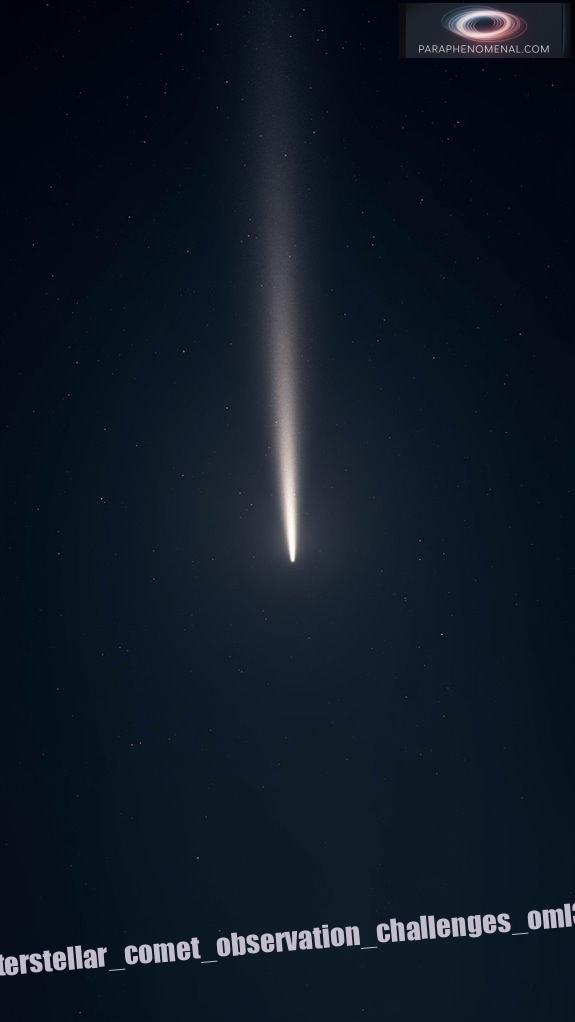
Observing interstellar comets like 3I/ATLAS presents a unique set of challenges that often hinder researchers’ efforts to gather thorough information about these elusive objects.
One significant issue is the faintness challenges. Comets can be over 10,000 times dimmer than typical targets, pushing observation techniques to their limits. Even powerful instruments like the Hubble Space Telescope can’t resolve a comet’s nucleus, only capturing its coma.
Additionally, the short observation windows complicate matters further. High speeds mean you only have days or weeks for data collection, making extensive studies tough.
Cameras designed for planetary imaging need radical adaptations to track these faint targets. Ultimately, the combination of these factors prevents clear, detailed views necessary to understand interstellar comets better.
Future Missions and Opportunities
As opportunities to study interstellar comets increase, upcoming missions promise to enhance our understanding of these intriguing celestial objects.
You’ll witness the birth of future mission strategies that employ advanced cometary rendezvous techniques:
- ESA’s Comet Interceptor launches in 2029 to target pristine comets.
- Missions will lie in wait to study interstellar visitors when they’re most accessible.
- Advanced spectrometry tools will analyze comet compositions and origins.
- Current technologies enable efficient low-energy rendezvous with celestial bodies.
- These missions prepare scientists for rapid responses to newly discovered objects.
In this ever-evolving field, our ongoing exploration, supported by platforms like ParaPhenomenal, seeks to demystify these cosmic treasures and foster a deeper understanding of their significance.
FAQ
What Are the Main Characteristics of Interstellar Comets Like 3i/Atlas?
Interstellar comets like 3I/ATLAS possess unique characteristics. Their hyperbolic trajectory indicates they aren’t bound to the Sun, while their high speed—over 130,000 miles per hour—makes them remarkable.
Composition analysis reveals ices like water and carbon dioxide, forming comas and tails. Their dust and gas features intrigue scientists, prompting trajectory predictions.
Understanding these comets is essential, aligning with our purpose at ParaPhenomenal to explore extraordinary cosmic phenomena and their mysteries.
How Do Interstellar Comets Differ From Solar System Comets?
Interstellar comets differ notably from solar system comets in their origins and structure.
While solar system comets form within the Sun’s protoplanetary disk, interstellar comets come from outside this influence, traveling on hyperbolic paths through space.
These unique origins mean their chemical compositions, volatile content, and physical characteristics may vary.
Curiously, scientists believe there are 3 to 100 times more interstellar comets ejected than those that remain in our Oort cloud, underscoring their rarity.
Can Amateur Astronomers Observe 3i/Atlas?
Yes, amateur astronomers can observe 3I/ATLAS, especially in late 2025 and early 2026.
You’ll need good amateur equipment and effective observational techniques to track it. The comet’s faint brightness of around magnitude 17.8 makes detection challenging, especially in crowded star fields.
Using capable telescopes with autoguiding features will help you capture images and data, contributing valuable knowledge that complements professional research efforts.
What Is the Significance of Studying Interstellar Comets?
Studying interstellar comets reveals significant scientific implications regarding cosmic origins.
These objects carry materials that can tell you about the early conditions in different galaxy systems, allowing a peek into processes that shaped the universe. Their unique compositions can redefine understanding of solar and planetary system development.
How Can Space Telescopes Detect Dim Celestial Objects?
Space telescopes detect dim celestial objects using photometric measurements and spectral analysis. They gather light from distant targets, even when it’s faint, by utilizing advanced imaging techniques.
These methods include multi-frame detection, which combines images over time, making weak signals clearer amidst noise.
Furthermore, filtering techniques enhance visibility, allowing astronomers to analyze and identify celestial objects more accurately.
This information fuels our understanding of the universe, which is why we created ParaPhenomenal.
References
- https://www.youtube.com/watch?v=ZtQHgCEVZ4o
- https://www.esa.int/Science_Exploration/Space_Science/ESA_observations_of_interstellar_comet_3I_ATLAS
- https://www.esa.int/Science_Exploration/Space_Science/ESA_s_ExoMars_and_Mars_Express_observe_comet_3I_ATLAS
- https://ffesp.org/nasa-confirms-3i-atlas-mysterious-interstellar-visitor-enters-solar-system/
- https://science.nasa.gov/solar-system/comets/3i-atlas/comet-3i-atlas-multimedia/
- https://esahubble.org/news/heic2509/
- https://watchers.news/2025/10/16/unusual-nickel-and-cyanide-emissions-detected-around-interstellar-object-3i-atlas/
- https://en.wikipedia.org/wiki/3I/ATLAS
- https://science.nasa.gov/solar-system/comets/3i-atlas/
- https://www.iflscience.com/anti-tail-and-odd-594-kilometer-feature-found-on-interstellar-object-3iatlas-by-keck-observatory-81188
- https://www.skyatnightmagazine.com/news/3i-atlas-not-aliens
- https://www.universetoday.com/articles/a-message-in-a-bottle-from-another-star
- https://science.nasa.gov/missions/hubble/as-nasa-missions-study-interstellar-comet-hubble-makes-size-estimate/
- https://www.astronomy.com/science/comet-3i-atlas-shows-signs-of-water/
- https://www.stsci.edu/contents/news-releases/2025/news-2025-022
- https://www.smithsonianmag.com/science-nature/telescopes-reveal-surprising-chemistry-of-a-rare-interstellar-object-passing-through-our-solar-system-180987262/
- https://www.spectroscopyonline.com/view/cosmic-visitor-with-a-red-glow-looking-inside-the-interstellar-comet-3i-atlas
- https://www.spectroscopyonline.com/view/interstellar-comet-3i-atlas-shows-its-spectral-secrets-through-palomar-and-apache-point-observations
- https://www.nextbigfuture.com/2025/08/interstellar-3i-atlas-has-nickel-without-iron-and-other-chemical-makeup-that-is-unlike-natural-objects-in-the-solar-system.html
- https://www.iflscience.com/comet-3iatlas-caught-on-camera-from-mars-orbit-this-was-a-challenge-81092
- https://www.earth.com/news/comet-3i-atlas-closest-images-exomars-mars-express-esa-combined-observations/
- https://www.spectroscopyonline.com/view/interstellar-comet-3i-atlas-shows-mysterious-spectroscopic-activity
- https://scitechdaily.com/rare-comet-older-than-the-sun-seen-by-mars-orbiters/
- https://science.nasa.gov/wp-content/uploads/2023/11/interstellar-object-interceptor-.pdf
- https://www.universetoday.com/articles/researchers-at-swri-produced-a-mission-concept-for-exploring-interstellar-objects-like-3iatlas
- https://www.space.com/astronomy/comets/interstellar-comet-3i-atlas-will-be-eyed-by-mars-and-jupiter-probes-as-it-zooms-past-the-sun-this-month
- https://www.esa.int/Space_Safety/Planetary_Defence/ESA_tracks_rare_interstellar_comet
- https://www.aura-astronomy.org/blog/2025/08/07/as-nasa-missions-study-interstellar-comet-hubble-makes-size-estimate/
- https://science.nasa.gov/blogs/3iatlas/2025/08/25/nasas-new-spherex-mission-observes-interstellar-comet/
- https://www.planetary.org/articles/what-is-comet-3i-atlas