What an intriguing mystery lies in the cosmos!
Extreme eccentricity reveals that 3I/ATLAS follows a bizarre, elongated orbit, unlike anything else I’ve encountered.
With an eccentricity of approximately 6.14, this celestial wanderer performs a unique solar flyby, boasting a retrograde inclination over 90 degrees.
Can you imagine the implications? It hints at an interstellar origin, racing through space at around 58 km/s!
Its odd surface traits invite further exploration. Are we on the verge of redefining astronomical classifications?
There’s so much more about these fascinating phenomena waiting to be uncovered!
My Spooky Encounter with the Unknown in the Night Sky
A few years ago, while camping far away from city lights, I experienced an unsettling event that haunts me to this day.
Late at night, I noticed a peculiar light moving erratically in the sky. It was unlike any satellite or plane I’d seen.
Feeling a mix of fear and wonder, I watched as it flickered and changed colors. Suddenly, it disappeared!
Could it have been an unidentified flying object? Could it have been related to celestial phenomena like 3I/ATLAS?
Thinking back, I can’t help but ponder whether this was simply a figment of my imagination or a glimpse into something beyond our understanding.
Paranormal investigations can sometimes lead us down paths where science and the supernatural intertwine seamlessly, challenging our beliefs about reality.
Quick Takeaways
- 3I/ATLAS’s extreme eccentricity of about 6.14 indicates a one-time solar flyby, distinguishing it from typical celestial orbits.
- The high eccentricity suggests a hyperbolic trajectory, revealing its origin as an interstellar object ejected from a distant star system.
- Its elongated orbit contributes to significant variations in distance from the Sun, leading to potential thermal and geological activity.
- The unusual retrograde inclination over 90 degrees indicates complex evolution, possibly from separate formation or external capture.
- 3I/ATLAS’s extreme eccentricity enhances our understanding of interstellar objects and challenges existing classifications within the solar system.
Characteristics of Extreme Eccentricity
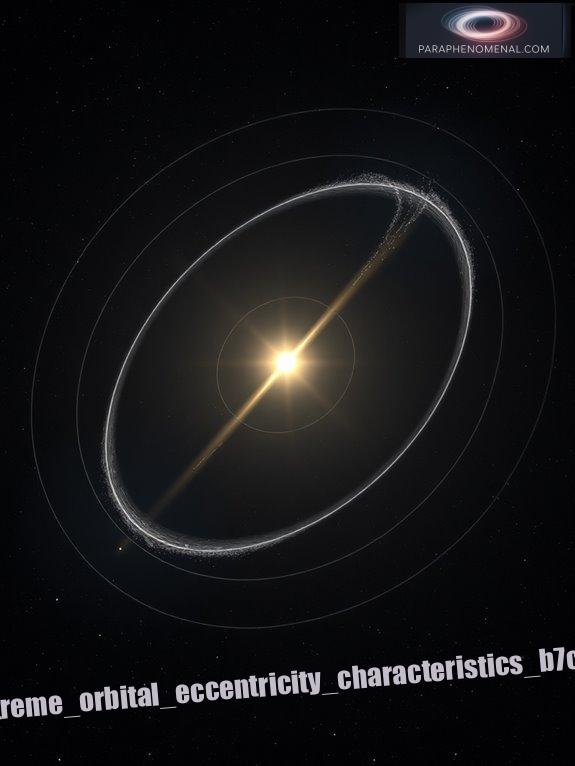
Extreme eccentricity in orbits presents a fascinating glimpse into the dynamics of celestial mechanics and the behavior of astronomical bodies.
When an orbit’s eccentricity approaches 1, we witness highly stretched, oval-shaped paths where the central body is at one focus, not the center. This means orbital distances vary greatly, with an object flying fast at its closest point and slowing down far away.
High eccentricity orbits, like those of comets, spend most of their time far from their central star, leading to extreme temperature swings and unusual geological activity. Understanding these characteristics helps us grasp the chaotic nature of such orbits. In addition, the average eccentricity of many comets can exceed 0.99, highlighting their unique and extreme trajectories.
High eccentricity orbits, typical of comets, create vast temperature fluctuations and unique geological phenomena, revealing the chaos of celestial dynamics.
It’s essential in exploring unconventional bodies, a mission we proudly support at ParaPhenomenal. Climate shifts could change everything, from environments to potential habitability.
Implications of a Hyperbolic Trajectory
The hyperbolic trajectory of 3I/ATLAS reveals significant implications for our understanding of orbital dynamics and interstellar objects.
This object’s journey through our solar system provides clear realizations:
- Its high eccentricity of about 6.14 indicates a one-time solar flyby, confirming it won’t return.
- The inclination of 3I/ATLAS doesn’t align with planetary planes, hinting at an interstellar origin.
- The rapid speed of roughly 58 km/s suggests it was ejected from a distant star system, and 3I/ATLAS was discovered on July 1, 2025, showcasing the effectiveness of modern astronomical techniques.
These findings not only reshape our view of such celestial bodies but also drive our mission at ParaPhenomenal to explore the cosmos.
As we investigate further, understanding hyperbolic trajectories helps us reveal secrets of our universe and its astonishing history.
Comparative Analysis With Other Interstellar Objects
While exploring the fascinating domain of interstellar objects, I find it essential to compare 3I/ATLAS with other known visitors from beyond our solar system.
The eccentricity of 3I/ATLAS, around 6.1 to 6.2, marks it as profoundly hyperbolic, unlike ‘Oumuamua, which has an eccentricity of about 1.2. Notably, the hyperbolic trajectories of interstellar objects provide critical insights into their origins and movements.
Similarly, 2I/Borisov possesses an eccentricity of roughly 3.5, both falling short of 3I/ATLAS’s extreme path.
2I/Borisov’s eccentricity of approximately 3.5 highlights just how unique 3I/ATLAS truly is in its cosmic journey.
This variance confirms 3I/ATLAS’s status as a free traveler, unbound by the Sun’s gravity.
The data underscores the scientific importance of these interstellar visitors, highlighting that 3I/ATLAS is the largest interstellar object discovered to date.
With platforms like ParaPhenomenal, we aim to share these discoveries, revealing the wonders of our universe and inspiring curiosity in the explorers within us all.
Understanding the Retrograde Inclination
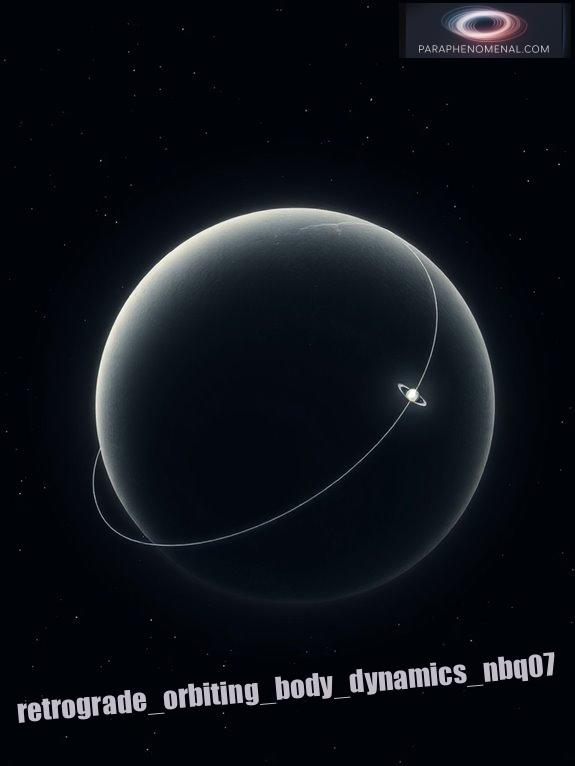
Understanding retrograde inclination is essential when exploring the enthralling behaviors of orbiting bodies in our universe.
Retrograde inclination occurs when an orbit’s tilt exceeds 90 degrees compared to its host body’s equatorial plane. This unique orbital motion moves against the spin of the planet or star it orbits. It’s intriguing, for these orbits aren’t just rare, they also suggest a complex evolution. Retrograde satellites typically formed separately or through external capture rather than initial creation.
Key characteristics include:
- Opposing central body rotation, leading to distinct dynamical interactions.
- Formation often through external capture rather than initial creation.
- Unique stability patterns due to reduced interactions with prograde objects.
At ParaPhenomenal, we aim to investigate deeper into these enthralling phenomena, revealing understandings that enhance our comprehension of these celestial wonders.
Transmission of High Velocity Through Space
High velocity through space plays an essential role in shaping the trajectories of celestial objects, particularly those like 3I/ATLAS that venture into our Solar System from interstellar space.
With an eccentricity of 6.141, 3I/ATLAS’s path is hyperbolic, indicating it won’t return. Its entry speed of 58 km/s puts it among the fastest observed interstellar visitors. This velocity guarantees it maintains escape speed, crossing large regions of space in mere months, making observation a race against time. Similarly, the extremely high eccentricity of TIC 241249530 showcases unique orbital dynamics, providing insights into the evolution of such celestial bodies.
As it approaches perihelion in October 2025, its rapid motion challenges astronomers.
We’re driven to understand these fast-moving objects. Through our website, ParaPhenomenal, we aim to share this exhilarating pursuit of knowledge and uncover the stories behind cosmic visitors like 3I/ATLAS.
Insights Into Interstellar Origin and Ejection Physics
As 3I/ATLAS speeds through the Solar System, its very existence stirs up questions about where it came from and how it got here.
To understand its origins and the physics of its ejection, we consider a few key points:
- High Eccentricity: With an eccentricity of 6.14, it’s not coming back—it’s on a one-way journey.
- Hyperbolic Trajectory: This comet moves faster than most, indicating potential ejection from another star system billions of years ago, based on its estimated arrival from the Solar System.
- Galactic Influence: Its path may have been shaped by dynamic cluster interactions, leaving us pondering the mysteries of our universe.
These revelations into 3I/ATLAS help us grasp broader cosmic processes, which is one reason we created the ParaPhenomenal website—to bring these wonders to the forefront.
Unique Polarimetric Properties of 3I/ATLAS
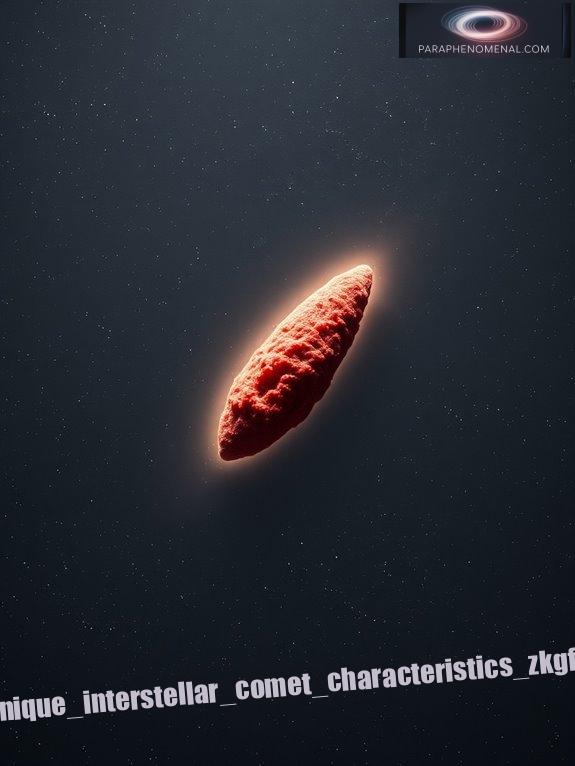
The unique polarimetric properties of 3I/ATLAS reveal captivating aspects of its composition and surface characteristics. This comet shows an extreme negative polarization, reaching about -2.7% at a 7° phase angle. Notably, the polarization changes from negative to positive around 17°, a combination we haven’t observed in other comets or asteroids. Additionally, the findings position 3I/ATLAS as the first polarimetric observations of an interstellar object, emphasizing its exceptional characteristics.
The distinct polarimetric behavior suggests a different dust texture, possibly indicating porous or fluffy aggregates. Moreover, 3I’s red-colored surface may contain water ice, linking it more closely to distant trans-Neptunian objects. Its measurements, gathered using advanced telescopes, open up the possibility that 3I represents a new category of interstellar objects.
At ParaPhenomenal, we’re dedicated to uncovering such extraordinary celestial phenomena and their implications.
FAQ
How Was 3i/Atlas Discovered and Tracked?
3I/ATLAS was discovered on July 1, 2025, through the Asteroid Terrestrial-impact Last Alert System‘s automated telescope. Its unusual speed and trajectory caught my attention.
Tracking it involved multiple telescopes worldwide, like Hubble and the International Gemini Observatory.
These observations focused on its composition, velocity, and physical properties during its journey through the inner solar system.
I created this website to share such incredible cosmic discoveries with you.
What Tools Are Used to Study Its Composition?
To study 3I/ATLAS’s composition, scientists use several powerful telescopes.
The Gemini North Telescope, along with the Hubble Space Telescope, provides detailed images and size estimates. Spectroscopy from these instruments reveals gases and ices around the comet.
The JWST and Neil Gehrels Swift Observatory collect additional data, while ground-based observatories track changes over time.
For those seeking to understand the universe, tools like these are essential, and that’s part of why I love sharing this knowledge.
Can 3i/Atlas Affect Earth’s Atmosphere?
No, 3I/ATLAS can’t affect Earth’s atmosphere. It isn’t coming close enough, remaining about 1.8 AU away, which is too far for any impact or interaction.
While it does release gas and dust as it travels, that material disperses rapidly in space, not reaching Earth.
Understanding these comets helps scientists, and at ParaPhenomenal, we want to connect you with amazing discoveries like this. Knowledge is powerful, especially when it comes to interstellar objects.
Are There Plans for Future Observations?
Yes, there’re plans for future observations of 3I/ATLAS.
Astronomers want to gather detailed data as it approaches perihelion in 2025. They’ll use advanced telescopes and spectrographs to track its composition, velocity, and interaction with the Sun.
I’m excited about the potential collaboration between ground-based and possibly space telescopes, which could reveal secrets about its origin.
This journey fuels our quest for understanding, which is why we created this website ParaPhenomenal.
What Are the Implications for Future Interstellar Missions?
The implications for future interstellar missions are significant. They push the boundaries of technology, demanding breakthroughs in propulsion systems, like nuclear or laser-driven methods.
We need advanced autonomous navigation due to short communication windows. Additionally, these missions can collect samples from other planetary systems, transforming our understanding of astrobiology.
References
- https://astrobiology.com/2025/07/gemini-north-observes-comet-3i-atlas.html
- https://www.youtube.com/watch?v=XEggZo3SXNM
- https://cosmobc.com/interstellar-comet-3i-atlas/
- https://arxiv.org/pdf/2509.05181
- https://science.nasa.gov/solar-system/comets/3i-atlas/
- https://www.britannica.com/topic/Comet-3I-ATLAS
- https://www.planetary.org/planetary-radio/2025-3i-atlas
- https://www.youtube.com/watch?v=FpRhebUepok
- https://en.wikipedia.org/wiki/Orbital_eccentricity
- https://www.diy.org/article/orbital_eccentricity
- https://fiveable.me/key-terms/astrophysics-ii/orbital-eccentricity
- https://www.johndcook.com/blog/2022/10/22/orbital-anomalies/
- https://tfaws.nasa.gov/wp-content/uploads/Rickman-Presentation.pdf
- http://www.braeunig.us/space/orbmech.htm
- https://worldbuildingpasta.blogspot.com/2023/12/climate-explorations-eccentricity.html
- https://www.astronomy.com/science/what-we-know-so-far-about-3i-atlas-the-interstellar-visitor/
- https://www.seti.org/news/comet-3iatlas-a-visitor-from-beyond-the-solar-system/
- https://arxiv.org/html/2508.02777v2
- https://www.iflscience.com/seti-paper-responds-to-claims-interstellar-object-3iatlas-might-be-an-alien-spacecraft-81100
- https://lweb.cfa.harvard.edu/~loeb/HCL25.pdf
- https://www.emergentmind.com/topics/interstellar-object-3i-atlas-ba06f698-1dc9-478a-8503-44fe88ff539f
- https://www.space.com/astronomy/comets/new-interstellar-object-3i-atlas-everything-we-know-about-the-rare-cosmic-visitor
- https://economictimes.com/news/international/us/3i/atlas-not-an-alien-mothership-scientists-reveal-new-theory-about-alleged-interstellar-messenger/articleshow/124322757.cms
- https://www.iflscience.com/another-comet-3iatlas-record-got-us-asking-how-do-we-know-an-object-is-interstellar-81079
- https://ui.adsabs.harvard.edu/abs/2025ApJ…989L..36S/abstract
- https://en.wikipedia.org/wiki/Retrograde_and_prograde_motion
- https://kids.kiddle.co/Retrograde_and_prograde_motion
- https://fiveable.me/key-terms/intro-astronomy/retrograde-orbit
- https://cseligman.com/text/sky/retrograde.htm
- https://fiveable.me/key-terms/intro-astronomy/retrograde