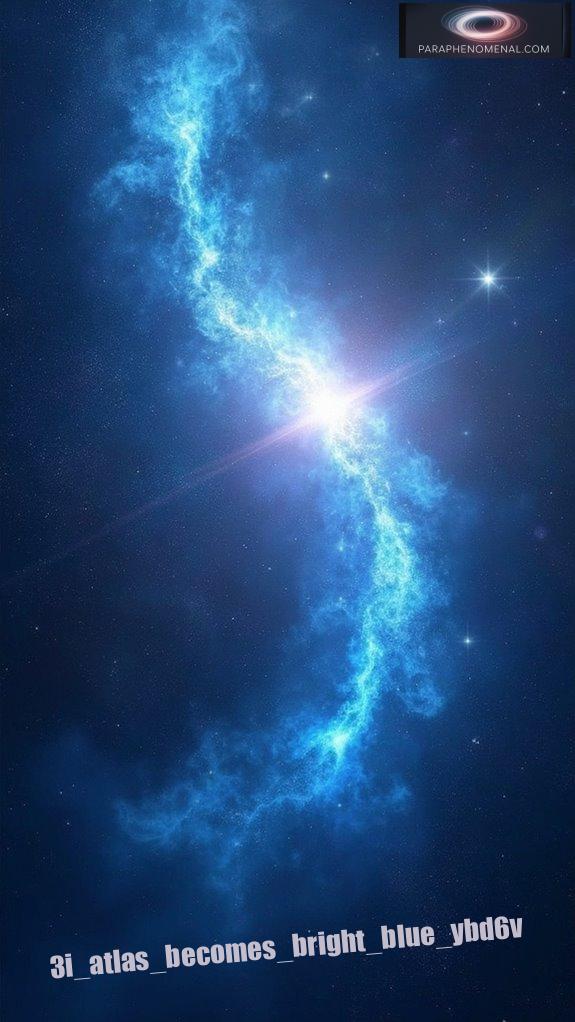
Have you ever witnessed a cosmic spectacle that just leaves you in awe?
As I follow 3I/ATLAS, its brilliant glow captivates me.
Approaching perihelion, its V magnitude nearly hits 9.
I can’t help but marvel at the transformation — its coma shifting from reddish to deep blue.
This fascinating color change, fueled by the rapid sublimation of gas, especially water ice, reveals how solar radiation shapes its emissions.
Isn’t it incredible to think about such celestial phenomena and their behaviors?
There’s so much more to uncover about its unique journey!
Quick Takeaways
- 3I/ATLAS exhibited rapid brightening as it approached perihelion, with geocentric V magnitude nearing 9 due to intense solar radiation.
- The comet’s coma color changed from reddish to blue hues, indicating an increase in gas emissions related to its proximity to the Sun.
- Brightness enhancement exceeded that of typical Oort cloud comets, attributed to the fast sublimation of water ice driven by solar heating.
- Observations from the Hubble Telescope and other advanced instruments highlighted the dynamic evolution of the comet’s coma composition.
- The increased emissions also featured ionized molecules, showcasing complex interactions between solar radiation and the comet’s volatile components.
Brightening Behavior Ahead of Perihelion
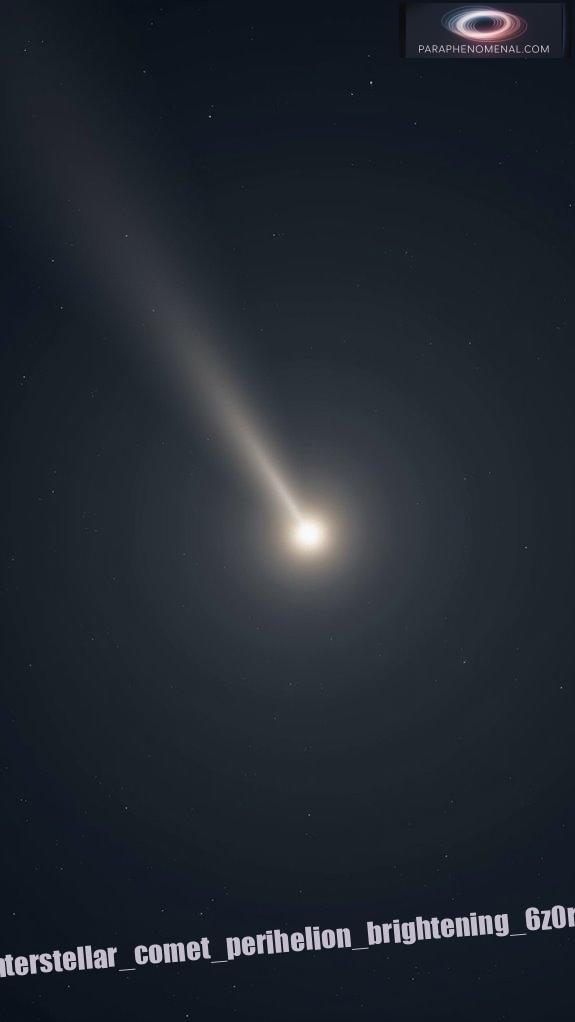
3I/ATLAS, an interstellar comet, recently exhibited remarkable brightening behavior as it approached perihelion, reaching an estimated geocentric V magnitude near 9.
This striking brightening likely stems from specific brightening mechanisms linked to perihelion dynamics. As the comet neared the Sun, heat from solar radiation triggered the fast sublimation of gases, particularly water ice, which enhanced its brightness.
Importantly, this rate of brightening surpassed that of typical Oort cloud comets at similar distances. The unique interplay of sunlight and the comet’s composition plays an essential role, allowing you to witness these changes as they unfold. Furthermore, the sublimation rates of gases in comets can vary significantly based on their distance from the Sun and the composition of their ices.
Understanding these dynamics and mechanisms helps deepen appreciation for our universe, a core desire that drives the creation of platforms like ParaPhenomenal.
Color Changes and Coma Evolution
As the comet approached perihelion, noticeable changes in its coma color became evident, reflecting the complex interactions between sunlight and the comet’s materials.
You’d observed the coma shifting from reddish hues of early observations to a distinctly bluer shade near perihelion. This transformation hints at developing coma composition, driven by increased gas emissions.
The gas emissions, influenced by solar radiation, led to variations in the color spectrum, revealing an interconnected relationship between brightness and color changes. Recent observations with the Hubble Telescope have provided invaluable insights into these phenomena.
Through our ongoing interest, we created this platform, ParaPhenomenal, to share perspectives about such phenomena.
Understanding these changes in 3I/ATLAS not only captivates but reveals the dynamic lifecycle of a traveling interstellar visitor.
Keep watching; the journey of this comet unfolds remarkable discoveries.
Orbital and Physical Characteristics
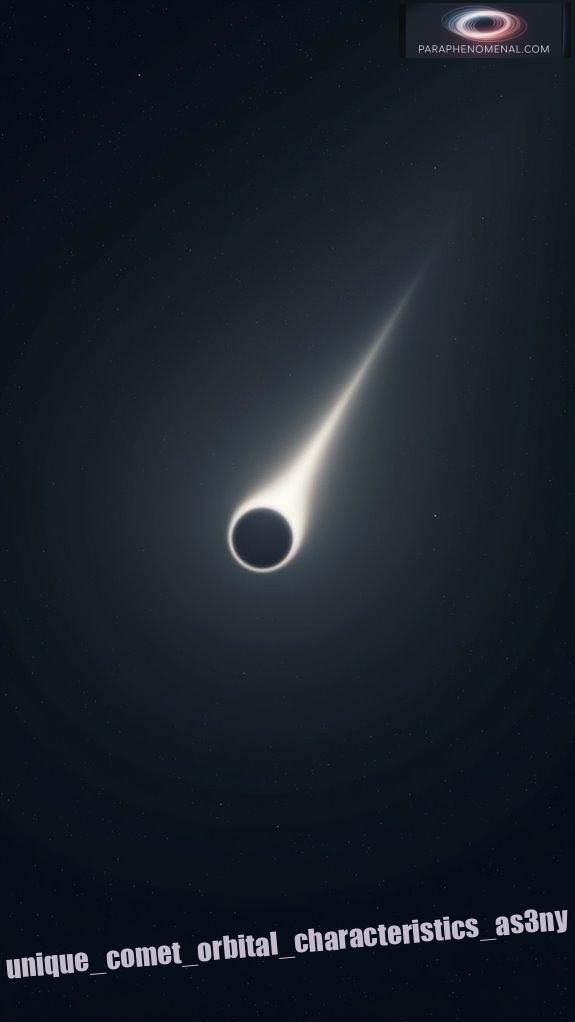
While tracking the comet’s journey, you can observe its unique orbital and physical characteristics that set it apart from typical solar system comets.
- Perihelion: This event occurred on October 29, 2025, at 1.36 AU from the Sun, a space between Earth’s and Mars’s orbits.
- Velocity: The comet moves at a staggering speed of over 130,000 mph (210,000 km/h), reflecting its interstellar origin.
- Trajectory Analysis: Its trajectory is remarkably straight and flat, differing from the more curved paths of typical solar system comets.
- Nucleus Composition: The specifics of its nucleus, including shape and material, remain uncertain due to limited observations. Recent studies suggest that its trajectory may have been influenced by gravitational interactions with Mars and Jupiter, leading to its unusual path.
Understanding these characteristics deepens our knowledge of cometary science, which is why ParaPhenomenal was created—to explore the wonders of our universe.
Observation Techniques and Instruments
The observation of 3I/ATLAS relied on advanced techniques and instruments that provided critical understandings into its behavior as it approached the Sun.
Multiple platforms collaborated to guarantee data accuracy, utilizing space-based solar observatories like GOES-19 and SOHO, alongside ground-based telescopes such as the Nordic Optical and Teide twin telescopes.
These imaging techniques offered crucial perspectives into brightness metrics and color changes.
Observers faced detection challenges during solar conjunction, but consistent collaboration filled data gaps.
Spectral analysis revealed gas emissions, contributing to our understanding of the comet’s activity. Notably, these discoveries are part of NASA’s ongoing mission to study comets and their properties, which helps enhance our knowledge of celestial bodies and their effects on the solar system.
Such tools are indispensable for studying unique objects like 3I/ATLAS, highlighting why platforms like ParaPhenomenal exist—to advance knowledge on fascinating astronomical events that capture our imagination.
Cometary Activity and Sublimation Processes
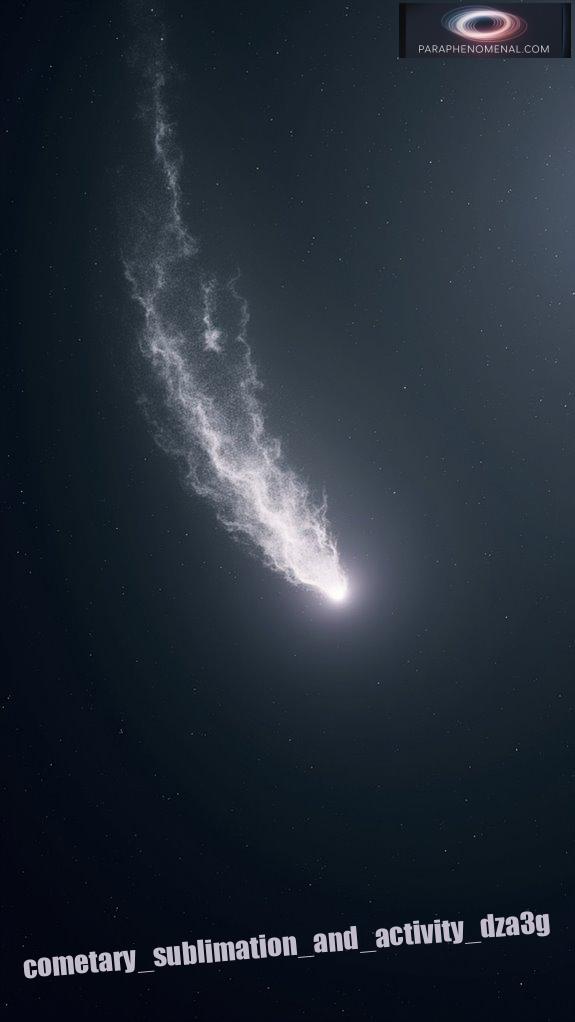
Understanding cometary activity and sublimation processes reveals how these celestial bodies transform as they journey through the solar system.
- Early sublimation occurs mainly through CO₂, cooling the surface and delaying water ice sublimation.
- Near perihelion, solar heating triggers rapid sublimation of H₂O, resulting in increased gas emissions.
- Gas emissions often include ionized molecules influenced by solar radiation, enhancing brightness and leading to a blue color shift.
- Changes in coma composition show the dynamic interaction of volatiles, driving variations in activity patterns.
Additionally, the unusual interstellar velocity of 3I/ATLAS plays a crucial role in its sublimation dynamics, affecting its brightness and evolution.
FAQ
What Does the “I” in 3i/Atlas Stand For?
The “i” in 3I/ATLAS stands for “interstellar,” highlighting its interstellar implications. This comet showcases fascinating cometary composition, giving you a unique opportunity to explore materials and dynamics from beyond our solar system. Isn’t that thrilling?
How Does 3i/Atlas Compare to Previous Interstellar Comets?
3I/ATLAS stands out among interstellar comets due to its unique trajectory, composition, and rapid brightening behavior. You’ll find its characteristics differ considerably, offering new perspectives compared to previous interstellar visitors like 2I/Borisov and ʻOumuamua.
Are There Any Potential Hazards From 3i/Atlas Passing by Earth?
“Better safe than sorry.” While 3I/ATLAS poses minimal risks during its pass, remaining vigilant is smart. Potential impacts mostly concern celestial threats, but current trajectories suggest Earth will experience no significant hazards from this comet.
What Is the Significance of Its High Velocity?
The significance of its high velocity lies in unique velocity measurements, highlighting its interstellar origin. This provides cosmic implications, showcasing processes from beyond our solar system, and offering perspectives into the universe’s vast and dynamic nature.
How Was 3i/Atlas Initially Discovered?
You’d find that 3I/ATLAS was discovered using advanced observation techniques, including the Zwicky Transient Facility. These discovery methods allowed astronomers to detect its unusual trajectory, marking it as a unique interstellar visitor, sparking curiosity and excitement.
References
- https://arxiv.org/html/2510.25035v1
- https://en.wikipedia.org/wiki/3I/ATLAS
- https://www.livescience.com/space/comets/nasa-spacecraft-reveal-interstellar-comet-3i-atlas-brightened-rapidly-as-it-swooped-behind-the-sun
- https://avi-loeb.medium.com/3i-atlas-rapidly-brightens-and-gets-bluer-than-the-sun-near-perihelion-3bf100df8390