
What if I told you that understanding the behavior of comets could unlock secrets about UFO activities?
As I dive deeper into this fascinating world, I discover that comets lose mass through the sublimation of water and gases while approaching the Sun.
This process reveals unique details about their structures and compositions, varying dramatically with distance from our star.
How many UFO sightings might be linked to such celestial phenomena?
Delving into these icy bodies helps us piece together the mysteries surrounding unidentified aerial phenomena.
My Close Encounter with the Unknown: A Lesson from Comet Activity
A few years ago, I witnessed a strange light in the sky. Initially thinking it was a comet, I later learned about the connection between celestial events and UFO sightings.
The experience was both unsettling and exciting. I researched these phenomena, finding many instances of strange lights linked to solar activity.
It’s a reminder that expanding our understanding of space can illuminate the unknown right above our heads, bridging the gap between science and mystery. Exploring realms like astrophysics, sublimation, and UFO dynamics can lead to incredible insights.
Quick Takeaways
- Sublimation rates in comets are measured using infrared spectroscopy, allowing quantification of water emissions.
- Gas production rates vary among comets and are influenced by factors like heliocentric distance and solar activity.
- Emission line strength has a direct correlation with water production rates, aiding in comet characterization.
- Differential gas ratios, like C2/CN, differentiate between “typical” and “depleted” comets, revealing compositional diversity.
- Sublimation induces pressure gradients that can lead to structural failure, reshaping comet nuclei over time.
Sublimation Dynamics of Cometary Nuclei
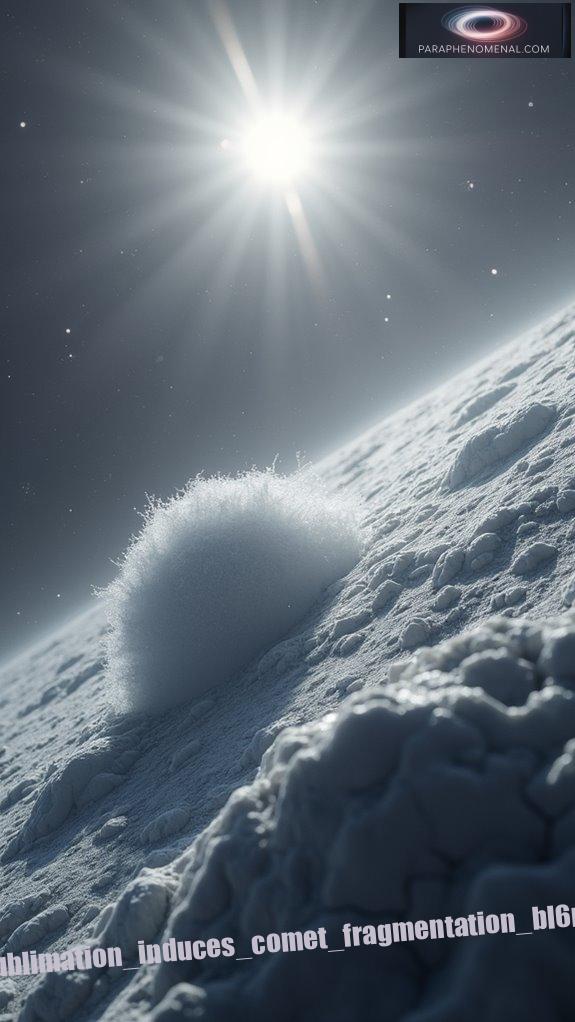
Sublimation dynamics play an essential role in the structure and behavior of cometary nuclei, as they interact with various environmental factors.
Sublimation dynamics are crucial in shaping cometary nuclei, influenced by their interactions with environmental factors.
As you observe a comet, sublimation pressures concentrate on the sunward side, creating stress that can lead to nuclear fragmentation. These pressures peak at the subsolar point, fostering inherently unequal stresses. When these stresses exceed the material strength, which is often around 0.5 Pa, fragmentation occurs. The mechanism of sublimation pressure is particularly significant as it can induce differential stresses that may lead to structural failure of the comet’s nucleus.
Comet ISON serves as a prime example of how this mechanism can cause disruption.
Lower albedos might suggest weakened nuclei, making them more vulnerable to fragmenting under the strain of sublimation.
Understanding these dynamics not only reveals the secrets of comets but also aligns with ParaPhenomenal’s mission to explore the wonders of our universe.
Measuring Sublimation Rates in Comets
Understanding the rates at which water and gas sublimate from cometary nuclei is essential for studying a comet’s behavior and characteristics.
You can measure sublimation rates using various sublimation methods, particularly through spectral analysis. Infrared spectroscopy allows you to identify and quantify water emissions directly, enabling calculations of sublimation rates based on the strength of spectral lines. Notably, recent observations from the James Webb Space Telescope revealed main-belt comets like comet 238P/Read exhibiting significant water vapor activity, which underscores the importance of water emissions in sublimation studies. Additionally, high levels of carbon dioxide have been observed in some cometary comas, impacting the overall sublimation dynamics.
By correlating emission line strength with water production rates, you can estimate the effective sublimation area of a comet’s surface. Furthermore, modeling helps to connect real-time observations, adjusting for heliocentric distance, surface temperature, and solar activity.
This integration of observational data with thermodynamic models ultimately improves your understanding of how comets evolve and react as they approach the Sun—knowledge we aim to share through the ParaPhenomenal platform.
Comparative Analysis of Cometary Gas Production
When comets approach the Sun, their gas production varies considerably, making it essential to analyze these differences for classifying and understanding these icy bodies.
- Different gas ratios can reveal compositional diversity.
- Each gas type contributes to the enigmatic nature of comets.
- Changes in outgassing can transport your imagination to distant worlds. The release of gases like CN, C2, and NH2 offers understanding into comet classification. For instance, varying C2/CN ratios help differentiate comets as “typical” or “depleted.” Recent findings indicate that gas production rates can exhibit significant variations based on different comet species, highlighting the influence of heliocentric distance on the volatility of these gases.
Generally, gas production varies from stable to abrupt increases, influenced by heliocentric distances. Understanding these dynamics not only feeds your curiosity but also connects us to the narrative of our universe.
That’s part of why we created ParaPhenomenal—to explore what lies beyond.
Physical Consequences of Sublimation on Comet Structure
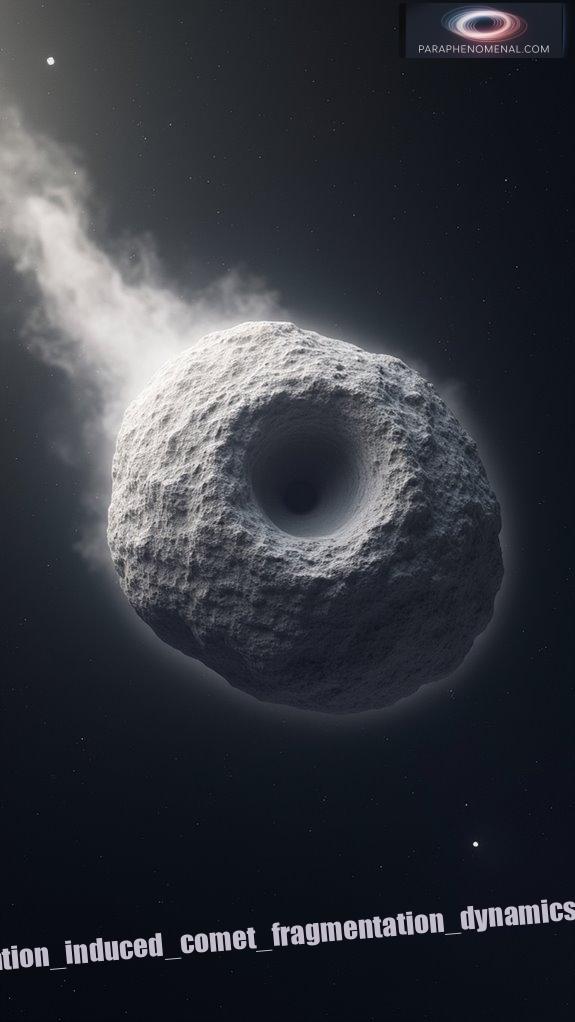
As comets journey toward the Sun, they undergo significant changes due to the process of sublimation, which affects their overall structure. The sublimation effects create pressure gradients across the comet nucleus, leading to differential stress that can cause fragmentation. When stress surpasses the nucleus’s strength, it may lead to structural failure, breaking apart these celestial bodies. Surface modifications occur as prolonged sublimation erodes material, reshaping the nucleus and exposing new volatile compounds. This dynamic process results in dust jets that change over time, driven by the comet’s surface composition and solar distance. Additionally, the fragmentation events observed in comets like 3i/Atlas show the potential consequences of these sublimation processes on overall stability. Understanding these transformations not only fascinates us but is critical for our mission at ParaPhenomenal to explore the mysteries of comets and their impact on the solar system.
Advances in Observational Techniques for Comet Studies
Advancements in observational techniques have revolutionized the way we study comets, allowing scientists to gather essential data about these cosmic wanderers more efficiently than ever before.
- Decentralized networks like UNISTELLAR enable extensive optical monitoring, engaging citizen science enthusiasts for early luminosity data.
- High-resolution imaging from instruments such as the Next Generation Palomar Spectrograph helps analyze comet activity with surgical precision.
- Space-based missions contribute invaluable early detection and continuous monitoring through innovative measurements.
- Recent trajectories calculated for missions like those to Comet 3i/Atlas demonstrate enhanced mission planning capabilities that maximize observation success.
These techniques enhance our understanding of sublimation rates and gas release processes, deepening comprehension into primordial materials within these celestial bodies.
The developments inspire a sense of wonder, reminding us why we created ParaPhenomenal—to ignite curiosity and encourage exploration in comet studies.
FAQ
What Role Does Solar Radiation Play in Comet Activity?
Solar radiation drives comet activity by heating the nucleus, which causes ice to sublimate. As solar intensity increases when comets approach the Sun, radiation pressure pushes dust and gas away, forming the coma and the visible tails.
This process reveals fresh ice layers and enhances the comet’s overall brightness. You’ll find that understanding these mechanisms sheds light on primordial materials, a focus of our site, ParaPhenomenal, dedicated to uncovering the mysteries of comets.
How Do Comets Form Their Tails During Sublimation?
Comets form their tails during sublimation by releasing gas and dust when heated by solar radiation.
Did you know some comets can have over 20% of their surface actively releasing materials? This occurs through sublimation mechanisms, which convert ices directly to gas.
The tail composition includes tiny dust particles driven away by solar pressure, while ionized gases create a narrow plasma tail, both expanding dramatically as the comet gets closer to the Sun.
Can Sublimation Rates Predict a Comet’s Lifespan?
Yes, sublimation rates can predict a comet’s lifespan. By analyzing gas loss through sublimation modeling, you can estimate how long a comet will remain active.
Observations indicate that short-period comets typically last between 2,500 to 10,000 years before they exhaust their volatile materials. These lifespan predictions depend on factors like nucleus size and heliocentric distance, ensuring a thorough understanding of their life cycle.
This perspective enriches our fascination with celestial phenomena.
How Do Different Comet Types Vary in Gas Production?
Different comet types vary in gas production due to their nucleus composition and thermal history.
Jupiter-family comets generally exhibit lower gas emissions compared to Halley-type or long-period comets, which often have more volatile gases.
For instance, the dust-to-gas ratio also impacts these emissions, affecting how effectively gases sublimate.
What Environmental Factors Influence Sublimation in Comets?
Temperature variations and surface composition are vital environmental factors influencing sublimation in comets.
As a comet approaches the Sun, rising temperatures cause volatile ices, like water and carbon dioxide, to sublimate more rapidly. Different surface materials also play a role; their compositions dictate how easily gases escape.
Fluctuations in temperature and diverse surface makeup can lead to interesting sublimation patterns, affecting the comet’s behavior as it travels through space.
References
- https://agupubs.onlinelibrary.wiley.com/doi/full/10.1029/2022JE007329
- https://pmc.ncbi.nlm.nih.gov/articles/PMC10371862/
- https://academic.oup.com/mnras/article/509/2/3065/6420251
- https://www.eaps.purdue.edu/minton/docs/Icarus 2015 Steckloff.pdf
- https://docs.lib.purdue.edu/dissertations/AAI10075613/
- https://arxiv.org/abs/1507.02669
- https://agupubs.onlinelibrary.wiley.com/doi/abs/10.1029/2022JE007329
- https://academic.oup.com/mnras/article/527/3/7613/7455897
- https://ui.adsabs.harvard.edu/abs/2020JApA…41….1W/abstract
- https://ntrs.nasa.gov/citations/19930010051
- https://adsabs.harvard.edu/full/1992acm..proc..545S
- https://ui.adsabs.harvard.edu/abs/2007AAS…211.5604L/abstract
- https://academic.oup.com/mnras/article/508/2/1719/6369366
- https://ntrs.nasa.gov/api/citations/19930009966/downloads/19930009966.pdf
- https://ntrs.nasa.gov/api/citations/20205000487/downloads/STRIVES 20-16.pdf
- https://adsabs.harvard.edu/full/2006IAUS..229..413S
- https://www.sethajacobson.com/research-updates/2015/12/2/the-sublimation-driven-yorp-effect-or-syorp
- https://ntrs.nasa.gov/api/citations/19960038363/downloads/19960038363.pdf
- https://en.wikipedia.org/wiki/Comet
- https://blogs.esa.int/rosetta/2015/01/16/fine-structure-in-the-comets-jets/
- https://home.ifa.hawaii.edu/users/meech/papers/slovakia.pdf
- https://www.seti.org/news/comet-3iatlas-a-visitor-from-beyond-the-solar-system/
- https://www.spectroscopyonline.com/view/interstellar-comet-3i-atlas-shows-its-spectral-secrets-through-palomar-and-apache-point-observations
- https://economictimes.com/news/international/us/comet-c/2025-r2-swan-to-pass-earth-next-week-how-to-watch-and-see-if-its-visible-to-the-naked-eye/articleshow/124636689.cms
- https://thedebrief.org/3i-atlas-update-what-new-data-reveals-about-the-most-puzzling-interstellar-object-ever-found/
- https://science.unistellar.com/comets/missions/
- https://www.planetary.org/articles/how-to-spot-comet-swan
- https://www.esa.int/Space_Safety/Planetary_Defence/ESA_tracks_rare_interstellar_comet
- https://www.space.com/the-universe/comets/big-dark-comet-discoveries-could-be-coming-in-2025
- https://www.iflscience.com/anti-tail-and-odd-594-kilometer-feature-found-on-interstellar-object-3iatlas-by-keck-observatory-81188