
ESA’s JUICE spacecraft is on a remarkable mission, observing interstellar comet 3I/ATLAS.
This isn’t just about the comet; it’s about understanding Jupiter’s wild environment.
I find it fascinating! As JUICE measures various particles in Jupiter’s magnetosphere, we’re not only gaining insights into comet behavior but also exploring habitability factors.
With the challenges of limited observation time and low data transmission, each discovery feels monumental.
What do you think we might uncover next?
—
Unveiling the Secrets of UFOs: A Personal Encounter
Years ago, I was stargazing when I spotted an object darting across the sky—nothing like I’d ever seen.
Could it be a UFO? My heart raced with excitement and curiosity.
This experience heightened my interest in cosmic phenomena, leading me to research various sightings and explore the connection between celestial events and potential extraterrestrial life.
Such moments ignite a passion, don’t you think? I believe every sighting could be a piece of a larger puzzle we are only beginning to understand.
Quick Takeaways
- JUICE’s limited active observation time restricts its capabilities in studying 3I/ATLAS due to proximity to the Sun and equipment overheating risks.
- Despite challenges, JUICE aims to gather data on 3I/ATLAS’s particle environment while investigating interactions between Jupiter and its moons.
- The spacecraft’s Particle Environment Package (PEP) will enhance understanding of potential energy sources affecting cometary activity.
- Post-perihelion, observatories will analyze changes in 3I/ATLAS’s emissions, offering insights into its composition and behavior after solar transit.
- Collaborative efforts, including citizen science, will track brightness changes of 3I/ATLAS, enriching data about this interstellar comet’s activity.
Overview of JUICE Mission
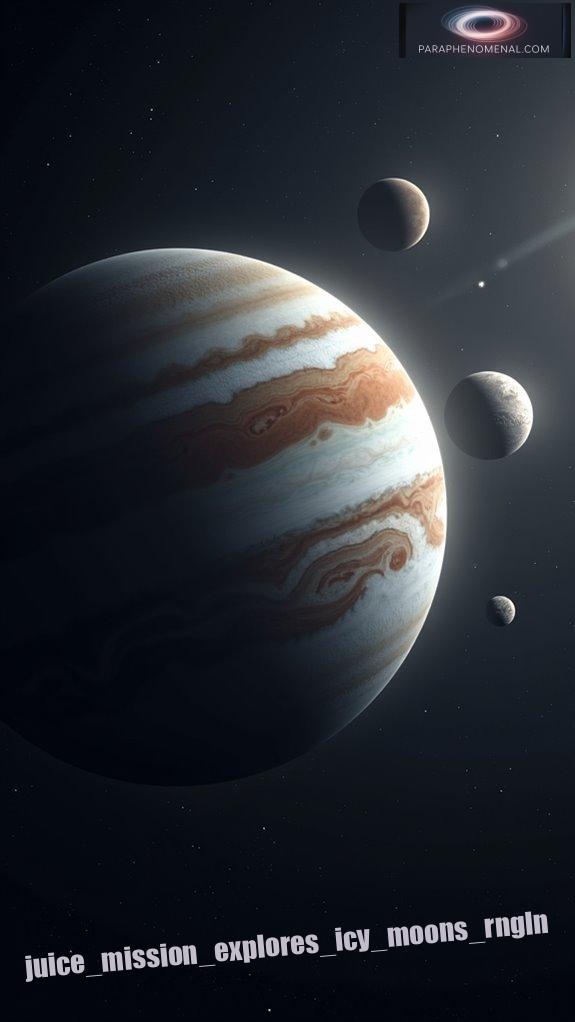
The JUpiter ICy moons Explorer, or JUICE, represents a significant leap in our exploration of the outer solar system. This ambitious JUICE mission, launched on April 14, 2023, aims to investigate Jupiter and its three largest icy moons: Ganymede, Callisto, and Europa. Focusing on astrobiology, this spacecraft seeks to characterize potential habitable environments among these icy worlds. It’s designed as a solar-powered orbiter, capable of complex interplanetary maneuvers with advanced technology. The mission timeline includes arriving at Jupiter in July 2031, with at least four years of observations planned. Through its cosmic objectives, JUICE will enhance our understanding of the conditions that support life, revealing secrets about these intriguing moons and their dynamic interactions with Jupiter. As part of the mission, researchers will also examine how these icy moons might contribute to our understanding of habitability around gas giants.
3I/ATLAS: The Interstellar Comet
Discovered on July 1, 2025, by the ATLAS survey telescope in Chile, comet 3I/ATLAS captures our attention with its unique characteristics as an interstellar object. Its hyperbolic orbit confirms an interstellar origin, distinguishing it from typical solar system comets. Notably, its eccentricity of approximately 6.1 highlights the extreme nature of its trajectory through space. Interestingly, this comet is expected to reach its closest approach to the Sun in December 2025, providing an exceptional opportunity for observation.
Here’s a brief look at its essential features:
| Feature | Details |
|---|---|
| Comet Composition | Solid, icy nucleus with a dust cocoon |
| Brightening Anomaly | Unexpectedly brightened faster than peers |
| Physical Activity | Ongoing sublimation and tail emission |
As you explore its comet composition and behavior, you might find it intrigues your curiosity about the cosmos, which is why we created ParaPhenomenal—sharing our fascination with the universe.
Observation Challenges Faced by JUICE
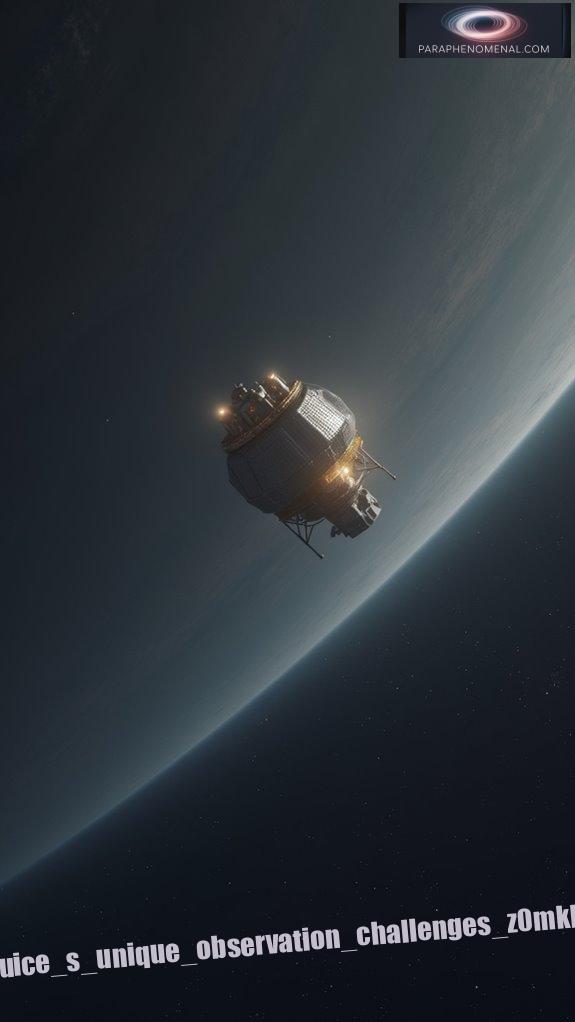
JUICE’s mission isn’t solely focused on Jupiter; it’s also geared towards making observations of intriguing objects like the interstellar comet 3I/ATLAS.
Yet, observation challenges arise due to thermal constraints and operational limitations. During its cruise phase, the spacecraft operates close to the Sun, restricting instruments to just 30 minutes of active operation each day. These limited windows always risk overheating sensitive equipment, leading to no planned science observations. Additionally, JUICE will be the first spacecraft to orbit a moon that is not Earth’s Moon, illustrating its significant contributions to space exploration. Recent reports suggest that 3I/ATLAS is experiencing a slowdown in brightness, which adds further interest to JUICE’s observations.
Plus, from a distance of 64 million km, remote sensing severely reduces imaging resolution and detail. Data transmission rates are low, meaning you’ll wait until February 2026 for the results.
This unexpected observation campaign showcases JUICE’s flexibility, adapting its mission to seize unique scientific opportunities in deep space.
PEP Instrument Capabilities
While exploring the Jovian system, the Particle Environment Package, or PEP, plays an essential role in understanding the dynamic interactions within this unique environment. PEP’s nine sensors measure both charged and neutral particles, providing an extensive view of particle detection across Jupiter’s magnetosphere. Designed for omnidirectional coverage, PEP can detect energetic neutrals, ions, and electrons, offering perspectives into plasma properties and the cosmic weather around icy moons like Ganymede and Europa. Additionally, the PEP instrument is crucial for investigating the chemical and thermal energy sources that may contribute to potentially habitable conditions in these environments.
Data Transmission and Expected Insights
As JUICE ventures into the depths of the Jovian system, effective data transmission becomes essential for relaying important information back to Earth. Utilizing Ka band and X band frequencies, JUICE guarantees robust communication with data bandwidth allowing a daily transmission of at least 1.4 gigabytes. The continuous coverage provided by ESA’s antennas in Spain, Argentina, and Australia enhances transmission efficiency, securing uninterrupted signals.
| Data Type | Storage Capacity | Ground Stations |
|---|---|---|
| Telemetry Data | 1.6 Terabytes | Cebreros (Spain) |
| Scientific Payload | Malargüe (Argentina) | |
| New Norcia (Australia) | ||
| NASA Deep Space Network |
With quick relay to ESA’s ESOC, data is transformed into valuable knowledge for further exploration.
Comparison With Other Spacecraft Observations
The comparison between JUICE and other spacecraft observations highlights unique strengths in exploring 3I/ATLAS. JUICE advantages include its unique position that allowed it to observe the comet during its highest activity phase, providing real-time data that Earth-based telescopes missed.
While Mars observations captured the comet’s approach from the sun’s far side, they faced challenges, such as operational delays with the Mars Reconnaissance Orbiter.
JUICE’s instruments, including the wide-field PEP, gathered extensive data, integrating knowledge about comet dynamics. Other interplanetary observers contributed complementary data, but JUICE’s ability to fly through the comet’s tail offered a rare opportunity for direct sampling.
This synergy of observations enhances our understanding, which is one reason we created this platform, ParaPhenomenal, to share knowledge on these extraordinary missions.
Future Opportunities for Continued Study
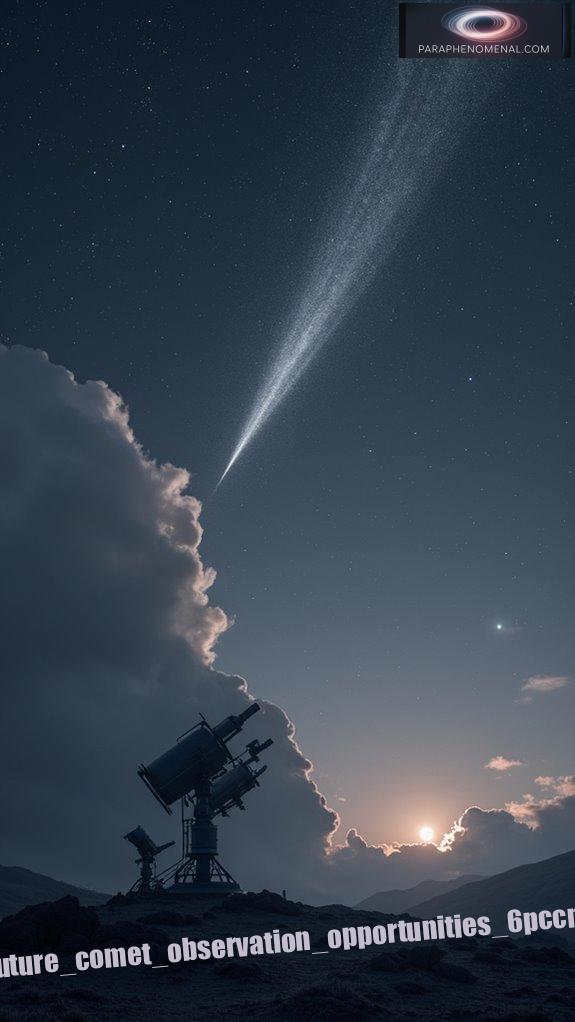
Future opportunities for continued study of comet 3I/ATLAS will unfold as researchers utilize various ground and space-based observational tools. Post perihelion observations will allow major observatories to analyze changes in the comet’s gas and dust emissions. After the solar transit, 3I/ATLAS will be visible to large telescopes, enabling extensive time-series analysis through data from multiple sites. Space telescopes like Hubble and JWST will provide high-resolution imaging to capture molecular details as the comet cools. Additionally, the unique characteristics of 3i/Atlas technology will provide insights into the processes driving its emissions. Citizen science contributions will also play an essential role. Amateur astronomers can track brightness changes and detect outbursts, uploading data that enhances professional findings. Together, these efforts will deepen our understanding of interstellar comet activity and nurture a community keen on exploration and discovery, like the one fostered by ParaPhenomenal.
FAQ
How Does a Spacecraft Track a Fast-Moving Object Like 3i/Atlas?
To track a fast-moving object like 3I/ATLAS, you use advanced tracking techniques and orbital mechanics, constantly adjusting trajectory using telemetry data. This allows for precise navigation and the ability to follow dynamic celestial paths effectively.
What Scientific Instruments Does JUICE Carry Besides the PEP?
When it comes to the JUICE mission, you’ll find cutting-edge instruments like JANUS, MAJIS, and GALA. They aim to uncover Jupiter’s secrets, supporting your desire for knowledge about its moons and atmospheric mysteries.
How Was the Comet Named 3i/Atlas?
The comet 3I/ATLAS was named using established naming conventions, reflecting its historical significance. The “3I” identifies it as the third interstellar object, while “ATLAS” honors the survey telescope that discovered it.
What Are the Potential Implications of Studying Interstellar Comets?
Studying interstellar comets carries profound implications for understanding comet origins, revealing clues about planetary formation and the chemical makeup of distant systems. You’ll discover revelations that reshape your view of the universe and our cosmic history.
How Can Amateur Astronomers Observe 3i/Atlas?
To observe 3I/ATLAS, use amateur tools with an 8 to 10-inch aperture, master long exposure techniques, and choose dark skies. Plan your timing wisely, align equipment, and embrace the thrill of discovery!
References
- https://www.youtube.com/watch?v=ZtQHgCEVZ4o
- https://science.nasa.gov/solar-system/comets/3i-atlas/
- https://www.mps.mpg.de/juice-and-3iatlas-an-unexpected-encounter-in-space
- https://astrobiology.nasa.gov/missions/juice/
- https://www.eoportal.org/satellite-missions/juice
- https://www.planetary.org/space-missions/juice
- https://www.cosmos.esa.int/web/juice/overview
- https://en.wikipedia.org/wiki/Jupiter_Icy_Moons_Explorer
- https://www.youtube.com/watch?v=I8jkXMompss
- https://www.space.com/35692-esa-juice-facts.html
- https://www.isas.jaxa.jp/en/missions/spacecraft/current/juice.html
- https://ui.adsabs.harvard.edu/abs/2025MNRAS.542L.139B/abstract
- https://www.space.com/astronomy/comets/interstellar-invader-comet-3i-atlas-is-still-full-of-surprises-an-unexpected-brightening-has-scientists-baffled
- https://www.livescience.com/space/comets/comet-3i-atlas-has-been-transformed-by-billions-of-years-of-space-radiation-james-webb-space-telescope-observations-reveal
- https://skyandtelescope.org/astronomy-blogs/explore-night-bob-king/all-eyes-on-interstellar-comet-3i-atlas/
- https://www.iflscience.com/jupiter-bound-mission-to-study-interstellar-comet-3iatlas-from-deep-space-this-weekend-81404
- https://arc.aiaa.org/doi/pdf/10.2514/6.2018-2493
- https://interestingengineering.com/innovation/esa-juice-spacecraft-antenna-problems
- https://sscspace.com/juices-venus-flyby-a-success/
- https://www.nae.edu/260902/The-JUICE-Mission-Challenges-and-Expectations
- https://www.dlr.de/en/research-and-transfer/projects-and-missions/juice/the-juice-spacecraft
- https://www.jhuapl.edu/news/news-releases/230411-three-apl-instruments-that-put-juice-in-europe-jupiter-mission
- https://sci.esa.int/web/juice/-/61110-juice-instruments
- https://research.aber.ac.uk/en/projects/pep-particle-environment-package-for-juice-design-for-the-jupiter-3/
- https://www.mps.mpg.de/planetary-science/juice-pep
- https://www.beyondgravity.com/en/news/beyond-gravity-computer-controls-europes-jupiter-spacecraft
- https://gi.copernicus.org/articles/13/177/2024/
- https://www.baesystems.com/en-uk/insight/the-bae-systems-tech-supporting-esas-juice-deep-space-mission
- https://www.cosmos.esa.int/web/juice/payload
- https://www.space.com/astronomy/comets/you-wont-see-interstellar-comet-3i-atlas-zoom-closest-to-the-sun-on-oct-30-but-these-spacecraft-will