3I/ATLAS is like a cosmic enigma, isn’t it?
With its eleven captivating anomalies, it challenges everything we thought we knew about comets.
I can’t help but marvel at its extreme negative polarization and odd coma composition—with way more carbon dioxide than water!
And those brightness spikes? They are downright puzzling.
The trajectory of 3I/ATLAS, marked by high eccentricity and unusual speed, makes me wonder if there’s something more extraordinary at play here.
What could possibly cause such intriguing behaviors?
Is it possible we’re looking at something that defies explanation?
There’s so much more to discover!
My Close Encounter with the Unknown
A few years back, while stargazing in the countryside, I spotted a fast-moving light zigzagging across the sky.
Could it have been a satellite, or did I witness something truly otherworldly?
It had a brightness that pulsed, reminiscent of what we see with comets like 3I/ATLAS.
This moment got me exploring UFO phenomena and the intriguing intersection of astronomy and extraterrestrial investigation.
Was I opening a door to secrets hidden above us?
These experiences make anomalies like 3I/ATLAS even more fascinating!
Quick Takeaways
- 3I/ATLAS displays extreme negative polarization and a unique carbon dioxide-to-water ice ratio, indicating unusual formation conditions.
- Brightness spikes during perihelion are linked to coronal mass ejections, creating unexpected emission colors and patterns.
- Size estimates for the nucleus vary widely, suggesting unconventional density and sublimation characteristics compared to typical comets.
- The object’s hyperbolic trajectory shows an eccentricity of ~6.137, raising questions about gravitational influences and potential artificial propulsion.
- 3I/ATLAS exceeds the speeds of previous interstellar objects and challenges existing comet classification due to its lack of a visible tail.
1. Polarimetric and Composition Anomalies
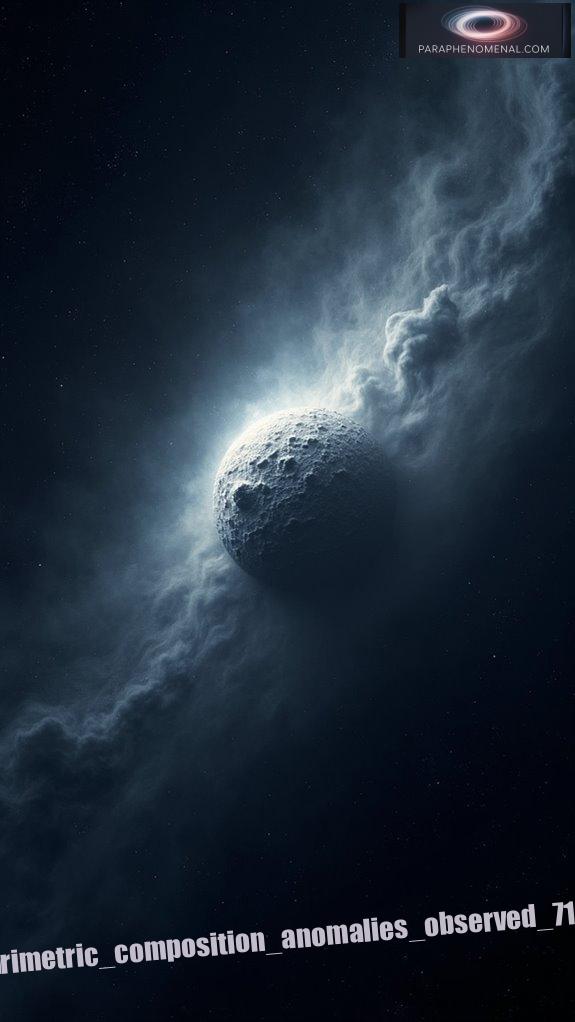
When studying celestial bodies like 3I/ATLAS, researchers often uncover striking anomalies in both polarimetric and compositional data. The polarimetric analysis reveals extreme negative polarization, a unique feature previously unseen in other comets or asteroids. This causes an unmatched level of intrigue about its grain properties and surface composition. Additionally, the compositional diversity shows a low water content, with carbon dioxide dominating the gas plume. This peculiar mix suggests formation under cold, CO₂-rich conditions, challenging our understanding of cometary bodies.
Notably, the object’s trajectory alignment with our solar system’s planets provokes further questions about its origin and potential purpose, its unusual interstellar speed indicates that it has traveled through the solar system at velocities exceeding typical cometary speeds. Our efforts at ParaPhenomenal highlight such fascinating findings, paving the way for deeper exploration of these extraordinary celestial entities.
2. Brightness and Photometric Anomalies
3I/ATLAS’s brightness and photometric anomalies reveal extraordinary features that stand out among celestial bodies.
You’ll find that these phenomena include:
- A dramatic brightness spike during perihelion due to coronal mass ejections.
- A sudden shift to a deep broadband blue emission, indicating a hotter object than typical comets. Observations suggest that this coloration aligns with the comet’s proximity to the Sun.
- Photometric consistency despite variations in brightness measurements, which challenge known comet activity models. Additionally, new observations have highlighted its anomalous brightness reminiscent of potential extraterrestrial technology.
Each anomaly suggests 3I/ATLAS is fundamentally different, possibly defying natural explanations, a theme we explore through ParaPhenomenal to understand the universe’s mysteries.
Your curiosity allows you to see beyond what’s known.
3. Size, Mass, and Physical Scale Anomalies

Understanding the size, mass, and physical scale anomalies of 3I/ATLAS reveals even more about its unique nature.
Nucleus size estimates vary widely, with some suggesting a diameter from 0.32 km to 5.6 km, but density estimates indicate that a smaller nucleus, maybe under 1 km, is likely. The nucleus estimated diameter reflects its distinction as an interstellar object, potentially altering our understanding of comet formations. This inconsistency in size estimates underscores the unique characteristics that set 3I/ATLAS apart from typical comets.
Surface properties are unusual, featuring reflective dust and possibly icy or metallic elements.
Activity patterns include significant dust ejection and unusual sublimation, complicating our understanding.
These anomalies challenge conventional comet assumptions and stir curiosity, highlighting the need for deeper exploration, a goal we at ParaPhenomenal endeavor to pursue through our detailed investigations of celestial phenomena.
4. Trajectory and Kinematic Anomalies
The trajectory and kinematic anomalies of 3I/ATLAS reveal some fascinating aspects of this interstellar object.
Consider the following key points:
- It follows a hyperbolic trajectory with eccentricity ~6.137, the highest recorded.
- Its speed upon Solar System entry was about 58 km/s, remarkably faster than its predecessors.
- Trajectory analysis shows an alignment with the ecliptic plane, suggesting non-random path selection. Additionally, its potential artificial propulsion indicates that traditional celestial mechanics may not fully explain its behavior. This raises further interest in the interstellar origin of 3I/ATLAS, as it challenges our current understanding of object formations in space.
These kinematic discrepancies raise questions about gravitational interactions and have important observational implications.
Such anomalies fuel ongoing debate about natural versus artificial origins, highlighting the complexities of what we consider normal in celestial mechanics.
5. Spectral and Color Anomalies

Anomalies observed in 3I/ATLAS’s spectral and color signatures add an interesting dimension to its study.
You’ll notice that its spectroscopic signatures reveal unexpectedly strong chemical emissions, hinting at unusual reactions. The object exhibited an unusual blue coloration, diverging from the typical red hue of comets. This striking shift suggests energized gases at play, rather than merely reflected sunlight.
Furthermore, its emissions lacked the common markers of typical cometary outgassing. These anomalies challenge existing theories, inviting deeper exploration into the complex processes governing 3I/ATLAS, making it an enchanting subject for those seeking to understand the cosmos through ParaPhenomenal. Additionally, its hyperbolic trajectory raises questions about its origins and potential interactions with other celestial bodies.
6. Hypothesized Artificial/Extraterrestrial Technology Signatures
While exploring 3I/ATLAS, researchers stumbled upon signals that intrigue and challenge our understanding of celestial phenomena.
They detected a mysterious pulse sequence at 1420 MHz, suggesting possible extraterrestrial communications.
Consider these key points:
- The Fibonacci-like pattern implies intelligent design.
- Non-gravitational acceleration hints at engineered propulsion.
- Unusual outgassing suggests advanced material engineering.
These elements raise questions about 3I/ATLAS and whether it’s merely a cosmic wanderer or a product of advanced technology.
Understanding these signatures might redefine our grasp of the universe, making the quest for knowledge all the more essential at ParaPhenomenal.
7. Unusual Negative Polarization Characteristics

Although many celestial bodies exhibit predictable polarization characteristics, 3I/ATLAS stands out with its strikingly unusual negative polarization branch, revealing complexities in its structure and composition.
You’ll notice its deep and narrow negative polarization reaches around -2.7% at a phase angle close to 7°. This low inversion angle, along with extreme negative polarization, indicates unique surface anomalies and suggests unusual scattering behaviors.
The data suggests a surface dominated by large particles and a coma rich in water ice and dark materials, pointing to a fascinating blend of characteristics.
3I/ATLAS redefines what we comprehend about the diversity of small solar system bodies.
8. Rapid Brightening Events
Rapid brightening events in 3I/ATLAS present a remarkable contrast to the unusual negative polarization characteristics previously discussed.
These events showcase unexpected brightness patterns and rapid luminosity changes that have puzzled astronomers.
Here are three key aspects of these phenomena:
- 3I/ATLAS brightened at twice the typical rate during perihelion, reaching V magnitude 9.
- Its unique composition may lead to heightened gas surges and emission colors.
- Observational data confirmed an unusual blue hue, indicating prominent gas emissions rather than dust.
Discovering these anomalies is why we created ParaPhenomenal, aiming to decipher cosmic mysteries and share them with you.
9. Coma Composition and Material Differences

The coma of comet 3I/ATLAS presents a fascinating mix of materials, challenging our understanding of comets in the solar system.
With a carbon dioxide-to-water ice ratio of about 8:1, it reveals material differences uncommon in other comets. This high carbon dioxide content indicates unique formation conditions, possibly from a carbon-rich parent system.
While traces of water ice exist, they’re less abundant, suggesting a mixed but complex coma composition. Such findings spark curiosity about this comet’s origin, urging us to explore its distinctive properties.
At ParaPhenomenal, we investigate these anomalies, aiming to uncover the secrets of the universe together.
10. Non-gravitational Acceleration Observations
As we explore the unusual properties of comet 3I/ATLAS, an intriguing phenomenon emerges in the form of non-gravitational acceleration.
This acceleration raises questions about its origin and implications, and you might consider these key points:
- Comet-like outgassing could be creating non-gravitational forces, propelling 3I/ATLAS.
- Alternatively, it might involve technological sources, such as a propulsion engine, suggested by rapid color changes.
- Data gaps challenge our understanding of acceleration mechanisms, leaving much to discover.
These observations invite curiosity about the nature of 3I/ATLAS, highlighting why we created ParaPhenomenal— to further explore such enigmatic occurrences.
11. Comparison to Known Interstellar Objects
While exploring the characteristics of known interstellar objects, you’ll find that 3I/ATLAS stands out in several remarkable ways.
Its incredible speed of 58 km/s surpasses 1I/ʻOumuamua and 2I/Borisov, illustrating distinct interstellar dynamics.
Additionally, 3I/ATLAS features the highest recorded orbital eccentricity, confirming its unique hyperbolic trajectory, which allows it to exit our Solar System permanently.
While its classification remains consistent with comets, its lack of a visible tail raises questions.
These anomalies, which we note on ParaPhenomenal, enrich our understanding of interstellar classification and the fascinating diversity among objects traveling through space.
FAQ
How Was 3i/Atlas Discovered Initially?
You’ll find that 3I/ATLAS was initially discovered on July 1, 2025, through collaborative research by the ATLAS survey telescope in Chile, marking a significant moment in the discovery timeline of interstellar objects.
What Telescopes Were Used for Observing 3i/Atlas?
Like stargazers painting the night, amateur telescopes joined forces with advanced instruments, employing diverse observation techniques to capture the enigmatic 3I/ATLAS. This collaboration between passion and technology revealed understandings into the comet’s celestial journey.
What Specific Measurements Were Taken During Its Observations?
You’ll find that measurements during observations included light intensity variations, tracking brightness changes, and evaluating the orbital trajectory, confirming the comet’s hyperbolic path while mapping its unique features and behaviors across its journey.
Are There Any Plans for Future Observations of 3i/Atlas?
Yes, there’re exciting future observation plans for 3I/ATLAS. Various missions, including Hubble and JWST, are set to capture essential data during its close approach in December 2025, allowing you to discover interstellar mysteries firsthand.
What Are the Implications of These Findings for Future Interstellar Missions?
Your interstellar travel plans must embrace innovative technologies, balancing unpredictability with safety. As findings reveal complex interactions, you’ll refine navigation and prepare for potential encounters, ensuring freedom while advancing toward unexplored cosmic domains.
References
- https://en.wikipedia.org/wiki/3I/ATLAS
- https://www.youtube.com/watch?v=OVSp-qoVHwQ
- https://interestingengineering.com/space/3i-atlas-a-city-sized-alien-spacecraft
- https://economictimes.com/news/international/us/3i/atlas-shows-signs-of-alien-engine-and-non-gravitational-acceleration-harvard-scientist-explains-interstellar-objects-abnormal-behavior-avi-loeb-blue-color-artificial-propulsion-manhattan-sized-solar-spacecraft/articleshow/125026995.cms
- https://arxiv.org/pdf/2509.05181
- https://futurism.com/space/nine-reasons-avi-loeb-3i-atlas
- https://www.primetimer.com/features/what-are-the-nine-anomalies-in-3i-atlas-observations-that-challenge-its-natural-origins-according-to-harvard-scientist-avi-loeb
- https://www.iflscience.com/interstellar-comet-3iatlas-shows-extreme-negative-polarization-what-does-that-mean-81012
- https://www.youtube.com/watch?v=bwJgcflf0lM
- https://www.youtube.com/watch?v=2_5eZJX0cc4
- https://thespacestore.com/blogs/blog/why-the-controversy-around-3i-atlas-theories-are-good-for-astronomy
- https://astrobiology.com/2025/08/hubble-makes-size-estimate-of-interstellar-comet-3i-atlas.html
- https://www.livescience.com/space/comets/3i-atlas-is-7-miles-wide-the-largest-interstellar-object-ever-seen-new-photos-from-vera-c-rubin-observatory-reveal
- https://science.nasa.gov/missions/hubble/as-nasa-missions-study-interstellar-comet-hubble-makes-size-estimate/
- https://economictimes.com/news/international/us/3i/atlas-mysterious-pulse-sequence-and-mothership-small-probes-release-claim-explained-why-is-us-government-silent-heres-alien-technology-claims-scientific-anomalies-massive-size-composition-interstellar-object-harvard-astrophysicist-avi-loeb-nasa-artificial-craft-natural-comet/articleshow/124904114.cms
- https://science.nasa.gov/solar-system/comets/3i-atlas/
- https://skyandtelescope.org/astronomy-blogs/explore-night-bob-king/all-eyes-on-interstellar-comet-3i-atlas/
- https://www.esa.int/Science_Exploration/Space_Science/Comet_3I_ATLAS_frequently_asked_questions
- https://esahubble.org/news/heic2509/
- https://cosmicpursuits.com/3880/a-visitor-from-beyond-comet-3i-atlas-rounds-the-sun/
- https://www.youtube.com/watch?v=A4Kfix9nNN4
- https://economictimes.com/news/international/us/3i/atlas-interstellar-object-turns-blue-near-sun-october-29-observations-anomalies-and-upcoming-earth-approach/articleshow/124955926.cms
- https://richardjamesrogers.com/2025/10/26/the-3i-atlas-enigma-interstellar-anomalies-the-wow-signal-and-lessons-for-the-classroom/
- https://www.youtube.com/watch?v=Ul7eqSkEzZM
- https://www.spectroscopyonline.com/view/3i-atlas-an-interstellar-enigma-natural-comet-or-engineered-probe-
- https://arxiv.org/html/2507.12213v1
- https://unionrayo.com/en/comet-3i-atlas/
- https://lweb.cfa.harvard.edu/~loeb/HCL25.pdf
- https://timesofindia.indiatimes.com/technology/tech-news/elon-musk-and-joe-rogan-talk-about-alien-object-3i/atlas-aiming-at-earth-that-harvard-scientist-have-declared-is-not-natural-and-the-link-to-the-tunguska-event/articleshow/125022676.cms
- https://www.youtube.com/watch?v=hV78BxrTZig