
Ever wonder about the origins of mysterious objects wandering our solar system?
3I/ATLAS is no exception.
I feel captivated by its story.
Ejected from a distant star system, it was flung into the vastness of interstellar space due to gravitational chaos among nearby stars.
Imagine the tumult of supernovae and instability creating this cosmic wanderer!
With ancient materials, 3I/ATLAS might just be a window into early planetary formation.
What secrets does it hold about our universe?
The journey of 3I/ATLAS sparks my curiosity—what else have we yet to discover?
UFO Sightings and Cosmic Curiosities: A Personal Anecdote
I’ll never forget the night I witnessed a UFO hovering over my hometown.
While stargazing, I felt a strange pull—something beyond the allure of constellations.
Could it have been a visitor from a distant star system, like 3I/ATLAS?
My heart raced as I observed its erratic movements, reminiscent of gravitational forces at play in space.
This experience opened my eyes to the possibility that the universe is filled with secrets just waiting to be unraveled.
Topics like extraterrestrial life, cosmic phenomena, and gravitational anomalies have since fascinated me, connecting the dots between UFO sightings and celestial bodies.
Quick Takeaways
- Gravitational dynamics during early star system formation lead to ejection of smaller bodies into interstellar space.
- Nearby stars create gravitational interactions, often resulting in planetary instability and ejection events.
- Massive stellar events, like supernovae, contribute significantly to the formation and ejection of interstellar objects.
- 3I/ATLAS likely formed in the thick disk of the Milky Way, characterized by older, metal-poor stars.
- Understanding these ejection mechanisms enhances knowledge about the origins of interstellar objects such as 3I/ATLAS.
Interstellar Origin and Journey of 3I/ATLAS
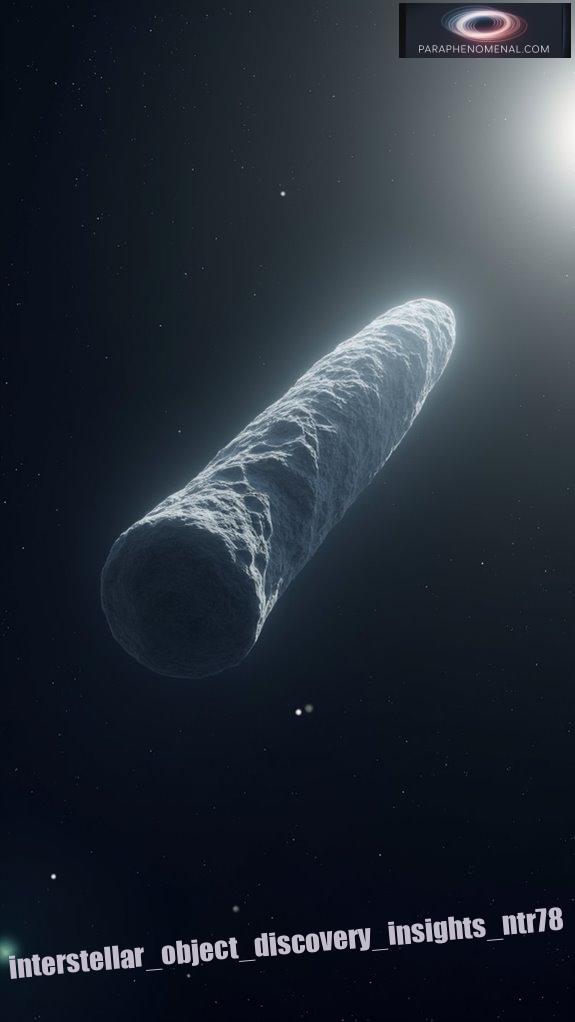
While exploring the vast reaches of space, scientists discovered 3I/ATLAS on July 1, 2025, making it only the third known interstellar object to enter our Solar System.
This fascinating object likely originated from a distant star system, born from the processes of stellar migration. Its hyperbolic trajectory, traveling at 61 km/s, signals a long journey through cosmic filaments and dense star fields near the Galactic Center, where many stellar migration processes shape the formation of such bodies.
Despite the challenges in early detection, data gathered reveals that 3I/ATLAS carries pristine materials, unaltered by Solar System influences. The maximum orbital speed of this unique comet reaches up to 68.3 km/s at its closest approach to the Sun, a testament to its interstellar journey.
Data indicates that 3I/ATLAS holds untouched materials, offering a glimpse into the cosmos before Solar System influence.
As researchers study this ancient messenger, they’re revealing more about the universe we navigate. Continued observations will enhance our understanding of interstellar objects and the vast dimensions we seek to explore at ParaPhenomenal.
Age and Galactic Context of 3I/ATLAS
3I/ATLAS not only captivates scientists with its origin story but also poses intriguing questions about its age and the broader galactic framework.
Preliminary age estimation suggests it could be around 311 billion years old, making it the oldest detected interstellar object. Even a conservative estimate of about 7 billion years still highlights its significant age compared to our solar system’s 4.5 billion years. This remarkable age aligns with the characteristics of interstellar visitors that originate from older parts of the Milky Way.
Its possible origins come from the thick disk of the Milky Way, a place filled with older, metal-poor stars. This connection to galactic history enriches our understanding of how early planetary systems formed in a vastly different chemical environment, as the age of 3I/ATLAS indicates a history that could greatly inform our knowledge of stellar evolution. As we explore its age, we learn more about our galaxy and its evolution.
Physical Characteristics of 3I/ATLAS
Many fascinating aspects define the physical characteristics of 3I/ATLAS, making this interstellar object an intriguing subject for astronomers.
The nucleus size is estimated to range from 1,000 feet to 3.5 miles across, though it’s not directly visible due to the surrounding coma. Observations confirm this icy nucleus is active, typical of comet classification, and recent studies have provided insights into its composition of the nucleus, further emphasizing its unique characteristics.
The coma activity suggests a significant dust production rate, with an estimated mass-loss between 0.1 and 1.0 kg/s. Dust particles vary in size and are ejected at speeds reaching 1 m/s. As you investigate deeper into studying 3I/ATLAS, you’ll find that ongoing research aims to refine our understanding of its nucleus and coma activity, revealing more about its enigmatic nature. Additionally, the comet is classified as a comet due to its icy nucleus and active coma, linking it with traditional cometary behavior.
Theories of Ejection From Host Star Systems
The ejection of objects like 3I/ATLAS from their host star systems is a fascinating process influenced by various gravitational and dynamic interactions.
Gravitational influence from nearby stars plays a critical role, particularly during early star system formation when planets are still settling. As these systems evolve, planetary instability often leads to the chaos necessary for ejections.
Gravitational forces from nearby stars significantly influence early star system formation, creating chaos that leads to planetary ejections.
Gravitational interactions among planets can fling smaller bodies, like comets, into the vastness of interstellar space. Moreover, massive stellar events, such as supernovae or close encounters with other stars, can also cause objects to be expelled.
Understanding these mechanisms helps you grasp the origins of unusual interstellar objects, like 3I/ATLAS, and appreciating our quest for knowledge through ParaPhenomenal enriches this experience.
Role in Planetary Formation Theories
Understanding the role of objects like 3I/ATLAS in planetary formation theories reveals how essential these icy bodies are in developing our knowledge of the universe.
These elements provide valuable perspectives, including:
- Formation implications regarding the origins of icy bodies beyond the CO₂ frost line.
- Compositional analysis helping us understand chemical gradients within protoplanetary disks.
- Evidence of volatile compounds indicating cold formation environments far from their host stars.
- Links to the potential formation zones of outer planetesimals, offering clues about extrasolar systems.
Studying these factors not only aids in refining the models of material distribution but also enhances our grasp of how planetary systems evolve.
Current Observations and Future Research on 3I/ATLAS
As 3I/ATLAS continues its journey through the solar system, various observational campaigns are in full swing, revealing intriguing reflections into its nature.
Recent discoveries, like hydrogen cyanide emissions detected by the James Clerk Maxwell Telescope, suggest complex chemical processes at play.
Recent findings of hydrogen cyanide emissions indicate intriguing complexity in 3I/ATLAS’s chemical processes.
Ground-based telescopes from Hawaii, Chile, and Australia, along with space-based instruments like Hubble and James Webb, employ advanced observational techniques to gather valuable data.
ESA’s Mars Express and Juice missions also provide unique understandings during 3I/ATLAS’s perihelion. Observations from space telescopes highlight the comet’s remarkable features and offer insights into its interstellar characteristics.
Future research aims to analyze elemental composition and potential origins through ongoing observations, permitting comparisons between interstellar and solar-system bodies.
This collaboration fosters the understanding that drives our curiosity, allowing us to explore the cosmos freely, and is part of what fuels ParaPhenomenal’s creation.
FAQ
How Can We Differentiate Between Cometary and Asteroidal Objects?
To differentiate between cometary and asteroidal objects, you’ll want to examine their nucleus composition and surface characteristics.
Comets generally contain more ice and volatile materials, while asteroids are more solid and mineral-rich.
Comets display comas and tails, indicating their volatile contents, whereas asteroids lack these features.
What Instruments Are Used to Observe 3i/Atlas?
To observe 3I/ATLAS, scientists use various instruments, including optical telescopes for capturing visible light and infrared spectroscopy to analyze its thermal emissions.
These tools help determine the object’s composition and behavior, revealing its cometary nature. Ground-based and space-based observatories contribute to tracking its movement and monitoring changes, making the observations essential.
At ParaPhenomenal, we endeavor to deliver detailed understanding about celestial events like this, ensuring you stay informed about the universe’s wonders.
Are There Any Known Interactions With Other Celestial Bodies?
3I/ATLAS hasn’t had significant celestial interactions with other bodies.
Computer simulations reveal it traveled largely untouched by gravitational influences from neighboring stars, retaining its ancient nature.
Approaching the Sun from 1.4 AU, it poses no threat to Earth.
As you ponder its journey, the vastness of interstellar space ignites wonder; this comet, despite its high speed and grand history, remains a solitary traveler through the cosmos, far from the entanglements of our solar system.
How Might 3i/Atlas Affect Earth’s Environment During Close Approaches?
3I/ATLAS won’t considerably affect Earth’s environment during close approaches.
With gravity influences so far away, there aren’t any expected environmental shifts. At its closest, 3I/ATLAS maintains a distance that prevents any debris from reaching us.
The comet’s high-speed passage keeps its materials localized, ensuring Earth remains unaffected.
While we monitor its activity for scientific purposes, any possible impacts are negligible, keeping our planet safe and allowing us to satisfy curiosity about the cosmos.
Could Future Missions Directly Sample 3i/Atlas or Similar Objects?
Sampling 3I/ATLAS or similar objects is like trying to catch lightning in a bottle; it’s fast, unpredictable, and demanding.
Future mission designs could enable sample collection, but advanced technology is essential. Quick-response probes with innovative propulsion will minimize travel time.
You’ll need precise navigation to adapt to their orbits, ensuring instruments withstand harsh environments.
With collaborative efforts, you could finally access vital understandings about these mysterious visitors from beyond our solar system.
References
- https://science.nasa.gov/solar-system/comets/3i-atlas/
- https://ffesp.org/nasa-confirms-3i-atlas-mysterious-interstellar-visitor-enters-solar-system/
- https://timesofindia.indiatimes.com/science/interstellar-object-3i/atlas-is-remarkable-prof-brian-cox-explains-its-origins-and-7-5-billion-year-journey/articleshow/124607576.cms
- https://news.northeastern.edu/2025/09/08/3i-atlas-comet-interstellar-traveler/
- https://lweb.cfa.harvard.edu/~loeb/HCL25.pdf
- https://www.space.com/astronomy/exoplanets/interstellar-objects-might-seed-planetary-formation
- https://www.iflscience.com/interstellar-object-3iatlas-may-be-a-10-billion-year-old-time-capsule-from-an-earlier-age-of-the-universe-81077
- https://www.planetary.org/articles/what-is-comet-3i-atlas
- https://en.wikipedia.org/wiki/3I/ATLAS
- https://science.nasa.gov/missions/hubble/as-nasa-missions-study-interstellar-comet-hubble-makes-size-estimate/
- https://www.youtube.com/watch?v=ZtQHgCEVZ4o
- https://arxiv.org/html/2507.08111v1
- https://www.livescience.com/space/comets/interstellar-visitor-3i-atlas-could-be-the-oldest-comet-ever-seen-and-could-grow-a-spectacular-tail-later-this-year
- https://economictimes.com/news/international/us/3i/atlas-came-from-mysterious-frontier-of-early-milky-way-scientists-study-interstellar-comet-scientists-tracked-its-trajectory-for-millions-of-years-and-suggest-it-could-be-billions-of-years-old/articleshow/124345006.cms
- https://www.space.com/astronomy/asteroids/astronomers-say-new-interstellar-visitor-3i-atlas-is-very-likely-to-be-the-oldest-comet-we-have-ever-seen
- https://www.esa.int/Science_Exploration/Space_Science/Comet_3I_ATLAS_frequently_asked_questions
- https://astrobiology.com/2025/07/interstellar-comet-3i-atlas-discovery-and-physical-description.html
- https://arxiv.org/abs/2507.05252
- https://www.iflscience.com/anti-tail-and-odd-594-kilometer-feature-found-on-interstellar-object-3iatlas-by-keck-observatory-81188
- https://ui.adsabs.harvard.edu/abs/2025MNRAS.542L.139B/abstract
- https://thedebrief.org/3i-atlas-update-what-new-data-reveals-about-the-most-puzzling-interstellar-object-ever-found/
- https://www.astronomy.com/science/comet-3i-atlas-shows-signs-of-water/
- https://www.planetary.org/articles/where-do-3i-atlas-and-other-interstellar-visitors-come-from
- https://www.esa.int/Science_Exploration/Space_Science/ESA_s_ExoMars_and_Mars_Express_observe_comet_3I_ATLAS
- https://science.nasa.gov/blogs/planetary-defense/2025/07/02/nasa-discovers-interstellar-comet-moving-through-solar-system/
- https://www.esa.int/Science_Exploration/Space_Science/ESA_observations_of_interstellar_comet_3I_ATLAS
- https://theskylive.com/c2025n1-info
- https://watchers.news/2025/10/16/unusual-nickel-and-cyanide-emissions-detected-around-interstellar-object-3i-atlas/
- http://dspace.mit.edu/handle/1721.1/28610
- https://arxiv.org/html/2507.00753v1