
Have you ever wondered what lies beyond the stars?
Delving into UFO activity is a fascinating journey.
I carefully study multiple sightings, focusing on recurring features like unusual silhouettes and glowing orbs.
What about the behaviors? Some witnesses describe avoiding interaction, while others feel a pull of curiosity.
Environmental factors also matter; could weather or location shape these occurrences?
Analyzing proximity to these phenomena allows me to gather more vivid accounts.
These patterns help paint a clearer picture of the unknown—and trust me, the discoveries are intriguing.
Unforgettable Close Encounter with a UFO
One balmy night a few summers ago, I experienced something inexplicable.
While stargazing in my backyard, I spotted a strange light off in the distance. It drifted silently, defying the usual aircraft navigation.
As I rushed to grab my camera, the mysterious craft hovered impossibly close, revealing a sleek metallic disc that seemed to shimmer under the moonlight.
I couldn’t help but feel a mix of fear and fascination. Was this a simple military test or something beyond our understanding?
That night reaffirmed my passion for documenting UFO sightings and investigating the broader implications of extraterrestrial life.
Quick Takeaways
- Collect and compare witness reports from multiple encounters to identify shared physical characteristics of humanoid entities.
- Analyze patterns in body shapes, facial structures, and other physical traits documented across various sightings.
- Utilize government investigation findings to enhance understanding of recognized entity classifications based on appearance.
- Document the location and timing of sightings to identify environmental factors that may influence entity traits.
- Investigate recurring behaviors associated with the entities, as these may correlate with their physical manifestations.
Common Physical Traits of Humanoid Entities

When you think about humanoid entities, it’s intriguing to note that they often share common physical traits. These traits can help in entity classifications, important for understanding various beings you might encounter.
You’ll notice consistent features, like similar body shapes or recognizable facial structures, which emerge across reports.
The report reliability plays a significant role in identifying these features. Data from multiple encounters can reveal patterns, emphasizing the importance of gathering trustworthy information. Many government investigations into these sightings have provided further insights into the characteristics of humanoid beings.
Behavioral Patterns Observed in Encounters
In many encounters, distinct behavioral patterns emerge, shaping our understanding of various entities. Recognizing these routines helps in anomaly detection and enhances our ability to engage with these occurrences.
Consider these three common patterns:
- Recurring Actions: Entities often exhibit repeating behaviors, like appearing at similar times or locations during sightings.
- Interaction Responses: The way these entities respond to human presence can vary, including avoidance, curiosity, or aggression.
- Communication Methods: Many entities utilize specific sounds or signals that reveal their intentions, helping with pattern recognition. Additionally, some interactions may correlate with electromagnetic exposure, which has been documented during close proximity alien contact.
Environmental Impact During Sightings

Environmental factors play an essential role in shaping the setting in which sightings of entities occur.
When you observe these events, consider the local ecosystems surrounding you. The availability of water, plant life, and wildlife can influence what you see. Entities might appear more frequently in areas with abundant natural resources, as they rely on resource utilization for their survival or activity.
Changes in weather can also impact sightings; for example, fog may mask details, while clear nights could enhance visibility. Each of these elements shapes the encounter, intertwining nature with the phenomena you experience. Additionally, researchers have noted that UFO sightings can correlate with environmental changes, highlighting the potential connection between natural settings and these occurrences.
Understanding these environmental impacts helps enrich your interpretations of sightings, connecting your experiences to the broader ecosystem in which they unfold, a core idea behind our website, ParaPhenomenal.
Proximity Effects on Witness Accounts
Proximity to an entity can greatly shape the accounts of those who witness it, altering not just what they see but how they interpret their experiences. Your visual perception considerably influences your recollections, and eyewitness reliability may waver based on how close you’re to the phenomenon.
Here are three key points about proximity effects:
- Closer Distance: The nearer you are, the more detail you might notice, which can enhance memory precision.
- Emotional Response: Being close can provoke heightened feelings, affecting how you narrate the event later.
- Group Influence: Witnesses nearby may sway each other’s accounts, leading to shared misconceptions or reinforced memories.
Understanding these nuances helps explain why we created ParaPhenomenal, aiming to analyze and share accurate witness accounts in the domain of extraordinary experiences. The impact of paranormal audio analysis on collecting evidence is crucial for interpreting these experiences effectively.
Government Responses and Investigations
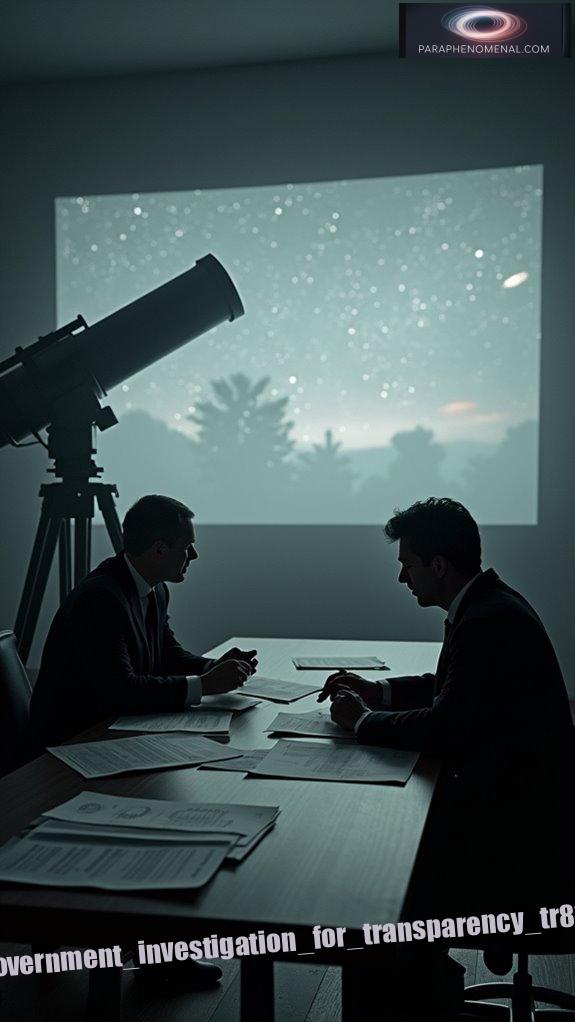
Governments often spring into action when unusual phenomena occur, launching investigations to understand what’s happening and guarantee public safety.
These actions are often driven by a commitment to government transparency, ensuring that citizens aren’t left in the dark about potential threats.
Investigative methods can include gathering witness statements, analyzing physical evidence, and employing scientific techniques.
Transparency during these investigations helps build trust between the government and the public, allowing citizens to stay informed of progress and findings.
While some may view these responses with skepticism, it’s essential to recognize that they can serve as a safeguard against fear and misinformation.
Just as our website, ParaPhenomenal, seeks to clarify these intriguing occurrences, official investigations aim to provide clear understandings into what may seem unexplainable. Additionally, the release of official records of alien encounters by decorated soldiers adds another layer of credibility to these government efforts.
Comparative Analysis of Sighting Reports
As sightings of unusual phenomena continue to capture public attention, analyzing these reports can reveal patterns and similarities that might otherwise go unnoticed.
By examining these accounts, we can better understand people’s interpretations of experiences influenced by socio-cultural factors and psychological impacts.
Here are three aspects to take into account in your analysis:
- Consistency in Descriptions: Similarities in descriptions across reports can highlight common traits that signify authenticity.
- Cultural Setting: The societal backdrop often shapes how individuals perceive and report these encounters, reflecting cultural beliefs and fears.
- Emotional Reactions: Analyzing psychological responses can uncover underlying motivations for reporting, helping to grasp the phenomenon’s deeper significance.
Such analyses are essential for initiatives like ParaPhenomenal aimed at understanding these elusive encounters.
Changes in Entity Descriptions Over Time

Analyzing witnessed phenomena like those covered in the previous section reveals that descriptions can vary markedly over time.
You might notice how long-term observations showcase entity transformation, where traits shift in response to cultural influences, personal experiences, or developing narratives.
Description variability often reflects societal fears, aspirations, or changes in comprehension. For instance, an entity initially described as terrifying may eventually be viewed as a misunderstood figure over decades.
This progressive viewpoint encourages investigation into the reasons behind these transformations, allowing you to connect different interpretations of the same entity.
Resources like ParaPhenomenal help identify these changes, fostering deeper understanding into how societal shifts affect entity descriptions and the beliefs surrounding them.
FAQ
What Tools Help in Identifying Entity Appearance Traits?
To identify entity appearance traits, you can use data visualization tools for clear perspectives, enhancing characteristic mapping. These methods reveal patterns like hidden treasures, empowering you to navigate through vast data environments with freedom and clarity.
How Do Inconsistent Data Affect Entity Identification?
Inconsistent data undermines data reliability, leading to identification inaccuracies. When records contain missing or conflicting information, you’re left with uncertainties that can block effective recognition and linking of entities, limiting your ability to establish clear connections.
Can Behavioral Patterns Vary Among Similar Entities?
Yes, behavioral patterns can vary among similar entities. You’ll notice behavioral similarities at times, but entity differences often lead to unique actions, making it essential to analyze each case with an open mindset for understanding.
What Are the Challenges in Entity Resolution?
You’ll face a wild jungle of challenges in entity resolution! With messy data quality, tangled resolution algorithms, confusing entity overlap, and tricky similarity metrics, it’s a chaotic dance that demands your sharpest skills to tame.
How Does Machine Learning Assist in Trait Identification?
Machine learning algorithms enhance trait identification by analyzing patterns in datasets. You can leverage data preprocessing techniques to clean and structure data, ensuring your models effectively recognize and link recurring traits across various settings for ideal understanding.
References
- https://docs.lib.purdue.edu/cgi/viewcontent.cgi?article=2712&context=cstech
- https://www.puppygraph.com/blog/entity-resolution
- https://pmc.ncbi.nlm.nih.gov/articles/PMC7485218/
- https://gofishdigital.com/blog/identifying-entity-attribute-relations/
- https://www.gaussalgo.com/insights/revealing-sensitive-documents-with-entity-recognition
- https://cloud.google.com/discover/what-is-entity-extraction