
The mysteries of the cosmos never cease to amaze me.
Did you know that the 3I/ATLAS initiative launched in 2020 aims to uncover the secrets of interstellar objects?
On July 1, 2025, it detected an interstellar visitor—confirming its astonishing hyperbolic trajectory!
Imagine the excitement as we anticipate its closest approach to the Sun on October 29, 2025.
I can’t wait for the follow-up observations planned for December.
What could this mean for our understanding of cosmic phenomena?
Are we truly alone in the universe?
A Close Encounter: My Own UFO Sightings
I’ll never forget my own experiences with unidentified flying objects.
It was a warm summer night when I spotted a peculiar light in the sky.
At first glance, I thought it was a star.
But it began moving in ways that defied logic—darting, hovering, then disappearing!
This experience drew me deeper into researching UFOs and interstellar phenomena.
Like the 3I/ATLAS project, my curiosity heightened around the notion of extraterrestrial life and advanced technologies.
Could those encounters be linked to broader cosmic activities we’re yet to understand?
Quick Takeaways
- Initial concept development for the 3I/ATLAS project began in 2020, emphasizing technological advancements and data analysis improvement.
- Major project phases are scheduled, with key deliverables anticipated by 2025 to ensure timely progress.
- Iterative assessments of project milestones are planned every six months, allowing for adjustments and refinements.
- The project’s final outcomes are projected for public release in late 2025, aiming to share knowledge with the community.
- Collaboration with academic institutions and industry experts is ongoing to enhance the project’s impact and knowledge sharing.
Discovery and Initial Identification

On July 1, 2025, the NASA-funded ATLAS survey telescope at Río Hurtado, Chile, detected a faint object in the sky, marking the discovery of what would become known as 3I/ATLAS.
This event sparked immediate interest and initial reactions worldwide, as astronomers quickly recognized its significance. Utilizing advanced discovery techniques, scientists noted an initial magnitude of 18, indicating a challenging observation. Within hours, follow-up observations began, while professional and amateur astronomers contributed data from various locations. Early hypotheses suggested the object had a highly eccentric orbit, leading to alerts for further confirmation. Additionally, early characteristics revealed that 3I/ATLAS was confirmed to have a hyperbolic trajectory, ruling out its status as a Near-Earth Object. This unique interstellar origin has fueled speculation around the potential for evidence supporting extraterrestrial phenomena.
The intrigue surrounding 3I/ATLAS drives our mission at ParaPhenomenal, emphasizing the importance of sharing groundbreaking discoveries like this one for everyone to explore.
Orbital Timeline and Trajectory Details
As the excitement around 3I/ATLAS grows, understanding its orbital timeline and trajectory details becomes essential for astronomers and enthusiasts alike.
You’ll find that 3I/ATLAS follows a hyperbolic orbit, characterized by an eccentricity of 6.13941774. This trajectory analysis reveals the comet’s closest approach to the Sun will occur on October 29, 2025, at a distance of 1.36 AU, while it’ll reach about 1.8 AU from Earth. Given its significant velocity, you can expect dramatic orbital predictions, but rest assured, there’s no threat to our planet. The unique trajectory doesn’t allow for a closed orbit, making each interaction with our solar system a rare event to witness and analyze, as we endeavor to enhance understandings at ParaPhenomenal. Additionally, it is noteworthy that the discovery date of 3I/ATLAS was July 1, 2025, marking its entry into astronomical observation.
Origin, Age, and Scientific Significance
The discovery of 3I/ATLAS marks a significant milestone in our understanding of interstellar objects. Discovered on July 1, 2025, by the ATLAS survey telescope, it approaches with a hyperbolic trajectory that confirms its interstellar origin, having emitted light and displayed cometary behavior.
At about 1 kilometer in diameter, this active comet adds to our interstellar exploration efforts, representing a unique case within known interstellar objects due to its unique characteristics. The hyperbolic trajectory suggests that it originated from a distant star system, highlighting the hyperbolic trajectory characteristics that define interstellar comets.
As the third confirmed interstellar visitor, it helps us learn about material formed beyond our Solar System. Its coma, identified through spectrographic observations, allows scientists to study the chemistry of extrasolar cometary material, enhancing models of planet formation.
In creating ParaPhenomenal, we endeavor to connect you with such groundbreaking discoveries, fostering a deeper appreciation for the cosmos.
Observational Campaign
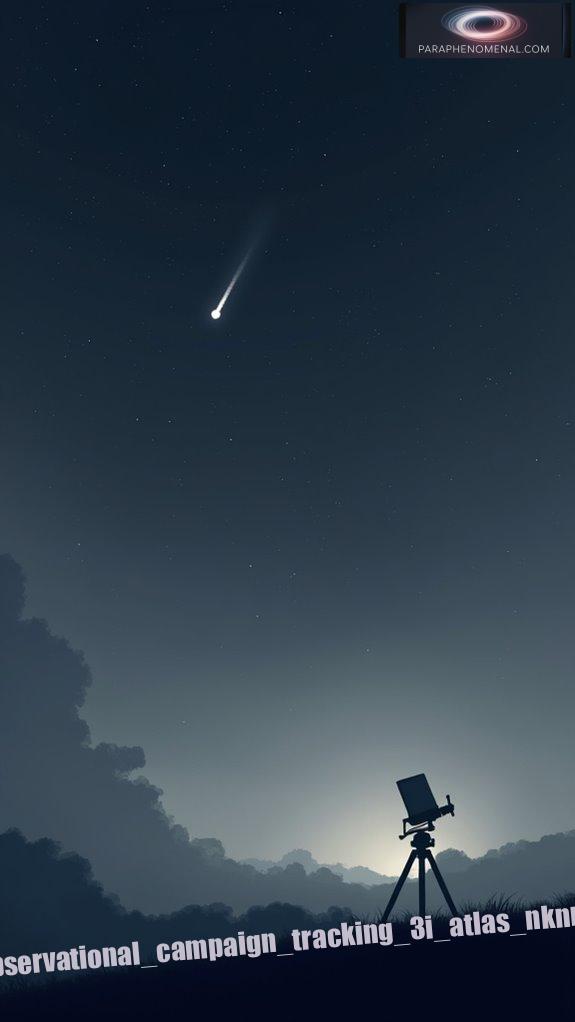
Since 3I/ATLAS was discovered, astronomers have been keen to track its journey and characterize its unique features during the observational campaign.
This period allows for essential pre-perihelion observations and sets the stage for in-depth post-perihelion analysis.
Key aspects of the observational campaign include:
- Pre-perihelion observations enabled by months of inbound tracking before October 29, 2025.
- The use of JWST for capturing post-perihelion data in December 2025 to analyze changes in brightness and composition.
- Ground-based citizen scientists invited to contribute critical observations before and after perihelion.
Engaging with 3I/ATLAS and participating in this journey deepens our understanding of these celestial objects, supporting the goal of ParaPhenomenal to explore and share the wonders of the universe.
Media Resources and Public Engagement
Media resources and public engagement play an essential role in the way we connect with the discovery of 3I/ATLAS. Through effective media outreach, NASA and various observatories share critical updates, ensuring that the public stays informed about this exciting interstellar object.
Public education initiatives, including interactive multimedia and live events, help demystify the science behind 3I/ATLAS. These resources support citizen involvement, as amateur astronomers are invited to contribute their observations.
Social media platforms serve as key tools for scientists to communicate their findings and address misconceptions.
Comparisons With Other Interstellar Objects
Comparing 3I/ATLAS with other interstellar objects reveals fascinating differences and similarities that help us understand its unique role in cosmic history.
You may notice several key points in its comparison with both 1I/ʻOumuamua and 2I/Borisov:
- 3I/ATLAS has the highest hyperbolic excess velocity, around 58 km/s, showcasing its dynamic interstellar journey.
- Its orbital eccentricity is a striking 6.137, the most hyperbolic of known interstellar objects, highlighting its trajectory anomalies.
- Furthermore, 3I/ATLAS is estimated to be about 7.5 billion years old, providing a glimpse into an interesting period of early galactic evolution.
- Notably, the composition of 3I/ATLAS includes volatile compounds, making it similar yet distinct from other interstellar visitors.
Understanding these elements not only serves our curiosity but gives perspective to observations on websites like ParaPhenomenal, expanding our view of the universe.
Future Research and Observations
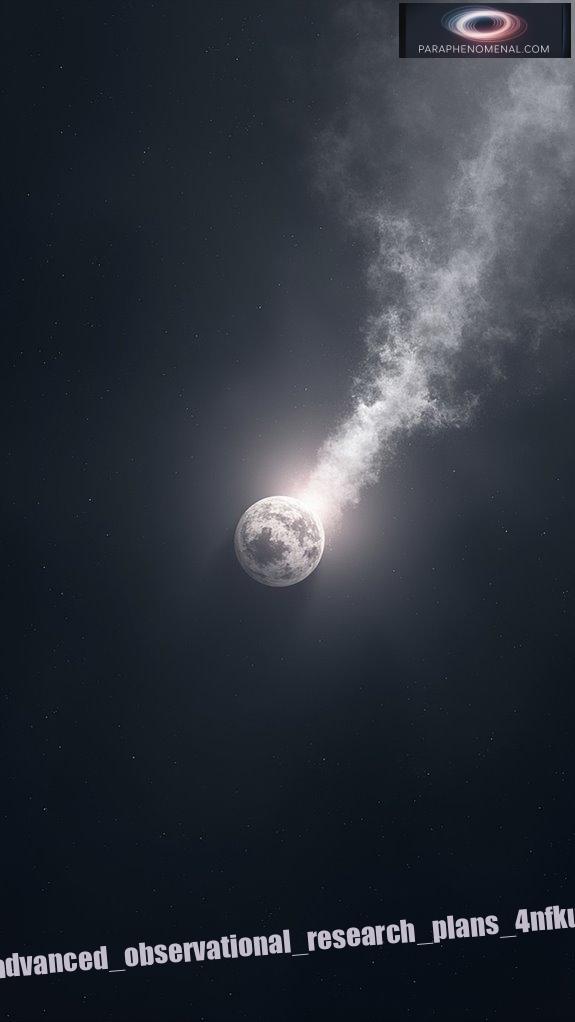
As astronomers prepare for the upcoming phases of observation for 3I/ATLAS, they’re focused on understanding its unique behavior and characteristics. They plan to utilize advanced imaging techniques and engage in thorough data analysis to unravel the comet’s mysteries.
Multi-wavelength campaigns, from radio to X-ray, will probe its nucleus structure and frenetic coma chemistry. Likewise, high-resolution imaging will help them assess the nucleus rotation and any outgassing asymmetries.
Multi-wavelength campaigns will unveil the nucleus structure and coma chemistry of 3I/ATLAS, enhancing our understanding of its dynamics.
Expect them to refine theories on interstellar object origins through theoretical modeling of non-gravitational forces. Archival searches for pre-discovery images will also extend its orbital arc, offering deeper understanding. Additionally, researchers are investigating the trajectory options for NASA’s missions to efficiently study 3I/ATLAS.
At ParaPhenomenal, our goal is to share this exciting journey of discovery with you, enhancing collective knowledge of interstellar phenomena.
FAQ
How Does 3i/Atlas Compare to Asteroids in Our Solar System?
3I/ATLAS differs greatly from asteroids in our solar system. Its composition includes a bright coma, indicating active gas and dust emissions, which is typical for comets but not for asteroids.
In your interstellar comparison, you’ll notice 3I/ATLAS has a hyperbolic orbit, unlike the bound elliptical orbits of asteroids.
With a nucleus likely less than 1 km, it’s generally smaller and more active than most asteroids you’d encounter, enhancing the intriguing nature of its journey.
What Tools Are Used to Study Interstellar Objects Like 3i/Atlas?
To study interstellar objects like 3I/ATLAS, scientists use a range of tools. They conduct spectroscopic analysis to uncover the object’s chemical makeup, revealing secrets hidden in its light.
Trajectory modeling helps predict its path, essential for understanding its origins. Regular sky surveys help in detecting these fast-moving entities, while specialized telescopes provide detailed observations.
The urgency of gathering data before the object departs inspires the creation of resources like ParaPhenomenal.
Can 3i/Atlas Be Seen With Amateur Telescopes?
No, 3I/ATLAS won’t be easily seen with amateur telescopes right now. Its visual magnitude is around 15, too faint for most of your equipment.
However, by November 2025, conditions should improve for amateur observation.
You’ll need a large telescope operating at low magnification, excellent night sky clarity, and good star charts to locate it.
Patience will be essential, especially since brightness may change unexpectedly.
Keep looking up!
What Impact Might 3i/Atlas Have on Solar System Exploration?
3I/ATLAS might revolutionize solar system exploration by showcasing technological advancements in tracking and understanding interstellar objects.
You’ll gain perspectives into exploration strategies by examining its composition, outgassing, and behavior near the Sun.
This data helps refine models of planetary formation and could offer clues about our cosmic neighborhood.
As you observe and learn more, you’ll appreciate how observing these celestial travelers impacts theories on comet interaction and the evolution of solar systems.
How Often Do Interstellar Objects Pass Through Our Solar System?
Interstellar objects (ISOs) pass through our solar system quite frequently, with about three solar encounters happening each day.
This means you could expect roughly 10,000 ISOs residing within Neptune’s orbit at any given moment. These objects, often undetected, come from various stellar origins and demonstrate a continuous flow through our solar space.
Understanding these interstellar frequencies fascinates astronomers and is a key reason why we created this website, ParaPhenomenal, to explore these cosmic wonders.
References
- https://www.seti.org/news/comet-3iatlas-a-visitor-from-beyond-the-solar-system/
- https://science.nasa.gov/solar-system/comets/3i-atlas/
- https://economictimes.com/news/international/us/3i/atlas-came-from-mysterious-frontier-of-early-milky-way-scientists-study-interstellar-comet-scientists-tracked-its-trajectory-for-millions-of-years-and-suggest-it-could-be-billions-of-years-old/articleshow/124345006.cms
- https://ffesp.org/nasa-confirms-3i-atlas-mysterious-interstellar-visitor-enters-solar-system/
- https://www.esa.int/Science_Exploration/Space_Science/ESA_observations_of_interstellar_comet_3I_ATLAS
- https://www.youtube.com/watch?v=XEggZo3SXNM
- https://science.nasa.gov/solar-system/comets/3i-atlas/comet-3i-atlas-multimedia/
- https://en.wikipedia.org/wiki/3I/ATLAS
- https://science.nasa.gov/blogs/planetary-defense/2025/07/02/nasa-discovers-interstellar-comet-moving-through-solar-system/
- https://www.esa.int/Science_Exploration/Space_Science/Comet_3I_ATLAS_frequently_asked_questions
- https://www.youtube.com/watch?v=-vzafaw0t08
- https://www.livescience.com/space/comets/comet-3i-atlas-is-losing-water-like-a-fire-hose-on-full-blast-rewriting-what-we-thought-we-knew-about-alien-star-systems
- https://theskylive.com/articles/2025/07/3i-atlas-a-month-by-month-observing-guide
- http://www.aerith.net/comet/catalog/0003I/2025N1.html
- https://theskylive.com/c2025n1-info
- https://www.cobs.si/comet/2643/
- https://astro.vanbuitenen.nl/comet/3I
- https://arxiv.org/pdf/2507.05252
- https://www.iflscience.com/anti-tail-and-odd-594-kilometer-feature-found-on-interstellar-object-3iatlas-by-keck-observatory-81188
- https://www.planetary.org/articles/what-is-comet-3i-atlas
- https://www.youtube.com/watch?v=ZtQHgCEVZ4o
- https://www.skyatnightmagazine.com/news/comet-3i-atlas-images
- https://news.northeastern.edu/2025/09/08/3i-atlas-comet-interstellar-traveler/
- https://www.iflscience.com/jupiter-bound-mission-to-snap-interstellar-comet-3iatlas-this-campaign-was-unexpected-for-everybody-81074
- https://www.planetary.org/planetary-radio/2025-3i-atlas
- https://www.youtube.com/watch?v=AiS5-eoa9IE
- https://www.seti.org/news/visitors-from-the-stars-understanding-comet-atlas-without-the-hype/
- https://timesofindia.indiatimes.com/science/interstellar-object-3i/atlas-is-remarkable-prof-brian-cox-explains-its-origins-and-7-5-billion-year-journey/articleshow/124607576.cms
- https://www.iflscience.com/prof-brian-cox-explains-what-he-finds-remarkable-about-interstellar-object-3iatlas-story-81168
- https://www.skyatnightmagazine.com/news/3i-atlas-not-aliens