Ever wondered what makes 3I/Atlas tick?
At 3.32 AU from the Sun, it isn’t your average cosmic visitor.
This celestial body is primarily composed of volatile gases, with carbon dioxide taking the lead.
Interestingly, it creates nickel vapor but has no iron!
Plus, the presence of cyanide and water ice suggests it’s active even far from our star.
Could its unique makeup hint at alien origins?
Fascinating, isn’t it?
My Close Encounter with UFO Evidence
I still remember that chilly evening when I spotted a strange light in the sky. It flickered unpredictably, reminiscent of the volatile gases found in comets like 3I/Atlas.
Fueled by curiosity, I researched more about UFO activity and their mysterious chemical signatures.
Like 3I/Atlas, could it have been a visitor from a distant world, trailing gases and elements unknown to us?
Every sighting adds a new layer to our understanding of the cosmos and fuels the intrigue of exploring the unknown.
Quick Takeaways
- 3I/ATLAS has a CO₂-rich nucleus, with a CO₂-to-water ratio of 8.0±1.0 indicating minimal water sublimation.
- Significant levels of nickel vapor are detected, likely due to volatile nickel carbonyls, with no iron presence.
- The comet exhibits cyanide (CN) in greater distribution, alongside water ice and hydroxyl (OH), signaling active sublimation.
- Unusual molecular signatures indicate 3I/ATLAS has an interstellar origin, contributing to its distinctive chemical makeup.
- The coma spans significant dimensions, and dust particles have varied ejection speeds, reflecting its evolving morphology.
Chemical Composition of 3I/Atlas

The chemical composition of 3I/ATLAS is fascinating, revealing important revelations into its structure and history.
You’ll find that the comet’s coma primarily consists of volatile gases, particularly carbon dioxide (CO₂), with an abundance that’s among the highest recorded in any comet.
At a distance of 3.32 AU from the Sun, the CO₂-to-water ratio stands at 8.0±1.0, indicating a CO₂-rich cometary nucleus.
Observations from NASA’s SPHEREx show minimal carbon monoxide (CO) presence, leading to a “carbon dioxide fog” in the coma.
This remarkably high CO₂ suggests either an insulating crust or specific formation conditions that limit water sublimation. Recent findings confirm the emission of water vapor and other gases during its approach to the Sun, further highlighting its active nature, which is consistent with gas sublimation processes observed in other comets.
These unique characteristics prompt curiosity about the comet’s origin and formation, inspiring our mission here at ParaPhenomenal.
Presence of Nickel Without Iron
Why does 3I/Atlas emit significant levels of nickel vapor without any detectable iron? This intriguing phenomenon raises questions about the comet’s unique chemical signature, especially given the traditional expectations of associated metal emissions.
Here are three key aspects to evaluate:
- Nickel carbonyls likely drive the significant nickel emission due to their volatility and reactivity, which is further enhanced by high-temperature conditions present in the comet’s nucleus.
- The absence of iron carbonyls suggests different stability under the comet’s water-rich conditions, contributing to the observed iron absence.
- This finding implies a distinctive elemental history, potentially formed in unusual environments compared to typical Solar System comets, indicating a vast cosmic diversity in formation conditions.
Understanding the nickel significance in this circumstance challenges existing models, encouraging us to explore diverse interstellar compositions, such as those documented by our platform, ParaPhenomenal.
Dominance of Carbon Dioxide
As 3I/ATLAS travels through the solar system, its remarkable composition reveals a striking dominance of carbon dioxide. This comet features an extraordinary CO₂-to-H₂O ratio of approximately 8:1, suggesting it formed in a unique environment, possibly near a CO₂ ice line.
The implications of this carbon dioxide formation are profound. It hints at a different evolutionary history compared to typical Solar System comets. Spectroscopic findings from the James Webb Space Telescope and others confirm its CO₂-rich nucleus, highlighting its distinct chemical makeup. Additionally, the dust mass-loss rates of 0.3 to 4.2 kg/s further indicate the comet’s unexpectedly high levels of activity. The presence of carbon dioxide formation in its nucleus may reveal essential clues about the early solar system’s composition and conditions.
Such understandings, which ParaPhenomenal aims to provide, help you understand the complexities of interstellar objects.
Studying 3I/ATLAS deepens our knowledge of distant star systems and their enigmatic environments.
Other Detected Molecules

Numerous molecules have been detected in the coma of 3I/ATLAS, revealing a fascinating blend of chemistry that sets it apart from typical solar system comets.
Among these unusual molecules are:
- Nickel (Ni): It stands out due to its presence without iron (Fe), challenging current models of comet chemistry.
- Cyanide (CN): Though detected in other comets, its distribution here is wider and more varied, hinting at different molecular lifetimes.
- Water Ice and Hydroxyl (OH): The presence of water ice and hydroxyl gas suggests active sublimation far from the Sun, reflecting complex origins.
Additionally, these unusual molecular signatures may indicate interstellar origin, which can redefine our understanding of comet formation in the universe.
These spectral variations reflect 3I/ATLAS’s unique chemical makeup and spark curiosity in us, pushing the boundaries of our understanding in the cosmos.
Morphological Characteristics
The morphological characteristics of 3I/ATLAS reveal intriguing details about this interstellar comet. Its coma spans up to 26,400 by 24,700 kilometers, roughly double the size of Earth, showcasing significant coma evolution as it approaches the Sun.
Initially, this celestial body shows no visible tail, possibly due to its low dust production.
This celestial body lacks a visible tail, likely a result of its low dust production.
As you observe its dust morphology, you’ll notice the dust cross-section measures about 230 kilometers within 10,000 kilometers of the comet. Dust particles eject at speeds of 0.01 to 1 m/s, contributing to a mass-loss rate between 0.1 and 1.0 kg/s.
Over time, the coma’s compact and slightly asymmetrical shape evolves, revealing more details. Sites like ParaPhenomenal explore these cosmic phenomena.
Origin and Motion of 3I/Atlas
Understanding the origin and motion of 3I/ATLAS reveals its fascinating cosmic journey through the universe. This celestial wanderer, believed to have formed from a low-metallicity parent star, ventured through the galaxy, witnessing galactic evolution shaped by gravitational forces along the way.
Here are some key aspects of its journey:
- Velocity: It travels at 58 km per second relative to our Sun.
- Interstellar Travel: After a long journey, it escaped its parent system, passing close to numerous stars.
- Chemical Composition: Rich in carbon dioxide, it likely formed beyond the CO2 frost line.
Additionally, its unique velocity distinguishes it from typical solar system comets, highlighting its exceptional characteristics.
As you explore this extraordinary object, you’ll discover more about the events that shaped our early galaxy.
Spectroscopic Observations and Implications
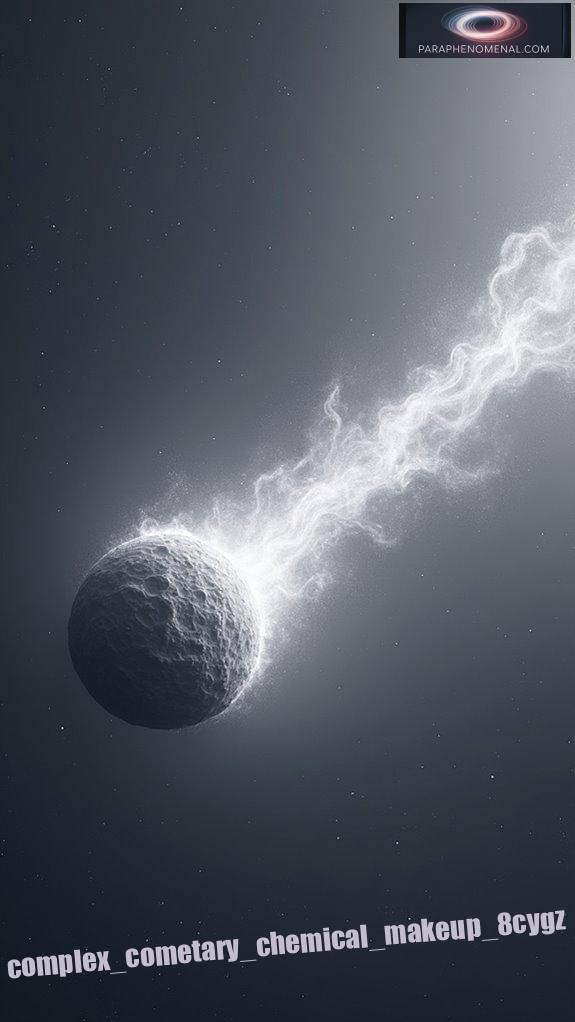
Spectroscopic observations of 3I/ATLAS have revealed a complex chemical makeup that offers valuable understandings into its nature and origin.
The spectroscopic analysis shows a high CO₂-to-H₂O ratio of roughly 8:1, highlighting the dominance of carbon dioxide over water, which is uncommon in Solar System comets.
A striking 8:1 CO₂-to-H₂O ratio reveals a unique carbon dioxide dominance in 3I/ATLAS, challenging conventional comet profiles.
Additionally, significant nickel concentrations and unusual organic signatures were detected, expanding our understanding of different comet compositions.
These compositional implications challenge previous assumptions about interstellar objects, showing shared characteristics between them and local comets.
Understanding these unique traits helps refine the definition of comets and underscores the need for curiosity in cosmic exploration, a purpose we advocate at ParaPhenomenal, enhancing our collective knowledge of the universe’s mysteries.
FAQ
How Does 3i/Atlas Compare to Other Known Comets?
3I/Atlas stands out from known comets due to its interstellar origin and unique comet characteristics.
Unlike typical solar system comets, it follows a hyperbolic trajectory, moves much faster at about 137,000 mph, and displays unusual emissions like high levels of nickel.
These astronomical similarities highlight exotic processes that may exist beyond our solar system.
Studying 3I/Atlas offers fascinating revelations, which is why we created ParaPhenomenal—to explore the mysteries of the universe together.
What Instruments Were Used to Observe and Analyze 3i/Atlas?
To observe and analyze 3I/ATLAS, scientists used tools like the Hubble Space Telescope for optical imaging and the Very Large Telescope (VLT) for spectroscopic analysis.
These instruments revealed details about the comet’s unusual composition, such as high CO₂ levels and nickel presence. The James Webb Space Telescope also helped uncover more mysteries.
Each instrument plays a vital role, as understanding this enigmatic comet can shed light on the formation of other celestial bodies.
Can 3i/Atlas’s Findings Influence Future Interstellar Missions?
Yes, 3I/ATLAS’s findings can greatly influence future interstellar missions. Its unique composition informs exploration strategies, suggesting that mission planning must adapt to diverse chemical environments.
Understanding the interplay of materials like the high carbon dioxide presence could guide scientists in deciphering other star systems.
As you explore studying such interstellar visitors, the understanding from 3I/ATLAS could enhance technology and methods, paving the way for groundbreaking discoveries beyond our own solar system.
What Challenges Did Scientists Face Studying 3i/Atlas?
Scientists faced significant challenges studying 3I/ATLAS. They struggled with data collection due to observational limitations, as its small size and vast distance hindered clear images.
The unusual presence of nickel, without iron, added to the mystery, complicating analysis. Gravity’s role in its origin still puzzles researchers.
Each limitation constricts their understanding, yet the quest for knowledge drives them.
ParaPhenomenal emerged to shed light on such phenomena, connecting enthusiasts with complex cosmic questions.
How Frequently Do Interstellar Objects Like 3i/Atlas Visit Our Solar System?
Interstellar objects like 3I/ATLAS visit our solar system infrequently, with only three confirmed in recent years. Their interstellar frequency is low, and they typically drift through space for millions of years before arriving.
Advances in telescope technology and coordinated surveys have improved detection, but most remain unnoticed due to their speed and short visibility time.
Understanding these celestial visitors, like what ParaPhenomenal aims to explore, enhances our knowledge of the universe.
References
- https://www.nextbigfuture.com/2025/08/interstellar-3i-atlas-has-nickel-without-iron-and-other-chemical-makeup-that-is-unlike-natural-objects-in-the-solar-system.html
- https://www.spectroscopyonline.com/view/interstellar-comet-3i-atlas-shows-mysterious-spectroscopic-activity
- https://www.skyatnightmagazine.com/news/3i-atlas-not-aliens
- https://science.nasa.gov/missions/hubble/as-nasa-missions-study-interstellar-comet-hubble-makes-size-estimate/
- https://news.northeastern.edu/2025/09/08/3i-atlas-comet-interstellar-traveler/
- https://universemagazine.com/en/james-webb-interstellar-comet-3i-atlas-consists-mainly-of-carbon-dioxide/
- https://ffesp.org/nasa-confirms-3i-atlas-mysterious-interstellar-visitor-enters-solar-system/
- https://www.smithsonianmag.com/science-nature/telescopes-reveal-surprising-chemistry-of-a-rare-interstellar-object-passing-through-our-solar-system-180987262/
- https://en.wikipedia.org/wiki/3I/ATLAS
- https://www.space.com/astronomy/comets/spherex-spots-carbon-dioxide-coma-around-comet-3i-atlas
- https://www.skyatnightmagazine.com/news/3i-atlas-gemini-south
- https://www.youtube.com/watch?v=arOgYkzMlp0
- https://www.spherex.caltech.edu/news/3i-atlas-co2-coma
- https://www.youtube.com/watch?v=TPLwBU9G_Xw
- https://arxiv.org/abs/2508.18209
- https://www.iflscience.com/anti-tail-and-odd-594-kilometer-feature-found-on-interstellar-object-3iatlas-by-keck-observatory-81188
- https://www.space.com/astronomy/asteroids/interstellar-invader-comet-3i-atlas-is-packed-with-water-ice-that-could-be-older-than-earth
- https://www.astronomy.com/science/comet-3i-atlas-shows-signs-of-water/
- https://watchers.news/2025/10/16/unusual-nickel-and-cyanide-emissions-detected-around-interstellar-object-3i-atlas/
- https://astrobiology.com/2025/07/interstellar-comet-3i-atlas-discovery-and-physical-description.html
- https://arxiv.org/html/2508.00808v1
- https://arxiv.org/abs/2508.00808
- https://science.nasa.gov/solar-system/comets/3i-atlas/
- https://www.youtube.com/watch?v=XEggZo3SXNM
- https://science.nasa.gov/solar-system/comets/3i-atlas/comet-3i-atlas-multimedia/
- https://thedebrief.org/3i-atlas-update-what-new-data-reveals-about-the-most-puzzling-interstellar-object-ever-found/
- https://scitechdaily.com/rare-comet-older-than-the-sun-seen-by-mars-orbiters/
- https://www.spectroscopyonline.com/view/3i-atlas-an-interstellar-enigma-natural-comet-or-engineered-probe-