
Is 3I/ATLAS the next big scoop in our search for UFOs?
I’m captivated by the idea that this celestial body, discovered in 2025, could be from another star system.
With its hyperbolic trajectory and nucleus brimming with volatile ices, it certainly exhibits classic cometary traits.
Who’s to say it doesn’t have more secrets hiding within its coma?
Imagine the possibilities if this object held clues to alien life or advanced technology.
Could 3I/ATLAS redefine our understanding of cosmic visitors?
Let’s explore it together!
A Close Encounter with the Unknown
I once spent a night stargazing in a remote area, seeking clarity about unexplained phenomena. Suddenly, I saw a bright object streaking across the sky.
It resembled a comet, but as it glowed, it changed directions mid-flight. Could it have been 3I/ATLAS?
With thoughts racing, I wondered how many of these objects could be more than just space debris. As I delved deeper into UFO studies, I pondered the connection between comets, asteroids, and extraterrestrial technology.
This experience ignited my passion for uncovering cosmic mysteries, urging me to share findings that may bridge the gap between our understanding of the universe and the allure of the unknown.
Quick Takeaways
- 3I/ATLAS features gas emissions and a dust coma, suggesting typical cometary activity indicative of a comet classification.
- Its nucleus composition includes volatile ices, aligning with characteristics commonly found in comets.
- The object has an orbital eccentricity of approximately 6.08 to 6.14, confirming its hyperbolic trajectory associated with interstellar comets.
- Ongoing spectroscopic analyses and imaging from observatories support its classification as a comet, providing data on its behavior and morphology.
- The complex taxonomy and lack of universal classification criteria by the IAU contribute to ongoing debates about categorizing 3I/ATLAS as a comet.
Discovery and Initial Classification

When 3I/ATLAS was discovered on July 1, 2025, it stirred curiosity among astronomers and the public alike. Found at the ATLAS survey telescope in Chile, the discovery significance quickly became clear. With an apparent magnitude of 18, it beckoned people to explore the great mysteries of the universe.
However, classification challenges emerged. Initially, 3I/ATLAS’s nature was uncertain—was it a Near-Earth Object or interstellar? As follow-up observations from various telescopes confirmed its hyperbolic trajectory, excitement built.
Classification challenges arose initially for 3I/ATLAS, leaving its true nature—near-Earth or interstellar—shrouded in mystery.
This comet’s classification brought attention to its extraordinary origins and potential revelations into the cosmos. Our website, ParaPhenomenal, exists to share these wonders, helping you grasp the complexity of celestial exploration.
Ultimately, 3I/ATLAS invites you to pursue freedom in understanding the universe’s secrets.
Orbital Characteristics and Interstellar Origin
As the excitement surrounding 3I/ATLAS continues to grow, its orbital characteristics reveal much about its interstellar origin. The comet defies expectations with an orbital eccentricity of approximately 6.08 to 6.14, indicating a hyperbolic trajectory that suggests it’s not bound to the Solar System. Its perihelion distance, around 1.36 AU, places it just inside Mars’ orbit, while its interstellar velocity reaches 57-60 km/s, showing it was likely ejected from another star. Notably, the current distance from Earth is 367,639,427 km, highlighting its position in relation to our planet. Given its distinct trajectory, 3I/ATLAS can be categorized as a hyperbolic trajectory, similar to other interstellar visitors.
Understanding its path helps us grasp its place among other interstellar visitors:
| Aspect | 3I/ATLAS | 1I/‘Oumuamua | 2I/Borisov |
|---|---|---|---|
| Object Type | Comet | Asteroid-like | Comet |
Physical Attributes and Confirmed Features
Understanding the physical attributes and confirmed features of 3I/ATLAS reveals why scientists classify it as a comet.
The estimated nucleus size ranges between 1,000 feet and 3.5 miles, comprised of volatile ices typical of comets. This solid icy nucleus hasn’t been directly imaged, but its presence is indicated through observed gas emissions and cometary activity, including a coma—an essential cometary trait. The unique composition of the nucleus aligns with the volatile ices that are characteristic of other known comets.
Photometric data supports its classification, showing color indices consistent with comet surfaces, while active dust ejection further confirms its nature. Recent observations from the Hubble Space Telescope have provided a clearer picture of this activity, enhancing our understanding of its characteristics.
Dust particles varying in size and velocities between 0.01 and 1 m/s reflect typical comet behavior. These attributes highlight the significance of analyzing such celestial bodies, fascinating enthusiasts who explore these wonders through ParaPhenomenal’s perspectives.
Controversial Perspectives on Comet Classification
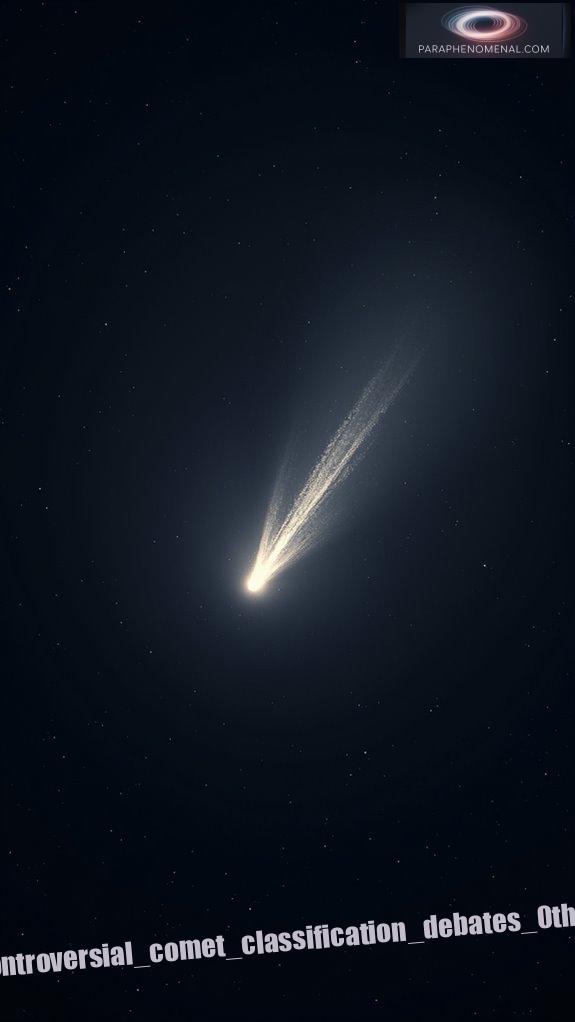
The classification of comets like 3I/ATLAS sparks a range of opinions and debates among scientists.
Comet taxonomy isn’t straightforward, largely due to varying orbital classification methods. Traditionally, short-period comets orbit the sun in less than 200 years, while long-period comets take longer. However, some researchers argue this approach oversimplifies things.
The classification of comets is complex, with short and long periods sparking ongoing debate among researchers.
The Tisserand parameter helps distinguish between comet-like and asteroid-like objects, yet even this creates disagreements.
Furthermore, objects that lack observable activity—like dormant comets or asteroid-like bodies in cometary orbits—further complicate classification. With no universal criteria from the IAU, researchers find themselves often at odds.
As we explore these controversies through ParaPhenomenal, understanding comet classification grows even more intriguing.
Ongoing Research and Observational Campaigns
While many astronomers enthusiastically pursue the study of comets like 3I/ATLAS, ongoing research and observational campaigns provide essential observations into its characteristics and behavior.
You can expect perspectives from these key areas:
- Spectroscopic analysis from multiple observatories to track gas emissions and volatile chemistry.
- Imaging techniques utilized to observe dust coma and changes in morphology over time.
- Coordinated monitoring by global telescopes covering visibility periods around perihelion.
- Early observations from the Very Large Telescope and Hubble revealing its structure.
- Archival data enabling thorough studies across various wavelengths.
These efforts not only enhance our understanding of 3I/ATLAS but also contribute to the broader knowledge of interstellar comets, a focus of our ParaPhenomenal initiative. Additionally, the research showcases the importance of space telescopes which are crucial for detailed observations of such distant objects in our solar system.
Implications of 3I/ATLAS’s Composition
3I/ATLAS’s composition raises intriguing questions about the nature and formation of interstellar bodies. Its unusual chemical anomalies set it apart from typical solar system comets, hinting at differing evolutionary paths.
You’ll notice 3I/ATLAS’s low-velocity dust ejection and the absence of expected emission lines at a considerable distance from the Sun, which challenge conventional models of comet behavior. These characteristics may indicate a unique gas and dust release mechanism never seen before. Additionally, its extraordinary interstellar speed suggests that 3I/ATLAS may not be subject to the same gravitational influences that affect comets within our solar system.
The implications for interstellar chemistry are profound. Studying its preserved volatiles could reshape our understanding of planetary formation beyond our Solar System.
This journey into 3I/ATLAS’s composition allows us at ParaPhenomenal to connect interstellar exploration with the core elements that shaped our universe, inspiring curiosity about what’s out there.
Public and Scientific Discourse on 3I/ATLAS

Public curiosity fuels interest in 3I/ATLAS, while scientific skepticism provides a necessary balance, ensuring that claims about its nature are rigorously examined. This tension between lay fascination and expert analysis drives the conversation about the comet.
- Media coverage highlights its interstellar status, sparking debate.
- Observations from multiple global observatories enhance understanding.
- Public access to sky charts encourages amateur astronomers to engage actively.
- Avi Loeb’s comments stir speculation, reinforcing the need for critical thinking.
- Ongoing studies continue to unravel the mystery of its composition.
- The public perception of celestial phenomena, such as UFO sightings, can significantly impact interest and research funding in cases like 3I/ATLAS.
FAQ
How Can I Observe 3i/Atlas Myself?
To observe 3I/ATLAS, start by checking the constellation Virgo, where it’s currently located.
You may see it with the naked eye if it brightens enough near its perihelion date on October 29, 2025.
Use basic observation techniques like star maps or astronomy apps to pinpoint its position.
Binoculars or a small telescope can enhance your view.
Engaging with astronomy clubs and resources from websites can deepen your experience.
What Tools Are Needed for Amateur Observations?
To observe 3I/ATLAS, you’ll need specific tools. Why not use a telescope that suits your needs?
Larger amateur telescopes can enhance visibility, while astronomical software helps you track its movement. CCD cameras are excellent for detailed images, and star charts guide your search.
Don’t underestimate the value of dark skies and joining local astronomical clubs for resources. They make your observation experience more accessible and enjoyable, which is why we created this website, ParaPhenomenal.
Will 3i/Atlas Pose Any Danger to Earth?
No, 3I/ATLAS won’t pose any danger to Earth.
Its trajectory analysis shows it’s on a hyperbolic path, meaning it will leave the Solar System without making contact.
Astronomical organizations are actively monitoring it for any changes in its trajectory, ensuring that 3I/ATLAS impact risk remains minimal.
Exploring such interstellar objects reminds us of our vast universe, which is part of why we created ParaPhenomenal—to share intriguing discoveries.
What Do Scientists Hope to Learn From 3i/Atlas?
Scientists hope to learn about 3I/ATLAS’s comet composition and its orbital trajectory.
By analyzing its icy nucleus, gas, and dust, they can uncover materials from interstellar space and understand differences compared to Solar System comets.
Observing the comet’s unique features and trajectory helps refine theories about planet formation.
This knowledge can prepare you for future interstellar objects and enhance your understanding of our universe.
Are There Any Planned Missions to Study 3i/Atlas?
Right now, there aren’t any planned missions to study 3I/ATLAS.
Scientists remain interested in its unique characteristics, which could reveal much about interstellar origins.
Without mission objectives or dedicated scientific instruments targeted at it, researchers rely heavily on ongoing observations to gather data.
This lack of exploration isn’t from a lack of curiosity; it’s to emphasize the need for additional understanding before any future missions can be determined.
References
- https://en.wikipedia.org/wiki/3I/ATLAS
- https://www.iflscience.com/anti-tail-and-odd-594-kilometer-feature-found-on-interstellar-object-3iatlas-by-keck-observatory-81188
- https://www.iac.es/en/outreach/news/3iatlas-iac-monitoring-closely-third-interstellar-object-detected-solar-system
- https://www.space.com/astronomy/asteroids/interstellar-invader-comet-3i-atlas-is-packed-with-water-ice-that-could-be-older-than-earth
- https://www.youtube.com/watch?v=XEggZo3SXNM
- https://www.livescience.com/space/comets/comet-3i-atlas-is-losing-water-like-a-fire-hose-on-full-blast-rewriting-what-we-thought-we-knew-about-alien-star-systems
- https://ffesp.org/nasa-confirms-3i-atlas-mysterious-interstellar-visitor-enters-solar-system/
- https://theskylive.com/articles/2025/07/3i-atlas-a-month-by-month-observing-guide
- https://science.nasa.gov/asset/hubble/comet-3i-atlas/
- https://www.seti.org/news/comet-3iatlas-a-visitor-from-beyond-the-solar-system/
- https://news.northeastern.edu/2025/09/08/3i-atlas-comet-interstellar-traveler/
- https://arxiv.org/pdf/2507.05252
- https://theskylive.com/c2025n1-info
- https://science.nasa.gov/solar-system/comets/3i-atlas/
- https://arxiv.org/abs/2507.05252
- https://astrobiology.com/2025/07/interstellar-comet-3i-atlas-discovery-and-physical-description.html
- https://science.nasa.gov/missions/hubble/as-nasa-missions-study-interstellar-comet-hubble-makes-size-estimate/
- https://ui.adsabs.harvard.edu/abs/2025MNRAS.542L.139B/abstract
- http://www.astronomia.edu.uy/Criterion/
- https://academic.oup.com/mnras/article/343/4/1057/1063330
- https://en.wikipedia.org/wiki/Comet
- https://britastro.org/wp-content/uploads/sites/Comet Observing Guide 2018 Dec (rev 4)_0.pdf
- https://www.astronomynotes.com/solfluf/s8.htm
- https://www.nsf.gov/news/research-team-discovers-seven-new-dark-comets-identifies-2
- https://solarstory.net/comets/
- https://arxiv.org/html/2508.18382v1
- https://www.spectroscopyonline.com/view/interstellar-comet-3i-atlas-shows-its-spectral-secrets-through-palomar-and-apache-point-observations
- https://www.planetary.org/planetary-radio/2025-3i-atlas
- https://thedebrief.org/3i-atlas-update-what-new-data-reveals-about-the-most-puzzling-interstellar-object-ever-found/
- https://www.skyatnightmagazine.com/news/3i-atlas-not-aliens